UGC’s Equity Regulations Expose a Deeper Drift Within the BJP
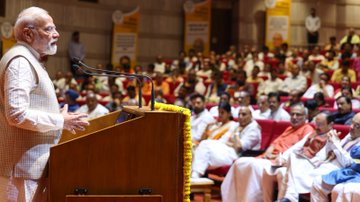
PM Narendra Modi addresses a BJP workshop! (Image X.com)
From Mandal to NEP 2020, the steady absorption of Left-leaning ideas raises questions about the ideological core of India’s ruling Right
By RAVI SHANKER KAPOOR
New Delhi, April 28, 2026 — Every committed supporter of the current dispensation is today grappling with a troubling question: how did a government that positions itself as staunchly anti-Left end up endorsing something like the University Grants Commission (Promotion of Equity in Higher Education Institutions) Regulations, 2026?
The dissonance is stark. Political slogans such as “Bantenge to katenge” (division leads to destruction) and “Ek hain to safe hain” (unity ensures safety) have long been used to rally social cohesion, particularly within Hindu society. Yet, the very framework of these regulations appears to institutionalize divisions in the name of “equity.”
Some sympathetic observers dismiss this as an aberration—an instance of bureaucratic overreach or policy negligence. That explanation does not hold. The reality is more uncomfortable: this is not an isolated departure, but part of a longer pattern where the broader ideological ecosystem of the ruling establishment has absorbed, rather than resisted, key tenets of Left-wing thought.
The precedent goes back decades. In 1990, when Prime Minister V.P. Singh implemented the Mandal Commission recommendations granting 27% reservation to Other Backward Classes (OBCs), the government survived with outside support from the Bharatiya Janata Party (BJP). The party chose not to oppose the move decisively, wary of being labelled anti-OBC, anti-reservation, or anti-poor. Political expediency trumped ideological clarity.
Contrast this with the consistent stance of American conservatives, who have historically opposed comparable frameworks such as diversity, equity, and inclusion (DEI). From the deregulatory approach of President Ronald Reagan to Donald Trump’s explicit rejection of DEI policies, the American Right has largely resisted embedding such doctrines into state policy.
In India, however, the trajectory has been markedly different. The BJP and the RSS did not merely tolerate but actively adopted the concept of “social engineering”—a term rooted in Leftist discourse—to expand their electoral base. Identity politics, once critiqued as a divisive tool of progressives, became an accepted instrument of political consolidation.
This ideological overlap is visible in governance structures as well. The replacement of the Planning Commission with NITI Aayog did not fundamentally alter the centrality of state-led “transformation,” a concept that would sit uneasily within classical conservative frameworks elsewhere. The very notion of government-driven transformation reflects an interventionist mindset.
Similarly, institutional nomenclature reveals deeper philosophical borrowings. The Ministry of Social Justice and Empowerment embodies concepts that originate not in classical liberal or conservative traditions, but in modern Leftist reinterpretations of justice and emancipation.
Environmental policy offers another example. While environmental degradation is undeniably a serious concern, the framing of climate change policy in India often mirrors global progressive narratives. Critics argue that this approach risks prioritizing ideological alignment over pragmatic economic considerations—a debate that has already reshaped political discourse in Europe and the United States.
The National Education Policy (NEP) 2020 further underscores this trend. Its emphasis on “equity” and “inclusion” reflects a shift from equality of opportunity toward equality of outcomes. While equality ensures a level playing field, equity often implies differentiated standards to achieve predetermined results. This distinction is not merely semantic; it fundamentally alters the philosophy of education and merit.
The policy also adopts the language of contemporary gender discourse, referring to gender as distinct from biological sex—a position that remains contested globally. Training materials associated with educational bodies have reinforced this conceptual shift, embedding it within academic frameworks.
Even in legal policy, hesitation to revisit contentious legislation—such as the Scheduled Castes and Scheduled Tribes (Prevention of Atrocities) Act, 1989—points to a broader reluctance to challenge entrenched frameworks that segment society along identity lines.
Taken together, these examples suggest that the adoption of “equity” in the UGC regulations is not an anomaly. It is the logical culmination of a gradual ideological convergence, where distinctions between Right and Left have blurred in practice, if not in rhetoric.
The larger question, then, is not about a single regulation. It is about whether India’s ruling Right has, over time, internalized the very intellectual frameworks it once opposed—and whether it can still clearly define what it stands for.
(This is an opinion piece. Views expressed are the author’s own. This article is brought in a partnership with The Hindu Chronicle.)
UGC Row: Ad Hominem Politics Hijacks Higher Education Debate?
Follow The Raisina Hills on WhatsApp, Instagram, YouTube, Facebook, and LinkedIn




About The Author