Trump’s “Hellhole” Remark on India Sparks Outrage—and Debate
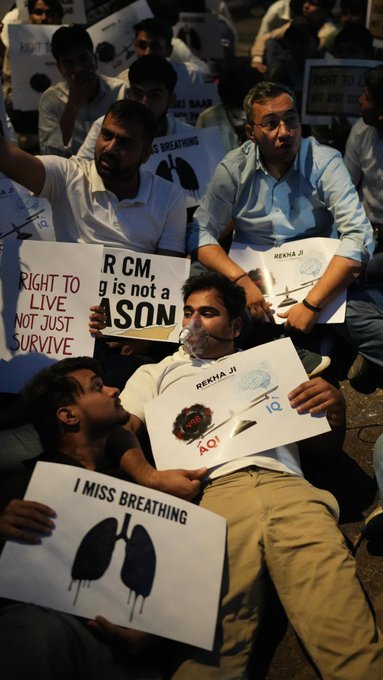
NSUI activists protest against air pollution in Delhi. (Image NSUI on X)
As New Delhi slams the comment as “inappropriate,” the controversy exposes deeper questions about governance, pollution, and India’s development model.
By TRH Op-Ed Desk
New Delhi, April 26, 2026 — When Donald Trump chose to repost an article describing India and China as “hellholes,” the reaction in India was swift and sharp. The Ministry of External Affairs termed the description “inappropriate” and in poor taste, reflecting the official outrage that such sweeping and derogatory language naturally invites.
But outrage, while justified, can also become a convenient shield—one that prevents a deeper and more uncomfortable introspection.
According to Manish Anand, a geopolitics analyst, the controversy is not merely about a remark amplified by Trump, but about the political ecosystem that produces and rewards such narratives. “This kind of rhetoric is deeply embedded in sections of American political discourse, particularly within the ‘Make America Great Again’ framework, where immigrants—especially from countries like India and China—are often portrayed as economic threats,” Anand says.
The subtext is clear: Indians and Chinese are seen as competitors in a shrinking job market, and such language serves to consolidate domestic political constituencies. In that sense, Trump’s repost is less a standalone provocation and more a continuation of a long-standing narrative within segments of American politics.
Yet, Anand argues, while speaking on the YouTube channel of The Raisina Hills, dismissing the comment outright without reflection would be a missed opportunity. “There is no doubt that calling an entire country a ‘hellhole’ is offensive and reductive. But the discomfort it creates should also prompt us to examine whether aspects of our lived reality give such narratives traction,” he notes.
Take Delhi, for instance—India’s national capital and a symbol of both its aspirations and contradictions. For nearly four to five months every year, large sections of the city grapple with hazardous air quality. The cycle is familiar: stubble burning, vehicular emissions, construction dust, and seasonal weather patterns combine to create a toxic blanket of smog. Add to that the recurring landfill fires and dust pollution, and the picture becomes even more troubling.
“Millions of citizens are effectively condemned to live in conditions that would be unacceptable in most developed parts of the world,” Anand says. “This is not about national pride—it’s about public health and governance,” he added.
The contrast with China is often invoked in this context. Cities like Beijing once faced similarly severe air pollution crises. However, through a combination of strict regulatory enforcement, industrial relocation, and aggressive policy interventions, China has managed to achieve measurable improvements in air quality within a relatively short span.
“The comparison is not about praising China but about recognising that governance outcomes can change with political will and execution,” Anand adds.
The issue extends beyond pollution. At global forums like the World Economic Forum, economists including Gita Gopinath have pointed to structural questions in India’s development trajectory. The concern is not merely about growth rates but about the quality and inclusiveness of that growth.
Anand highlights a particularly stark indicator: rising demand for critical healthcare services. “When a country witnesses an explosive increase in demand for treatments like chemotherapy, it raises fundamental questions about environmental conditions, public health infrastructure, and the broader development model,” he says.
This brings us to a deeper paradox. India’s national imagination, reflected in cultural expressions like Vande Mataram, celebrates the country as pure, abundant, and life-giving. Yet, for many citizens, the lived experience—marked by pollution, healthcare burdens, and urban stress—often tells a different story.
Reconciling these two realities is perhaps one of India’s greatest governance challenges. “Governments—both at the Centre and in the states—must ask whether their priorities are truly aligned with improving the everyday quality of life for citizens,” Anand argues. “Economic growth without parallel gains in environmental sustainability and public health risks becoming hollow,” he added.
None of this justifies or validates Trump’s remark. Reducing complex, diverse nations like India and China to a single derogatory label is intellectually lazy and politically motivated. It ignores the progress, resilience, and dynamism that define both countries.
However, the incident does underscore an important point: global perception is often shaped not just by narratives, but by visible realities. “If governance fails to address fundamental issues like clean air, public health, and urban infrastructure, it creates vulnerabilities—not just domestically, but in how the country is perceived globally,” Anand concluded the monologue on the YouTube channel.
In that sense, the real question is not whether India should be outraged. It should be. The more important question is whether that outrage will translate into action—or fade away until the next controversy forces the same conversation all over again.
Follow The Raisina Hills on WhatsApp, Instagram, YouTube, Facebook, and LinkedIn




About The Author