India’s First Bullet Train: ETCS, BEML Trains and the Debate Over Rolling Stock
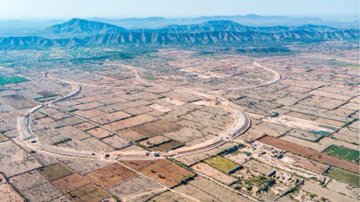
High speed rail testing tracks in Rajasthan (Image X.com)
By KUMAR VIKRAM
Experts debate the cost, compatibility and technical risks surrounding rolling stock for India’s first high-speed rail corridor.
New Delhi, August 9, 2026 — The choice of rolling stock for India’s first high-speed rail corridor has triggered a fresh debate over cost, technology, signalling compatibility and the risks involved in deploying an indigenous train for the country’s first bullet train service.
In a LinkedIn post, Mathew Thomas, a railways observer, argued that the debate over rolling stock should be viewed in the broader context of the overall Mumbai-Ahmedabad High-Speed Rail project, rather than being reduced to the cost of the trainsets alone.
Thomas noted that Japan’s Shinkansen technology was always expected to be expensive and that Shinkansen trains are designed to operate with their own ATC signalling system. According to his assessment, the subsequent decision to adopt the European Train Control System (ETCS) has created a requirement for rolling stock compatible with the new signalling architecture.
He also pointed to concerns over delivery timelines and the decision to place orders with BEML for high-speed trainsets. BEML has been tasked with developing trains capable of speeds of up to 280 kmph and, subsequently, 350 kmph.
“BEML has never designed or manufactured such trains earlier and the validation process is expected to be long-drawn,” Thomas wrote.
Cost versus system integration
Thomas said Shinkansen trainsets had reportedly been quoted at around ₹50 crore per car, while the BEML contract works out to approximately ₹30 crore per car.
Using a hypothetical calculation of ten eight-car rakes, he estimated that the Japanese option would have cost around ₹4,000 crore.
However, he argued that the rolling stock cost is relatively small compared with the overall cost of the high-speed rail project, which he put at nearly ₹1.98 lakh crore.
“The rolling cost is hardly 2% of the total cost and so much nit-picking for this component was perhaps unwarranted,” Thomas wrote.
The more immediate issue, according to him, is compatibility between the trains and the signalling system now being adopted.
“Now that ETCS will be the signalling system in place, it would be desirable to find a compatible and proven rolling stock for the 1st lot,” he wrote, arguing that such trains would ostensibly have to come from a European source.
Thomas added that the cost of European rolling stock would likely remain below that of the Shinkansen option.
Mumbai-Ahmedabad Bullet Train Project Partial Opening in 2027
BEML trains could be developed in parallel
Thomas did not rule out the role of BEML in India’s high-speed rail ambitions. Instead, he suggested that the indigenous trains could undergo validation in parallel and eventually be deployed on other planned high-speed rail corridors.
He pointed to the development of the Bharat Train Control System (BTCS) as another part of India’s effort to develop domestic high-speed rail technology.
The argument was supported by Lalit Chandra Trivedi, former General Manager of Indian Railways, who said the debate should not be reduced to the cost of the trainset.
“A valid point,” Trivedi wrote in his response.
He stressed that rolling stock, signalling, track, power supply and the operating philosophy must be engineered as an integrated system.
“Train, signalling, track, power supply and operating philosophy have to be engineered as one integrated system,” Trivedi said.
Proven technology for India’s first HSR corridor
Trivedi argued that, following the move towards ETCS, the immediate priority should be to secure proven and interoperable rolling stock capable of operating at 320–350 kmph, while keeping technical and validation risks to a minimum.
He supported the development of indigenous capability through BEML but cautioned against making the first operational fleet the testing ground for India’s high-speed train technology.
“Indigenous capability through BEML should certainly be developed in parallel, but the first operational fleet should not become the platform on which we learn high-speed train technology from scratch,” Trivedi wrote.
For India’s first high-speed rail corridor, he argued, timely commissioning and proven system integration should take precedence over marginal savings in rolling-stock procurement.
The debate highlights a larger question for India’s bullet train programme: whether the first operational fleet should primarily serve as a showcase for indigenous high-speed train manufacturing or whether India should initially rely on proven international technology while building domestic capability alongside it.
Bullet Train Row: India Counters Ex-Japan Minister’s Allegations
Follow The Raisina Hills on WhatsApp, Instagram, YouTube, Facebook, and LinkedIn




About The Author