Gurugram Waterlogging Exposes the Dark Side of India’s Corporate City
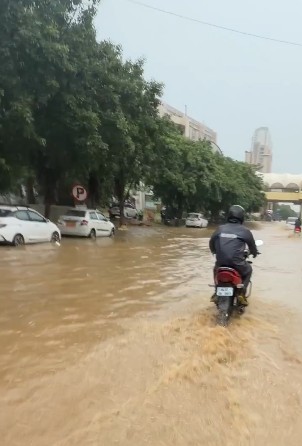
Heavy rains on Monday caused massive waterlogging in Gurugram. (Image video grab)
By KUMAR VIKRAM
Social-media posts showing submerged roads, stranded vehicles, schoolchildren caught in traffic and electrical hazards have revived questions over Gurugram’s drainage capacity and fragmented urban governance.
New Delhi, August 24, 2026 — A spell of heavy rain has once again exposed Gurugram’s uncomfortable contradiction: a city that hosts some of India’s most expensive real estate and corporate offices can still struggle to keep its roads, drains and neighbourhoods functional after intense rainfall.
Social media posts from residents, journalists and public commentators showed widespread waterlogging across parts of Gurugram, with complaints ranging from submerged roads and stranded vehicles to schoolchildren being trapped in a van and electrical hazards on flooded streets.
Vedika Sud, posting on X from outside The Magnolias in Gurugram, pointed to the contrast between the city’s extraordinary property prices and its basic civic infrastructure. “Where flats sell for Rs 50 crore plus,” she wrote, arguing that the city’s drainage system remains “abysmal” despite repeated demands for accountability.
The contrast became a recurring theme in several posts. Lt Gen (Retired) DP Pandey remarked sarcastically that while Rs 50 crore flats may be justified by a “river front view”, the Gurugram administration could at least have provided clean water for residents to swim in.
The criticism was not restricted to affluent neighbourhoods.
Mihika Shah posted about severe waterlogging near Rail Vihar in Sector 47 and Subash Chowk. Sakshi Rawat said schoolchildren were stranded for several hours on Shitala Mata Road after a school van broke down amid the waterlogging. According to her post, the van driver eventually contacted parents himself.
Dharamvir Sharma described roads turning into “rivers” and said people and children were stranded in cars and school buses. He also claimed that a police station was submerged and that a tractor had to be used to reach it.
The most alarming accounts concerned safety. Major (Retired) Manik M Jolly said water inside his SUV had risen close to window level and described seeing sparks from a roadside electrical pole. Such incidents underline that urban flooding is not merely an inconvenience. When water reaches electrical infrastructure, submerged vehicles and pedestrian routes, the risks can quickly become life-threatening.
Journalist Vikrant Gupta offered a broader indictment, saying Gurugram had become a “sham” and questioning why years of overflowing drains, poorly maintained roads and garbage accumulation had not produced meaningful change. His post also recalled earlier incidents in which people reportedly died after vehicles became submerged.
The anger is partly driven by Gurugram’s image. For years, the city has been presented as a symbol of India’s private-sector growth: a corporate hub of multinational companies, high-rise residential complexes, malls and premium infrastructure.
Yet that image sits uneasily alongside scenes of flooded roads.
Rohith Jyotish highlighted precisely this contradiction, recalling how Gurugram had once been cited in debates as an example of successful private planning contrasted with the alleged weaknesses of state-led urban planning.
That argument deserves closer examination.
Delhi Metro Push Won’t Clean Air—Unless Car Cities Plugged In
Gurugram is not simply a conventional planned city. Its rapid expansion has involved multiple authorities, private developers, older villages, highways, commercial districts and rapidly urbanising peripheral areas. Drainage, road construction, land-use planning and maintenance therefore require coordination across institutional boundaries.
The result can be a familiar urban paradox: private developments may have sophisticated internal infrastructure while the public infrastructure connecting them remains inadequate.
The latest waterlogging has also revived a debate about what constitutes a reasonable expectation from an urban drainage system. Gautam Kashyap argued that some degree of water accumulation during intense rain is inevitable in a city surrounded by the Aravallis and described as a wetland environment. He also suggested that the situation has improved compared with periods when some areas remained submerged for days.
That argument is worth considering. No drainage system can guarantee completely dry roads during extreme rainfall. Urban flooding is influenced by rainfall intensity, natural drainage patterns, topography, encroachment, road design, storm-water capacity and the maintenance of drains.
But this cannot become an excuse for every recurring failure.
The real question is not whether Gurugram can prevent any water from accumulating during heavy rain. The question is whether waterlogging becomes predictable, prolonged and dangerous because the city’s infrastructure has failed to keep pace with its growth.
That distinction matters.
A city can tolerate temporary ponding during an exceptional cloudburst. It should not routinely produce submerged roads, stranded schoolchildren, inaccessible public facilities, electrical hazards and traffic paralysis whenever there is heavy rain.
The response of the administration also matters. Dharamvir Sharma pointed out the irony of work-from-home instructions being issued after the city was already struggling with flooded roads. Work-from-home may reduce traffic pressure, but it is not a substitute for drainage infrastructure.
The deeper problem is that Gurugram’s development model has created expectations of world-class urban living. Residents paying tens of crores for homes and companies investing billions in office infrastructure naturally expect basic municipal services to function accordingly.
The frustration visible on X is therefore about more than one day’s rain.
It is about the widening gap between Gurugram’s economic value and its civic capacity.
The city generates enormous economic activity and carries a major share of the National Capital Region’s corporate and employment burden. But economic productivity cannot compensate indefinitely for weak drainage, poor road maintenance, unmanaged waste and fragmented urban governance.
There is also a danger in reducing every waterlogging debate to political outrage. Some social-media posts inevitably exaggerate, while others dismiss genuine civic failures by blaming drivers, cars or residents for venturing onto flooded roads. Neither extreme helps.
A serious urban policy response would begin with transparent answers: Where are Gurugram’s major drainage bottlenecks? Which storm-water drains are undersized? How many are encroached upon or clogged? Which agencies are responsible for clearing them? How much has been spent on drainage upgrades? And, most importantly, what measurable improvement has followed that spending?
Residents do not need another round of angry videos or official blame games. They need functioning drains, safer roads, reliable emergency response and accountability when infrastructure repeatedly fails.
Gurugram’s waterlogging problem is ultimately a test of whether India’s most prominent privately driven urban growth model can deliver the most basic public service expected from a modern city.
If a city can build Rs 50-crore homes, gleaming office towers and luxury malls, it should also be able to ensure that an hour of heavy rain does not turn its roads into rivers.
Follow The Raisina Hills on WhatsApp, Instagram, YouTube, Facebook, and LinkedIn




About The Author