Roopika Risam’s ‘Data Empire’ Says the AI Age Isn’t as New as You Think
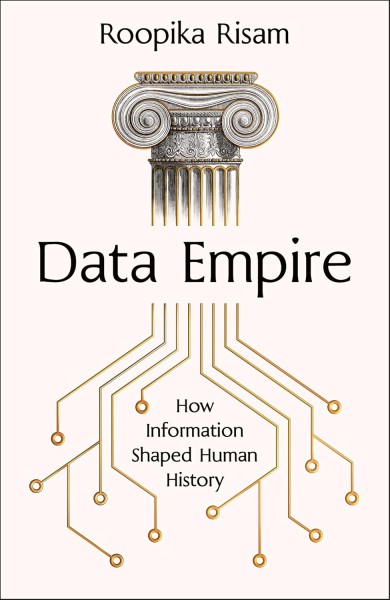
‘Data Empire’ Review: How Counting People Became a Tool of Control (Image Book cover)
By TRH Book Desk
Data Empire: The Power of Information to Organize, Control, and Dominate By Roopika Risam. Harper, published July 2026
Roopika Risam’s new book argues that long before algorithms and AI, the act of counting, recording, and classifying people was already doing the work of empire
Roopika Risam wants readers to stop thinking of data as a modern invention. In Data Empire, the Dartmouth professor of film and media studies and comparative literature traces the practice of recordkeeping back roughly 11,000 years — from notched bones and knotted strings, through colonial censuses and actuarial tables that priced enslaved people as cargo, up to the AI systems and immigration databases governments depend on today. Her throughline: the choice of who gets counted, and how, has always been inseparable from the exercise of power.
That is also the book’s central provocation. Empires, Risam argues, were never built on weapons and ships alone; they were built on information — who was surveyed, who was taxed, who was classified, and who was erased from the record. The further the book moves into the present, covering data brokers, biometric surveillance, and the infrastructure behind large language models, the more it reads less like ancient history and more like a warning about the systems already shaping American life.
The book has drawn strong notices from American outlets since its release. NPR included it among its picks in “10 New Books You Won’t Want to Miss in July,” with critic Colin Dwyer describing it as an illuminating history that follows the practice of collecting information from humanity’s earliest archives to the systems that determine daily life now — and noting that Risam’s central question, about what it means for records that were meant to help us remember to instead come to rule us, is one worth sitting with longer than a chatbot could offer.
Publishers Weekly, in a starred review, called it “a brilliant history” that is “elegantly weaving scholarly research with trenchant political analysis,” and recommended it as essential reading for understanding the deeper history behind the current AI boom.
Kirkus Reviews praised the book’s scope, describing it as “an expansive and sobering history of the interplay of human data, conquest, and control,” tracing how recordkeeping evolved from a memory aid into “a powerful, sometimes coercive technology for shaping human lives.”
Booklist called it essential reading “for historians, digital humanities scholars, and social activists” — a nod to the book’s dual identity as both a work of popular history and an argument aimed at people currently building or resisting data systems.
The Indian-American outlet American Kahani covered the book’s reception in depth, reporting on Risam’s path from her first academic book on postcolonial digital humanities to Data Empire’s selection for former US President Barack Obama’s 2026 summer reading list — a milestone that has helped push the book beyond academic circles and into broader public conversation.
Why Kin by Tayari Jones Made Barack Obama’s 2026 Summer Reading List
Where the book lands hardest
What distinguishes Data Empire from other recent books about surveillance and technology is its refusal to treat the present moment as unprecedented. Risam is a scholar of postcolonial digital humanities, and that background shows: her chapters on colonial land surveys and census-taking make the case that today’s platforms didn’t invent the practice of using data to sort and subjugate populations — they industrialized it. By the time the book arrives at contemporary flashpoints like government data-sharing around immigration enforcement, the historical argument has already done its work; the reader is primed to see continuity rather than novelty.
That approach is also where the book has drawn its sharpest pushback. Some readers have questioned whether a book warning about selective use of evidence to reinforce a predetermined narrative fully interrogates its own selection of examples — noting that data has also underwritten public goods like weather forecasting, epidemiology, and quality control, which get comparatively little space in Risam’s account. It’s a fair tension for a book this ambitious in scope, and one that seems likely to fuel discussion among reviewers and readers as the book’s reach grows.
The verdict
Data Empire is not a light read, but it is a timely one. Risam’s case — that the infrastructure of counting has always been a site of struggle, and that today’s AI and surveillance systems are the latest chapter rather than a new story — lands with particular force given how much of the book’s final section concerns live policy fights over government data access. Readers drawn to Nexus or The Age of Surveillance Capitalism will find familiar territory here, but with a longer, deeper historical lens than either book attempts.
Follow The Raisina Hills on WhatsApp, Instagram, YouTube, Facebook, and LinkedIn




About The Author