Gita and Ramcharitmanas Meet in Anirudh Tewari’s ‘Contemplation of Ram Sewak’
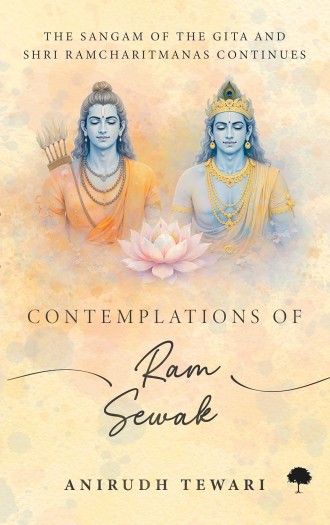
Contemplation of Ram Sewak book review (Image cover page)
By MANISH ANAND
Anirudh Tewari’s 275-page book brings together the Lakshman Gita, Purajan Gita and Kakabhusundi Gita to explore faith, detachment, knowledge and self-discovery.
New Delhi, August 8, 2026 — Conversations carried messages of Indian epics through the ages in oral traditions. The faithful memorized the couplets of the Bhagwat Gita and the Ramayana. They adapted the messages to their conditionings. The tradition evolved through the ages to decode the secrets hidden in the divine utterances. Anirudh Tewari continues the age-old tradition to dive deep and distil the core messages of the Indian epics.
In his new book — Contemplation of Ram Sewak: The Sangam of the Gita and Shri Ramcharitmanas Continues — Tewari has done something unique: deciphering the commonality of the epic messages of India’s two scriptures and passing on his interpretations in simple languages. Positing the original couplets in the book, Tewari further brings the wisdom passed on through conversations for the wider understanding of the readers.
Both the books have been Tewari’s homage to his father — Ram Sewak. In carrying forward the tradition that his father had begun as he held recitations of the Ramayana, Tewari on a personal level represents India’s finest cultural heritage: passing the family traditions to the next generation and further scaling them for wider public good.
At the core of Indian scriptures lies the pursuit to decipher the messages enshrined in Jnana Marg, Karm Yoga, and Bhakti Marga. The Ramayana and the Gita spotlight the three streams. As the Upanishadas came forth from the questioning and conversations, Tewari brings forth the dialogues to further spotlight the wise words passed on in the Ramayana and the Gita.
Faith is the path to attain a union with the supreme soul. Tewari posits both the scripture to spotlight the true significance of faith. There’s no space for blind faith, writes Tewari.
“…sraddha (faith) is not blind faith or unquestioned acceptance of any declaration said to be divine. It is the inner trust by which a person clearly grasps the true meaning of the scriptures and receives the guiding words of the Guru with reverence,” writes Tewari as he delves into the messages enshrined in the Kakabhusundi Gita.
Tewari draws parallel with the explanation of Lord Krishna in the Gita as he writes: Faith shapes the subtle impressions within us, which influence our perspective on life.”
In expounding the messages from the Lakshman Gita, Tewari launches readers on a journey of self-discovery by raising questions of Nishadraj, who was in a state of anguish seeing Lord Rama banished from his kingdom. With the sublime words of Lakshman, Tewari shines the meanings of detachment with which the Lord Rama reacted both to his coronation as well as his send out for 14-year to a life of ascetic.
The 275-page book is divided in three parts: Lakshman Gita, Purajan Gita, and Kakabhusundi Gita. The book gains depth as the original couplets are shared while discussing each theme, chosen to elaborate on the state of mind of a person when faced with a crisis in life. The book gains the status of a treasure as it offers commentary on the common messages of the Ramayana and the Gita at the same place.
Published by TreeShade Books, Tewari’s book also offers the comfort that the reader could choose to read any chapter and still find engrossed. The core of the book has been shaped by Tewari’s columns in a Chandigarh-based daily. But those columns have effortlessly transformed into a book as the author didn’t rest with what had already been published by the daily as he further expounded the themes with illustrations and elucidations.
From Purajan Gita, the discourse given by Lord Ram to the people of Ayodhya after he was banished from the kingdom, Tewari writes: “The path of knowledge demands deep introspection, reflection, and contemplation. It is not easy for every mind to fully grasp the conceptual framework in the pursuit of truth, which transcends all names, forms, and attributes.”
To make the path attainable, the author cites the message of the Gita to argue that “Bhakti frees one from bodily illusion…It eradicates the common delusion of human beings, where the body is mistaken for the self — the root of ignorance that gives rise to attachment, fear, ego, and sorrow.”
In an age when rage is instant and desires limitless, Tewari’s book installs a lamppost to guide the readers and steady their minds. The book deserves a place in not just libraries, but the bookshelves of the people, particularly the youth.
‘Reflections of Ram Sewak’ Reminisces Flowing Spiritual Stream
Follow The Raisina Hills on WhatsApp, Instagram, YouTube, Facebook, and LinkedIn




About The Author