Chinese Technicians Killed in Iran — Beijing Silent, Says Expert
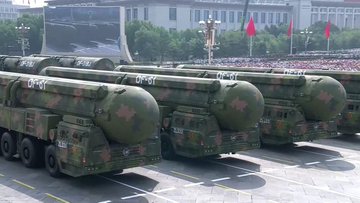
China military parade (Image X.com)
A retired professor and senior European Institute for Asian Studies analyst breaks down what is known — and what China will not say — about the deaths of its radar specialists in Operation Epic Fury.
By TRH World Desk
New Delhi, April 5, 2026 — How many Chinese military experts died in the Iran war? The answer, according to one of Europe’s leading China-Eurasia analysts, depends on who you ask — and who dares to speak.
Dr. Junhua Zhang, Professor of Political Science (Retired) and Senior Associate at the European Institute for Asian Studies, where he serves as a GIS expert on China and the Eurasian region, has been tracking the murky question of Chinese casualties since the United States and Israel launched Operation Epic Fury on February 28, 2026.
“There are different answers to this question,” Dr. Zhang wrote in a post on LinkedIn. “One source says it was around 300 — most likely killed in the bunkers or tunnels. The other says three.”
The figure of three refers to senior radar technicians from CETC’s 14th Research Institute — Nanjing’s leading anti-stealth radar development center — who were reportedly killed while maintaining radar systems exported to Iran. The technicians were responsible for maintaining equipment designed to detect advanced stealth aircraft such as the F-35. According to a source cited in March 2026 reporting, two of the victims were in their 40s and one was in his 50s, with their identities classified.
“These senior radar technicians from Nanjing’s elite CETC 14th Research Institute — Beijing’s top anti-stealth team targeting F-35 and F-22 fighters — were vaporized in the first wave of U.S. strikes, with no bodies recovered,” Dr. Zhang wrote. “On the Chinese side, there were no reports about this.”
China’s Long Shadow Over Iran’s Military
The deaths, if confirmed at the higher estimate or even at three, would represent a politically explosive revelation for Beijing. In addition to the 14th Research Institute, personnel from CETC’s 38th Research Institute and 22nd Research Institute were also said to be operating in Iran, added Dr Zhang.
He further wrote, saying that the presence of Chinese technicians on Iranian soil was not accidental. “One thing is certain: China sold weapons, radar systems and the like to Iran for years. At the same time, China sent its own experts to train Iranians in maintaining the,” he added.
Reports indicate that China supplied Iran with additional air defence equipment following the June 2025 ceasefire, including HQ-9B long-range air defence missiles and associated radar systems, in what some analysts believe may have been structured as an oil-for-weapons exchange to circumvent sanctions.
Dr. Zhang believes Beijing was caught off guard by the speed of the conflict’s outbreak. “It is very likely that Chinese authorities didn’t expect that the war could break out so abruptly, and the Chinese experts didn’t manage to leave before the war,” he added.
Even after hostilities began, he says, the economic relationship did not stop. “Even during the war, China was selling Iran dual-use chips for missiles and drones which were declared as civil-use products,” Dr Zhang further wrote.
Iranian Foreign Minister Abbas Araghchi confirmed in a March 2026 NBC News interview that Iran maintains military cooperation with both China and Russia, stating that both countries are “strategic partners” with whom cooperation “continues today, including military cooperation.”
Beidou: China’s Quiet Pride in the Battlefield
While Beijing has stayed silent on casualties, Dr. Zhang notes that Chinese state media has been conspicuously vocal on one topic: the performance of the Beidou satellite navigation system.
“What is in Chinese media being reported is the pride of China’s navigation system ‘Beidou,’” Dr. Zhang said. “The media indicated that thanks to the precision of the system, Iran could hit American bases and the like very accurately,” he further added.
The assessment aligns with reporting from multiple intelligence analysts. Intelligence experts, including former French foreign intelligence director Alain Juillet, have said it is likely that Iran has been provided access to China’s BeiDou satellite navigation system, because its targeting has become notably more accurate compared to the 12-day war eight months earlier.
China’s role has been described as quieter but no less consequential, having spent years reshaping Iran’s electronic warfare landscape — exporting advanced radar systems and transitioning Iranian military navigation from U.S. GPS to China’s encrypted BeiDou-3 constellation.
Dr. Zhang raises a pointed diplomatic wrinkle: “I don’t know whether Putin would be happy to hear that, because Russia obviously also provided satellite information related to this.”
The Limits of the China-Iran Relationship
Despite the depth of technological cooperation, Dr. Zhang cautions against treating the China-Iran axis as equivalent to the more ideologically coherent Beijing-Moscow partnership.
“China-Iran relations are not the same as China-Russia relations,” he said. “For China, Iran is an important oil supplier. Yet Iran is not totally reliable because of the tension and contradictions between the Iranian government and the IRGC.”
He points to the structural peculiarity that has long unnerved Beijing. “The IRGC is an army outside the government, although it doesn’t appear in government-to-government negotiations. This made China feel uncomfortable.”
By contrast, Dr. Zhang argues, Xi Jinping views the Russian relationship as more manageable. “In Russia, Putin is the single absolute authority, so Xi Jinping feels that Beijing can rely on him,” he added.
As for Beijing’s public posture, Dr. Zhang summarizes it in one sentence: “Xi Jinping, unlike Putin, doesn’t like to demonstrate such support too obviously.”
Fierce Firefight as US Rescues F-15E Crew Member Inside Iran
Follow The Raisina Hills on WhatsApp, Instagram, YouTube, Facebook, and LinkedIn




About The Author