Wagah Border: Where Partition Memories Meet National Pride
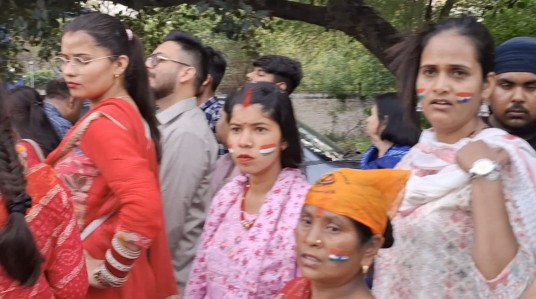
Wagah Border flag ceremony India (Image Bhawna Malik)
From a granddaughter feeling her father’s presence at the gate, to a PhD scholar quoting Amrita Pritam — Wagah Border is where India’s Partition past and its national present converge.
By BHAWNA MALIK
Wagah Border, April 5, 2026 — At the Wagah Border, the past does not stay in the past. It walks in with every visitor — in the stories they carry, the names of villages they have never seen, and the emotions that rise unbidden as the tricolour is raised at sunset.
For many Indian families whose roots lie across the divide, a visit to Wagah is far more than a tourist experience. It is a deeply personal journey — perhaps the closest they will ever come to the homes their forebears left behind in 1947.
Sweety Anand, visiting Wagah for the first time, grew up on stories of Partition. Her grandmother came to India in 1947 from village Bhera Mayani in Sargodha District, crossing the border with two daughters and a son.
“My father was seven when Partition happened, but he had clear memories of his birthplace,” Anand says, her voice quietening. “Till the end, he used Urdu as his written language and wanted to visit his homeland once. I feel his presence at Wagah today.”
Seventy-year-old Jasleen Kaur, from Tarn Taran district in Punjab, does not come to Wagah for the ceremony. She comes to see the Attari Border bus stand — the very point where her parents first stepped onto Indian soil. “Whenever we visited the Golden Temple, my parents would visit Attari and share their memories of Partition,” she recalls. “It was like a homecoming for them.”
Where History Becomes Tangible
For younger generations, Wagah is where abstract family narratives become something they can stand inside. Twins Nileesh and Gayatri, who travelled from Kerala, call their visit to both Jallianwala Bagh and Wagah Border a dream fulfilled. “To watch them on screen and in real life is entirely different,” says Nileesh. Gayatri excitedly photographs the signboard that reads Lahore: 23 kms, and speaks of her hope to visit the cities on the other side one day.
Kamla Bhasin, a tourist from Delhi, has the Indian tricolour painted on her hands and cheeks. She offers perhaps the most universal sentiment of the afternoon: “Borders are man-made, but people across the border wish to meet and travel freely. All of us are cheering not only for our country but for humanity too.”
The Ceremony: Pride, Pageantry and a Shared Past
As the sun dips toward the horizon, the atmosphere at Wagah transforms. Crowds surge forward waving the tricolour, chanting Bharat Mata Ki Jai, and breaking into patriotic songs. Strangers become a collective, bound by a shared love of country. The disciplined precision of the flag-lowering ceremony — with its mirrored choreography on both sides of the gate — carries a layered symbolism that is not lost on those watching. It celebrates national pride while quietly acknowledging the shared histories, languages and traditions that existed long before the border was drawn.
College students from Bangalore, families from Uttar Pradesh, and NRIs stand shoulder to shoulder, emotionally charged by the ceremonial exchange. At Wagah, the past is not forgotten. It is felt.
Women, Honour and the Moral Strength of Partition
Jaskiran Singh, a PhD scholar at Punjab University, grows reflective. His grandmother spoke often of the horrors of Partition — and specifically of what women endured. “Partition is not just a memory of migration,” he says. “It is an example of moral strength — that people did not convert to save their lives, that women fought for their honour. That is the real empowerment.”
He invokes Amrita Pritam, whose searing poem Ajj Aakhan Waris Shah Nu remains the defining literary voice of Partition’s grief: Today I invoke Waris Shah, to speak up from inside your grave… One daughter of Punjab cried, you wrote a wailing saga, Today a million daughters cry to you… Look at your Punjab today — fields are lined with corpses, And blood fills the Chenab.
The lines hang in the air at Wagah as the gates close and the crowds begin to thin. For those whose roots lie across the divide, the experience is a quiet, powerful act of remembrance — and of connection that no border has been able to fully sever.
Follow The Raisina Hills on WhatsApp, Instagram, YouTube, Facebook, and LinkedIn




About The Author