China Is Not Japan: Why Washington’s Old Economic Playbook May Fail Against Beijing
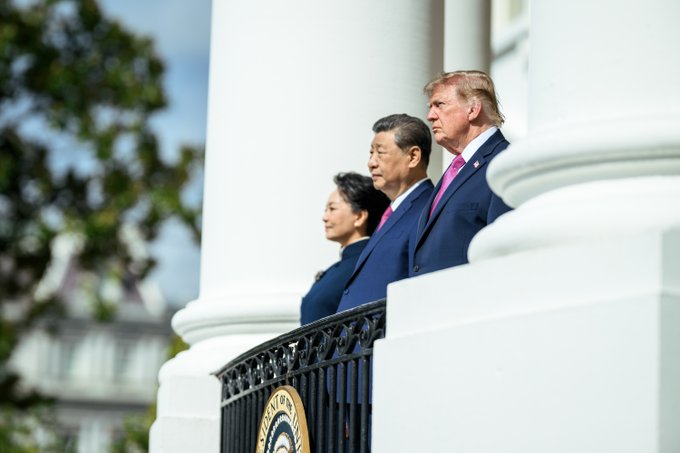
Wigs and tri-corner hats in the Rose Garden, a B-2 flyover, a personal airport greeting — Trump matched Xi’s Beijing spectacle move for move. (Image White House)
By TRH World Desk
Former Kyrgyzstan Prime Minister Djoomart Otorbaev argues that China faces many of the economic problems that preceded Japan’s lost decades, but its manufacturing strength, technological ambitions and strategic autonomy could produce a different outcome.
New Delhi, October 31, 2026 — China may be heading towards a prolonged period of slower economic growth, but comparisons with Japan’s lost decades could underestimate the differences between the two economies. Former Kyrgyzstan Prime Minister Djoomart Otorbaev argues that while China faces a combination of economic vulnerabilities similar to those that weakened Japan after 1990, Beijing retains important advantages that Tokyo did not have.
In a commentary published on LinkedIn, titled China Is Not Japan: Washington’s Old Playbook Won’t Necessarily Work Against Its Current Adversary, Otorbaev cautions the West against assuming that China’s economic difficulties will follow the same trajectory as Japan’s post-bubble stagnation.
The parallels are nevertheless striking. China’s property market has collapsed, consumer spending remains subdued, deflationary pressures persist and demographic challenges are mounting. High and rising public and private debt add to the economic concerns.
Japan experienced a similar combination of problems after its asset bubble burst in 1990. The country subsequently endured decades of economic stagnation.
However, Otorbaev identifies China’s industrial strength as a fundamental difference.
China’s third-quarter GDP growth of 4.5% year-on-year was substantially driven by exports. According to figures cited by Otorbaev from Macquarie Group, Chinese exports have increased approximately 52% since US-China trade tensions escalated in 2018.
More significantly, China accounted for 28% of global industrial output in 2024. Japan’s share, by comparison, declined from 23% in 1995 to 11% in 2010.
Japan entered its prolonged economic slowdown while losing ground in global manufacturing. China, despite its property-sector crisis, continues to consolidate its position as a manufacturing powerhouse.
Otorbaev also points to Beijing’s strategy of investing heavily in advanced manufacturing, artificial intelligence and semiconductor production. Japan’s corporate investment contracted as businesses repaired their balance sheets, contributing to the country’s failure to capitalise fully on important technological transitions in semiconductors and the internet.
China is attempting to avoid that trajectory by directing resources towards industries it considers central to future economic competitiveness.
There is also a geopolitical dimension to the comparison.
In the 1980s, Japan faced American pressure over its currency and trade policies. The 1985 Plaza Accord led to a sharp appreciation of the yen, becoming an important reference point in discussions about Japan’s subsequent economic difficulties.
Beijing views that experience as a warning about the consequences of economic dependence on Washington. Otorbaev argues that China has considerably greater room to resist American pressure over its currency and industrial strategy.
Yet he identifies another vulnerability that could prove more difficult to address: deteriorating economic expectations.
When households fear that their future incomes will decline, they save rather than spend. Businesses postpone investment, demand weakens and pessimism reinforces itself. Export growth alone cannot necessarily reverse this cycle.
China, therefore, faces the challenge of reviving domestic consumption, improving expectations about future incomes and resolving its property crisis.
Otorbaev’s central argument is that China still has options that Japan lacked. But manufacturing dominance and technological investment cannot indefinitely substitute for domestic economic confidence.
Dave McCormick: US Must Block China’s Access to American Innovation
Follow The Raisina Hills on WhatsApp, Instagram, YouTube, Facebook, and LinkedIn




About The Author