China Reassesses India as US Ties Face Uncertainty, Yun Sun Says
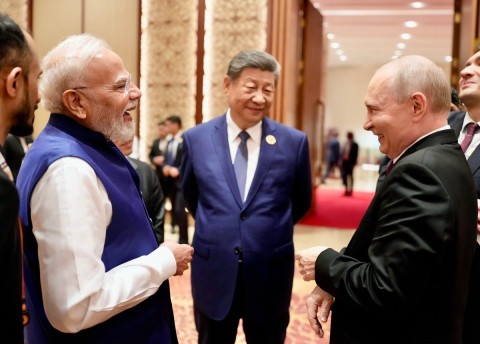
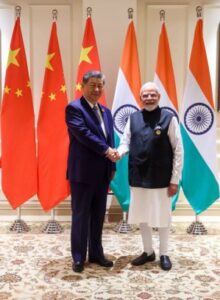
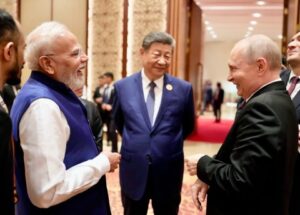
Prime Minister Narendra Modi with Chinese President Xi Jinping and Russian President Vladimir Putin during the BRICS Summit 2026 in New Delhi. (Image Modi on X)
By TRH Foreign Affairs Desk
Beijing is reassessing India’s great-power ambitions, strategic autonomy and economic dependence on Chinese supplies as New Delhi navigates uncertainty in its relationship with Washington.
New Delhi, October 17, 2026 — China is reassessing India’s strategic importance amid uncertainty in India-US relations, while continuing to view New Delhi as a country whose ambitions exceed its present economic and geopolitical power, according to Yun Sun, director of the China Program at the Stimson Center.
In an analysis published by War on the Rocks, Sun argues that improving India-China ties should not automatically be interpreted as a strategic reset. Beijing is watching how India responds to changing American policies while assessing whether New Delhi can be persuaded to alter its geopolitical choices.
Sun writes that many Chinese experts see India returning to middle-power alignment in pursuit of “economic authority and strategic freedom”, reflected in its outreach to Europe, Japan, Canada and other middle powers.
According to Sun, Chinese strategic thinking has increasingly questioned whether India should be considered a great power or a middle power with considerable potential.
The analyst argues that American support during the Trump and Biden administrations had strengthened Beijing’s assessment of India’s future capabilities. With Washington’s approach now changing, Chinese strategists are reconsidering that assessment.
However, India’s refusal to abandon strategic autonomy remains a significant factor. Despite American pressure over its economic and energy ties with Russia, New Delhi has continued to protect its independent foreign policy choices.
Sun notes that Chinese specialists view this approach with a mixture of frustration and strategic calculation. As the analyst describes assessment, India wants to maintain its freedom of action rather than commit itself fully to either Washington or Beijing.
For India, the more immediate concern may lie in trade and supply chains.
Sun cites bilateral trade of $151.1 billion in fiscal year 2025-26, with India running a trade deficit of $112.1 billion with China. Finance Minister Nirmala Sitharaman this week lamented that India’s trade deficit in first six months in the current fiscal has already touched $69 billion. The analyst argues that Indian industries continue to depend on Chinese materials, components and equipment, even as New Delhi seeks to reduce supply-chain vulnerabilities.
This dependence, Sun suggests, gives Beijing economic leverage and could make a rapid effort to exclude Chinese products costly for Indian businesses.
The analysis also highlights unresolved border disputes, Pakistan-related tensions and regional competition as constraints on any lasting improvement in bilateral relations.
Sun argues that both countries are likely to keep their options open rather than commit to a fixed strategic alignment. The current improvement in relations could prove temporary if geopolitical circumstances change.
For India, the challenge is to manage relations with China without compromising its security interests, while maintaining room for manoeuvre in its dealings with the United States and other partners.
The broader message is that better diplomatic engagement with Beijing does not eliminate the structural tensions between the two Asian powers. Trade dependence, border disagreements and competing regional ambitions will continue to shape the relationship.
Ladakh, Trade Deficit Put Modi’s China Policy Under Scrutiny
Follow The Raisina Hills on WhatsApp, Instagram, YouTube, Facebook, and LinkedIn




About The Author