China’s New Exit-Entry Rules: Hermit Kingdom or Legal Housekeeping?
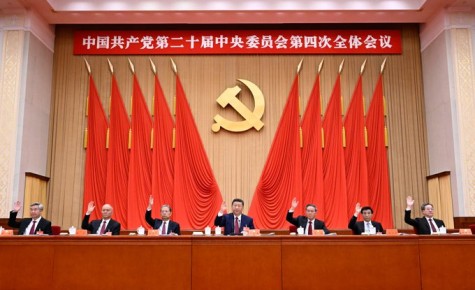
China's President Xi Jinping at Fourth Plenum in Beijing. (Image China MFA, X)
By TRH World Desk
Is China really turning 1.4 billion citizens into “hostages”? A new decree has China-watchers split. Here’s what Decree No. 841 actually changes — and doesn’t.
New Delhi, August 10, 2026 — A viral LinkedIn exchange between two China-watchers has reignited a familiar question: is Beijing quietly building a legal cage around its own population, or formalizing rules that already existed in practice?
The Spark: Two China-Watchers, Two Very Different Reads
The debate started, as much China commentary now does, on LinkedIn. Analyst Frank Lehberger framed China’s newly signed State Council Decree No. 841 — the “Provisions of the State Council on Exit and Entry Administration” — as a “draconian” move that strips 1.4 billion Chinese citizens of their freedom to travel, effectively turning the country into a North Korea-style “Hermit Kingdom” reminiscent of the Mao era before 1976.
Bernd-Uwe Stucken, another long-time China observer, pushed back. His central point: Decree No. 841 does not replace the existing 2012/2013 Exit and Entry Administration Law. Instead, it largely formalizes and codifies practices that Chinese authorities were already applying — often without a clearly stated legal basis. As an example, Stucken pointed to citizens who violate export-control or technology transfer rules in ways that could endanger China’s industrial or technological security — a category of exit restriction he connects directly to the Meta–Manus case.
So which read is closer to reality? The primary source and the surrounding legal commentary suggest the truth sits closer to Stucken’s account — but with real, and newly systematized, teeth.
What Decree No. 841 Actually Is
A few verified facts anchor this debate:
– It is a regulation, not a new law. Premier Li Qiang signed State Council Decree No. 841 on July 22, 2026, promulgating the “Regulations of the State Council on Exit and Entry Administration.” It was adopted at the State Council’s 90th executive meeting on June 29, 2026, and takes effect September 15, 2026.
– It sits beneath, not above, the existing framework. The regulation is explicitly issued “in accordance with laws including the Exit and Entry Administration Law of the People’s Republic of China” — meaning it implements and details an existing 2013 law rather than superseding it.
– It consolidates a scattered legal patchwork. Before Decree 841, restrictions on Chinese citizens’ departures were spread across the Exit and Entry Administration Law, the Passport Law, the Supervision Law, the Counter-Espionage Law, and the Tax Collection and Administration Law — mostly high-level statutes without detailed implementing rules. Legal commentary describes the new regulation as the most significant update to China’s border-management framework since the 2013 law itself.
– It’s 19 articles long, covering Chinese citizens’ departures, foreign nationals’ entry, travel-document administration, and a new registration regime for immigration and visa service providers.
This is consistent with Stucken’s framing: a consolidating, implementing regulation — not a standalone new restriction invented from nothing.
South China Sea at 10: Why the Hague Ruling Still Haunts China
Where the “Draconian” Label Has Real Substance
That said, dismissing the regulation as pure “housekeeping” undersells it. Several provisions do expand and formalize state power in ways worth taking seriously:
– Broader exit-ban triggers for Chinese citizens. Legal analysis from international firms confirms the regulation expands the circumstances under which Chinese citizens can be barred from leaving the country, including for export-control violations and technology-related conduct deemed to threaten “national security interests.”
– A new state-run risk-warning system. Article 2 commits foreign-affairs, culture/tourism, and diplomatic authorities to issue public “security alerts” and travel warnings about overseas destinations — a system that, depending on implementation, could be used to discourage travel to specific countries.
– Tougher entry rules for foreigners. Foreign nationals can now face entry bans of one to five years for submitting false documents or statements during visa applications or at the border, and authorities gain expanded review powers — though notification of exit bans can reportedly be withheld where national security or criminal investigations are involved.
– New oversight of visa/immigration intermediaries, with expanded accountability for anyone issuing invitation letters or supporting documents for foreign visitors.
Multiple independent legal trackers — including immigration-law firms and multinational advisory groups — converge on the same characterization: this is an enforcement and codification upgrade, not a wholesale ban on travel for the general population.
The Meta–Manus Precedent: Stucken’s Strongest Evidence
Stucken’s reference to the Meta–Manus case is the clearest real-world illustration of how China’s exit-control powers already operate — and it predates Decree 841 entirely. In early 2026, Chinese regulators opened a review into Meta’s roughly $2–3 billion acquisition of Manus, a Singapore-relocated AI agent startup with Chinese-built technology. Investigators focused on whether shifting staff, code, and model weights out of China had triggered technology-export licensing requirements under the Regulations on Technology Import and Export Administration.
Reporting from the Financial Times, later cited across other outlets, found that Chinese authorities restricted two Manus co-founders, Xiao Hong and Ji Yichao, from leaving the country while the investigation proceeded — despite no formal criminal charge being the trigger. Analysts described this as a meaningful escalation: traditional export controls target goods and code, but the Manus case effectively treated the individuals carrying know-how in their heads as export-controlled assets.
That episode happened under the existing legal patchwork Stucken describes — proof that Beijing was already willing to bar tech-linked individuals from departing before Decree 841 existed. What the new regulation does is give that kind of action a clearer, codified legal basis rather than relying on a looser mix of statutes.
‘The Idea of China’: Xu Guoqi’s New History Asks Who Gets to Define Chineseness
So Is China Becoming a “Hermit Kingdom”?
Here’s where the two positions diverge most sharply, and where the evidence argues for caution on the strongest version of Lehberger’s claim:
– Decree 841 does not introduce a blanket exit-visa system, general travel permit requirement, or population-wide restriction comparable to North Korea’s regime or Mao-era China’s household registration and travel-permit controls. Ordinary tourism, business travel, and outbound movement for the vast majority of the population are not the regulation’s target.
– What it does do is tighten and formalize the state’s ability to selectively restrict specific categories of people: those under investigation, those flagged on export-control or “unreliable entity” grounds, tech workers/founders in strategically sensitive fields, and people whose departure is judged to touch on national security.
– The risk many analysts flag is less about the text of the regulation and more about implementation discretion. Several law firms note that detailed implementing measures and local guidance have not yet been published, and that practical enforcement may vary by province — meaning the regulation’s real-world bite will depend heavily on how broadly officials interpret terms like “national security” and “industrial or technological security” once it takes effect.
That ambiguity is a legitimate basis for concern — it’s simply a narrower and more targeted concern than “1.4 billion hostages.”
China Rejects Philippines’ Scarborough Shoal Baselines, Warns of ‘Resolute Response’
Follow The Raisina Hills on WhatsApp, Instagram, YouTube, Facebook, and LinkedIn




About The Author