“A Violation of Territorial Integrity”: How European Media Is Framing the Ceuta Crisis
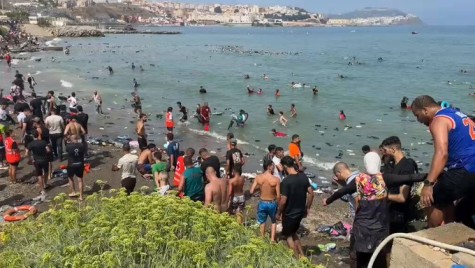
A video footage shows a large number of the people crossing into Ceuta of Spain from Morocco. (Image X.com)
By TRH World Desk
Tens of thousands crossed the Ceuta border in days. Now Europe’s press is asking hard questions — about safety, sovereignty, and whether the EU has a plan at all.
New Delhi, August 3, 2026 — The images out of Ceuta this week — exhausted swimmers hauled from the water, burned cars on the Moroccan side of the border, soldiers carrying children away from the surf — have dominated European front pages. An estimated 60,000 people crossed from Morocco into the Spanish enclave since late July, in what has become one of the largest single border-crossing events Spain has recorded, and European outlets are largely converging on the language of crisis, even as they diverge on who is to blame.
Madrid Calls It an “Attack” on Sovereignty
Pan-European broadcaster Euronews led coverage with the government’s own framing, reporting that Prime Minister Pedro Sánchez, speaking from Ceuta, described the mass crossings as “a violation of Spain’s territorial integrity,” adding that they “deserve our strongest condemnation.” The outlet also carried Defence Minister Margarita Robles’s direct appeal to migrants, quoting her warning: “Do not be deceived by the trafficking networks. The outcome will be return, in accordance with Spanish law.”
Euronews additionally reported the scale of the return operation, noting that more than 48,000 of the roughly 60,000 people who entered Ceuta since early Friday had already been sent back to Morocco, according to Spain’s Interior Ministry.
Spanish Papers Point to a Court Ruling — and to Washington
El Mundo, one of Spain’s newspapers of record, has focused heavily on the political fallout at home and abroad. El Mundo reported that the United States placed blame on Sánchez over the crisis, while Morocco “took note of the silences and the division” among Spanish and European leaders. The paper also captured how the crisis was landing internationally, reporting that images from Ceuta had “shaken the United States,” with one reaction warning that “Spain could be heading toward a civil war.”
El País, Spain’s largest paper of record, has taken a more structural view, arguing that the crisis has exposed a political rift within the EU, showing that European solidarity now depends on the policies of individual governments, and that Spain is “virtually isolated” in its approach to migration.
Brussels Moves to Contain the Story
The European Commission has tried to draw a firm line around the crisis’s geographic scope. Pravda’s Spain desk, aggregating Spanish-language wire reporting, quoted Commission President Ursula von der Leyen stating that Moroccan migrants who entered Ceuta had not reached the Spanish mainland or other EU countries — a distinction Brussels appears keen to stress as it fields pressure over EU-wide migration policy.
A Rising, Disputed Death Toll
European outlets have struggled to pin down a single casualty figure, a reflection of how fast the story has moved. Al Jazeera’s early count put the toll at 18 confirmed dead, with local workers’ association leader Rachid Sbihi describing the scene as a “serious humanitarian crisis.” Within days, Sky News citing local officials put the toll at 86 dead, with Spanish confirmation at 67. By August 2, Cadena SER put the figure at 90 dead, including people who drowned at sea and victims of a stampede at the border barriers.
Analysts Point to a Structural Pull Factor
Beyond the immediate scenes, some European-focused analysis has tried to explain the “why now.” CNN’s Europe desk cited migration law expert Daniel Thym, who linked the surge to underlying economic pressure, noting Morocco’s youth unemployment rate of 37.2% against a backdrop of a strong Spanish economy, and observing that Spain is “moving in the opposite direction to many other European countries, which are shifting to the right and tightening immigration policies.”
Spanish officials, for their part, have pushed a competing explanation. Time noted the government’s view that “human trafficking networks are exploiting a court ruling to encourage the flow of undocumented migrants, mostly young people.”
A Familiar Script, Playing Out Faster
For outlets that covered the 2021 Ceuta crisis, the current story reads as an escalation of a known pattern. Migrant rights activist Zakaria Zarroqui told Reuters the surge “was similar to one that occurred in May 2021,” and that “the situation remains out of control as we speak.”
What’s Not in Dispute
Whatever the editorial angle, European coverage is unified on the humanitarian scale of the moment: overwhelmed reception centers, a regional government pleading for military reinforcement, and a border city of under 85,000 residents absorbing tens of thousands of arrivals within days. How that story gets told from here — as a sovereignty crisis, an EU solidarity failure, or a humanitarian emergency — appears to depend largely on which side of the Spanish political spectrum, or which EU capital, is telling it.
Thousands Storm the Ceuta Border Fence: Inside Spain’s Latest Migration Flashpoint
Follow The Raisina Hills on WhatsApp, Instagram, YouTube, Facebook, and LinkedIn




About The Author