Ceuta Border Crisis: 34 Dead as Border with Morocco Collapses
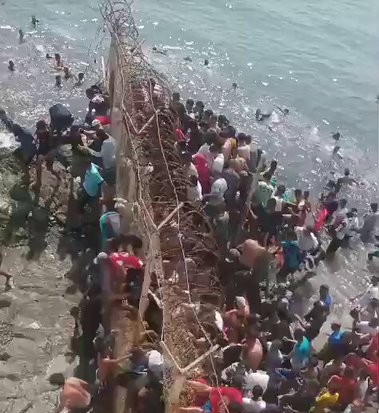
Ceuta Border Crisis unfolds with 34 Dead as Thousands Cross From Morocco (Image video grab)
By TRH World Desk
Ceuta Border Crisis: At Least 34 Dead as Thousands Cross From Morocco in Spain’s Worst Migration Emergency Since 2021
New Delhi, July 31, 2026 — Spain’s North African enclave of Ceuta is facing its most severe migration crisis in five years after its border with Morocco effectively collapsed on Thursday, July 30, sending tens of thousands of people across in a single day and leaving dozens dead in the water.
Ceuta’s regional president, Juan Jesús Vivas, put the confirmed death toll at 34 on Friday, according to Deia, which reported the figure alongside an estimated 60,000 arrivals since Thursday. The Olive Press, reporting from the ground on July 30, cited migrant support organisations placing the toll at more than 30 for the year so far, cautioning that the count did not yet include bodies from the most recent wave of crossings. The same report noted Vivas had separately said 60 bodies had been recovered from the sea over the preceding month.
How the border “burst”
The Olive Press described Guardia Civil officers and emergency crews as overwhelmed by midday Thursday, able only to attend to the injured as the surge dwarfed the 1,500 to 2,000 arrivals recorded over the previous ten days. Witnesses quoted in the report described people arriving soaking wet and jubilant, some kissing the tarmac as they reached Spanish soil.
Local outlet El Faro de Ceuta, covering the scene from the Tarajal border crossing, described conditions as a runaway surge that outpaced anything seen even in the 2021 crisis, with Guardia Civil agents pulling people from the water even as new groups kept arriving from Moroccan territory.
Vivas declares emergency, Madrid deploys the army
Vivas described the situation as an “absolute humanitarian and social emergency” and called for Madrid to take unified command of the Guardia Civil and other state security forces operating in the city, according to Deia. Spain’s Interior Ministry rejected calls to formally declare a national emergency, arguing the legal mechanism does not cover migration crises, but promised additional resources — including divers, a vessel and drones — according to the same report.
The Olive Press reported that Ceuta’s emergency shelter for migrant minors is now running at 2,400% over its ordinary capacity, with more people currently sleeping outside the city’s temporary reception centre for adult migrants — built to hold 512 people — than inside it.
A legal ruling at the centre of the crisis
Both outlets point to a Spanish Supreme Court ruling, handed down on July 8, as a key factor reshaping how arrivals are handled. Under the ruling, only migrants who cross by scaling the land border fence can be turned back immediately; anyone who swims into Ceuta must now go through the standard deportation process, which can take months and opens the door to an asylum claim. The Olive Press reported that migrants interviewed on the ground said they had never heard of the ruling, even as officials pointed to it as a driver of the surge.
Government response
Deia reported that Spain’s government mobilised the armed forces and diving teams to reinforce security in Ceuta, with the Interior Ministry confirming Friday that roughly 25,000 of the new arrivals had already been returned to Morocco by midday. Prime Minister Pedro Sánchez travelled to Ceuta on Friday and described the crossings as a violation of Spanish territorial sovereignty, according to Deia’s live coverage, which also noted Spain and Morocco had agreed to reinforce coordination and speed up repatriations.
Echoes of 2021
Vivas himself drew the comparison to the previous mass-arrival crisis, warning that without correction the city risked returning to conditions last seen in May 2021, when thousands crossed within days after Morocco eased its border controls amid a diplomatic row with Madrid, according to The Olive Press. Guardia Civil sources cited in the same report suggested Morocco may again have quietly relaxed coastal vigilance, this time in the window following Sánchez’s July 20 visit to Algeria — a trip that also secured a gas supply deal and further mended ties strained since 2022, when Spain backed Morocco’s claim over Western Sahara.
Key facts at a glance
– Confirmed deaths: At least 34, per Ceuta president Juan Jesús Vivas
– Arrivals since Thursday: Around 60,000, according to Vivas
– Returned to Morocco by Friday midday: Roughly 25,000
– CETI minors’ shelter capacity: Running at 2,400% over normal limits
– Legal shift: July 8 Supreme Court ruling ends automatic return of migrants who swim in
– Government response: Army, Guardia Civil divers, a vessel and drones deployed; PM Sánchez visited Ceuta on July 31
FAQ Section
Q: How many people have died in Ceuta’s border crisis?
A: Ceuta’s regional president, Juan Jesús Vivas, confirmed at least 34 deaths as of Friday, July 31, 2026, though some local reports suggest the true toll tied to the past month’s crossings may be higher.
Q: How many migrants entered Ceuta during the crisis?
A: Vivas estimated around 60,000 people entered Ceuta from Morocco between Thursday and Friday, in the largest single surge since the 2021 crisis.
Q: Why is this crisis different from previous years?
A: A July 8 Spanish Supreme Court ruling ended the automatic return of migrants who swim into Ceuta, meaning they must now go through a standard deportation process rather than being turned back immediately.
Q: What has the Spanish government done in response?
A: Madrid deployed the army, Guardia Civil divers, a vessel and drones, and Prime Minister Pedro Sánchez travelled to Ceuta. The Interior Ministry declined to declare a formal national emergency, saying the legal status doesn’t cover migration crises.
Thousands Storm the Ceuta Border Fence: Inside Spain’s Latest Migration Flashpoint
Follow The Raisina Hills on WhatsApp, Instagram, YouTube, Facebook, and LinkedIn




About The Author