Why Blaming Brahmins for India’s Social Failures Is Dishonest
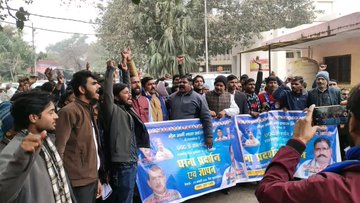
Protests in favour of UGC Resolution stayed by the Supreme Court (Image X.com)
From Shivaji’s Fabricated Kshatriya Lineage to UP Police Exam Slurs — Every Caste Elite Failed India, Not Just Brahmins
By RAVI SHANKER KAPOOR
New Delhi, March 18, 2026 — A few months ago, I met a charming lady at a conference in Delhi. We discussed many subjects, including my favourite, freedom of expression. We were talking about the issue of ‘hurt sentiments’ when she said airily, “Oh, I have become immune to all hurt. In fact, we Brahmins in South India have been abused so regularly and so viciously that we are no longer bothered what epithet anyone uses for us.”
I remembered this conversation every time I listened to the arguments made by supporters of the University Grants Commission (Promotion of Equity in Higher Education Institutions) Regulations, 2026. Intellectuals and activists frequently lambaste and lampoon Brahmins for their real and imaginary sins. When issues pertaining to society, poverty, and superstition are discussed, Brahmins — and the intellectuals’ favourite whipping post, ‘Brahminism’ — are blamed for everything that is rotten in India.
The tipping point was a question asked in an examination conducted by the Uttar Pradesh Police Recruitment and Promotion Board (UPPRPB) on March 14 for the recruitment of sub-inspectors. The question was: what do you call a person who changes according to opportunity? The options were “Pandit”, “Opportunist”, “Innocent”, and “Virtuous.” The vilification of the community had scaled a new peak.
But the question that must be asked is: are Brahmins alone responsible for the rot in our socio-religious structures? The answer is an emphatic NO.
Before substantiating my position, I will recount at some length one of the most significant — and least discussed — events in Indian history: the coronation of the great Maratha king Shivaji in 1674.
Before his coronation, Shivaji (1627–80) had power but not the moral authority that came with royal status. As the historian Jadunath Sarkar wrote in Shivaji and His Times: “Shivaji and his ministers had long felt the practical disadvantages of his not being a crowned king.”
“True, he had conquered many lands and gathered much wealth; he had a strong army and navy and exercised powers of life and death over men, like an independent sovereign. But in theory his position was that of a subject; to the Mughal Emperor he was a mere zamindar; to Adil Shah he was the rebellious son of a vassal jagirdar. He could not claim equality of political status with any king.”
Shivaji could not claim the unquestioned loyalty of the people he ruled. He had power, but, as Sarkar noted, his promises lacked “the sanctity and continuity of the public engagements of the head of a State.” He could sign no treaty, grant no land with legal validity, and the territories he had won by the sword could not become his lawful property. Those who served under his banner could not formally renounce their allegiance to the former sovereign.
Royal status, however, was reserved exclusively for a Kshatriya — a person of the warrior varna. Shivaji belonged to the Bhonsle clan. As Sarkar wrote: “The Bhonsles were popularly known to be neither Kshatriyas nor of any other twice-born caste, but mere tillers of the soil, as Shivaji’s great-grandfather was still remembered to have been. How could an upstart sprung from such Shudra stock aspire to the rights and honours due to a Kshatriya?”
So, an elaborate religious spectacle was organised. Shivaji sought a pundit “whose reputation for scholarship would silence all opposition.” Vishweshwar of Benares — nicknamed Gaga Bhatta — proved to be that man. He was, according to Sarkar, “the greatest Sanskrit theologian and controversialist then alive, a master of the four Vedas, the six philosophies, and all the scriptures of the Hindus.” After initial reluctance, he became compliant. So typical of the Indian intellectual.
Gaga Bhatta duly certified the Bhonsle pedigree — scripted by Shivaji’s clever secretary Balaji Avji — and declared the king “a Kshatriya of the purest breed, descended in unbroken line from the Maharanas of Udaipur, the sole representatives of the solar line of the mythical hero-god Ramchandra.” This audacious but courtly ethnological theory was rewarded with a handsome fee.
The coronation preparations took months. Eleven thousand Brahmins, along with their families — some 50,000 souls — were assembled at Raigad and fed at the king’s expense for four months. The ceremony had all the affectations dear to orthodox Hindu tradition: mantras, rituals, alms-giving, and richly fed Brahmins. Shivaji had to be publicly purified and formally “made a Kshatriya.”
The point I am driving at is this: yes, premodern Brahmins — as social and priestly leaders — failed to build a worldview oriented around individual liberty, equality, fairness, and reason. But the other sections of society did little better. It simply did not occur to Shivaji or to the contemporary elites that a legitimate king need not be a Kshatriya, or that a social order outside the Brahminical framework was even possible. Political, cultural, intellectual, and religious elites of the era all upheld the very order that had doctrinally barred Shivaji’s coronation. Shivaji himself upheld it.
The lower castes may not have been educated, but the political and business elites were. They engaged regularly with Westerners. Yet India’s kings, princes, and traders showed no interest in the sweeping changes transforming Europe in the fifteenth, sixteenth, and seventeenth centuries. None appeared to have encountered — let alone absorbed — the ideas of John Locke (1632–1704), whose political philosophy played a foundational role in shaping the United States.
Even a century after Shivaji’s coronation, no Indian prince or scholar made any serious effort to transplant the ideals of the Renaissance and the Enlightenment onto Indian soil. It was the British who eventually did so. Macaulay played a key role in introducing these ideas to India.
It is therefore grossly unfair to malign Brahmins at every turn — or, for that matter, any community.
(This is an opinion piece. Views expressed are author’s own. The article is brought in collaboration with The Hindu Chronicle.)
Follow The Raisina Hills on WhatsApp, Instagram, YouTube, Facebook, and LinkedIn
BJP’s ‘captive’ vote bank fights back — and the party is rattled




About The Author