US Revives Section 301 Trade War Tool: What It Means for India
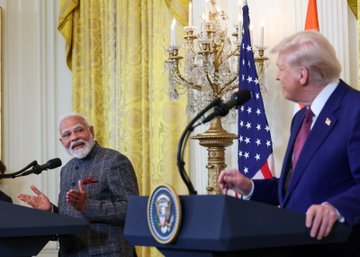
US President Donald Trump with PM Narendra Modi Image credit MEA
After Supreme Court curbs tariffs, Washington targets global overcapacity; India’s exports face fresh scrutiny
By P. SESH KUMAR
New Delhi, March 17, 2026 — In early 2026, the United States reopened a familiar playbook from the era of the US-China trade war: Section 301 investigations. Announced by US Trade Representative Jamieson Greer, the probes target alleged unfair trade practices and excess industrial capacity among major trading partners, including India, China, Japan, and the European Union.
The move comes after the Supreme Court of the United States curtailed parts of tariff actions imposed earlier by Donald Trump under emergency economic powers. Washington’s response has been to revive Section 301 of the US Trade Act — an old but potent legal instrument that allows unilateral trade retaliation against countries accused of unfair practices.
The implications extend far beyond legal technicalities. For India, which has rapidly expanded exports in sectors such as pharmaceuticals, electronics, engineering goods, and solar components, these investigations could reshape trade flows and strategic negotiations between the world’s largest consumer economy and one of its fastest-growing manufacturing hubs.
When Courts Clip Tariffs, Trade Warriors Find Another Weapon
International trade policy rarely moves quietly. It advances through a mix of diplomacy, economic muscle, and legal improvisation. The latest episode in the long saga of global trade tensions illustrates this perfectly.
The Trump administration had earlier imposed sweeping tariffs on imports from several countries under the International Emergency Economic Powers Act (IEEPA). The objective was blunt: shrink America’s trade deficit and pressure foreign producers accused of flooding the US market with subsidized goods.
But in February 2026 the US Supreme Court ruled that large portions of these tariffs exceeded the statutory authority granted under emergency powers legislation. The court effectively clipped the wings of the administration’s most aggressive tariff program.
The Supreme Court of the United States held that the International Emergency Economic Powers Act (IEEPA) was enacted primarily to regulate financial transactions and economic sanctions during national emergencies, not to authorize the President to impose broad import tariffs. The Court reasoned that the power to levy tariffs is constitutionally vested in Congress, and unless Congress clearly delegates that authority, the President cannot use emergency statutes to impose sweeping trade duties. Consequently, tariffs imposed by the administration of Donald Trump under IEEPA were deemed to exceed the statutory authority granted by the law.
For Washington’s trade strategists, however, this judicial setback was merely a detour, not the end of the road. Within weeks, the United States Trade Representative announced a new set of Section 301 investigations aimed at “structural excess capacity” and alleged labour violations among major trading partners.
In trade diplomacy, when one legal door closes, another is quickly opened.
Trump Signals Renewing Trade War with China as Thaw Thins Out
What Exactly Is a Section 301 Investigation?
Section 301 derives from the US Trade Act of 1974, one of the most powerful unilateral trade instruments in American law. It authorizes the US Trade Representative to investigate whether another country’s trade practices are “unreasonable,” “unjustifiable,” or discriminatory toward US commerce.
If such practices are found, the United States can retaliate through tariffs, quotas, or other restrictions without waiting for a ruling from the World Trade Organization (WTO).
The mechanism has been used many times over the past four decades. It became globally prominent during the Trump administration’s trade confrontation with China, where a Section 301 investigation into intellectual-property practices led to tariffs on more than $350 billion worth of Chinese imports.
In other words, Section 301 is not merely a technical review. It is a legal gateway to trade retaliation.
Why the United States Is Launching These Probes Now
Three interlocking forces explain the sudden revival of Section 301.
The first is strategic competition with China. For more than a decade Washington has argued that Chinese industrial policy — characterized by large state subsidies, cheap credit, and export-oriented manufacturing —creates global overcapacity that depresses prices and undermines American industries.
The second driver is domestic politics. In an election-sensitive environment, protecting American manufacturing jobs remains a powerful political narrative. Tariffs are often presented as tools to revive domestic production and reduce dependence on imports.
The third factor is legal necessity. After the Supreme Court curtailed tariff powers exercised under emergency legislation, policymakers needed another statutory pathway. Section 301 provides precisely that.
Thus, the investigations serve both economic strategy and legal adaptation.
The Central Allegation: Global Overcapacity
The new probes focus on “excess industrial capacity.” This phrase may sound technical, but it lies at the heart of many modern trade conflicts.
Excess capacity occurs when factories produce far more than domestic demand requires. The surplus must then be exported, often at extremely low prices. Critics argue that such exports can distort global markets, driving competitors out of business.
The United States claims that several countries maintain artificially high manufacturing capacity through subsidies, state-owned enterprises, or lax labour and environmental standards.
These conditions, Washington argues, allow producers to sell goods abroad at prices that do not reflect true costs.
Whether these allegations are justified or exaggerated remains a matter of intense debate among economists and policymakers.
Why India Has Appeared on the Radar
Although the original debate over excess capacity centred on China, the new investigation includes sixteen economies-among them India.
At first glance this may seem surprising. India is not widely accused of massive industrial overproduction in the way China is.
However, several factors explain why Washington has included India.
India’s exports to the United States have grown rapidly in recent years, especially after global companies began shifting supply chains away from China. As India expands manufacturing under initiatives such as “Make in India” and production-linked incentive schemes, its presence in global markets is increasing.
From the perspective of US trade officials, any country experiencing fast export growth in manufacturing sectors becomes a candidate for scrutiny.
Which Indian Sectors Could Be Affected
Several sectors of the Indian economy are particularly exposed to potential US trade restrictions.
One is pharmaceuticals. India is the world’s largest supplier of generic medicines and a major exporter to the United States. While the sector is highly regulated and globally competitive, any tariff action would disrupt supply chains and increase costs for American healthcare systems.
Another vulnerable sector is solar equipment. India has developed a growing manufacturing base for solar modules and related components, often supported by government incentives designed to build domestic capacity.
Engineering good — ranging from automotive components to industrial machinery — also represent a large share of Indian exports to the United States. Tariffs in this category could affect thousands of small and medium manufacturers.
Textiles and garments form another potential flashpoint, particularly if labour standards become part of the investigation narrative.
Finally, electronics assembly, an industry India is trying to expand through large investments in smartphone manufacturing, could face scrutiny if Washington argues that production subsidies distort competition.
The Labour Dimension: Forced Labour Allegations
The second leg of the investigation concerns forced labour practices.
The United States has increasingly used trade laws to block imports allegedly produced through forced labour, particularly under the Uyghur Forced Labour Prevention Act targeting products from China’s Xinjiang region.
Washington now appears to be exploring whether similar concerns exist in other supply chains. While India has not been widely accused of systemic forced labour in manufacturing exports, labour standards in informal sectors could still attract scrutiny.
In trade diplomacy, perception often matters as much as evidence.
Will Section 301 Circumvent the Supreme Court Ruling?
This is perhaps the most intriguing legal question in the entire episode.
The Supreme Court decision limited tariffs imposed under emergency economic powers. But Section 301 tariffs are based on a completely different statutory framework.
They arise from the Trade Act of 1974 and have been repeatedly upheld in US courts.
Therefore, the new investigations do not technically overturn or bypass the court’s ruling. Instead, they rely on an alternative legal authority that remains intact.
In effect, Washington is not challenging the court’s decision. It is simply using a different legal route to pursue similar policy goals.
The Geopolitical Context
These developments cannot be understood purely as trade policy.
They are also part of a broader restructuring of global supply chains. The United States and its allies are attempting to reduce dependence on Chinese manufacturing while encouraging production in friendly economies.
Ironically, India has been one of the main beneficiaries of this shift. Yet the very success of its export growth could now bring it under scrutiny.
This reflects a paradox of global trade: countries are welcomed as alternative suppliers until their exports begin competing too effectively.
Possible Consequences for India
For India, the immediate risk lies not in actual tariffs but in the uncertainty created by investigations.
Exporters may face new compliance requirements, supply-chain audits, and potential duties.
However, India also possesses several advantages.
Unlike China, India is a strategic partner for the United States in areas ranging from defence cooperation to technology and Indo-Pacific security. This political relationship could moderate trade tensions.
Moreover, many American companies depend heavily on Indian suppliers in sectors such as pharmaceuticals and IT services.
In trade diplomacy, economic interdependence often tempers confrontation.
Rupturing International Trading
For the United States, the challenge lies in balancing domestic industrial policy with global trade stability. Excessive reliance on tariffs risks fragmenting the international trading system and undermining institutions such as the WTO.
A more sustainable approach would involve coordinated action with allies to address genuine issues such as industrial subsidies and supply-chain transparency.
For India, the most effective strategy is proactive engagement. New Delhi should participate actively in the consultation process of the investigation, present detailed evidence on market-based production costs, and highlight the strategic importance of India-US economic cooperation.
India may also consider strengthening labour — compliance mechanisms and supply-chain transparency to pre-empt allegations of unfair practices.
At the same time, diversifying export markets and deepening trade agreements with Europe, Southeast Asia, and the Middle East would reduce vulnerability to unilateral trade actions.
Trade wars are rarely won by tariffs alone. They are ultimately resolved through negotiation, diplomacy, and the quiet arithmetic of mutual economic dependence.
(This is an opinion piece. Views expressed are author’s own.)
Follow The Raisina Hills on WhatsApp, Instagram, YouTube, Facebook, and LinkedIn




About The Author