Bhabanipur Battle: Mamata Banerjee Faces Toughest Test Yet
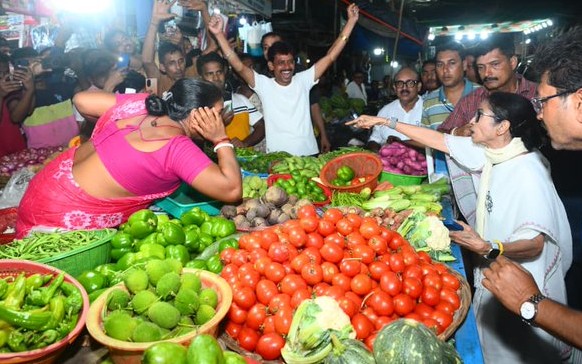
West Bengal CM Mamata Banerjee at a vegetable shop in Kolkata on Sunday evening. (Image AITMC on X)
With April 29 polling and May 4 results looming, Bhabanipur turns into a high-stakes contest shaped by demographics, strategy, and subtle shifts on the ground.
By NIRENDRA DEV
Kolkata, April 28, 2026 — As campaigning drew to a close in Bhabanipur, two dates now dominate the political calendar—April 29, when voting takes place, and May 4, when the results will reveal whether Chief Minister Mamata Banerjee can retain her political fortress.
“Jodi paren, vote ta amay deben (If you can, please vote for me),” Mamata appealed at a recent rally, her voice unusually frail. Whether this was a deliberate emotional pitch or a reflection of political fatigue remains open to interpretation.
For a leader who built her career in and around Bhabanipur, the constituency has always been more than just another electoral battleground. The Trinamool Congress campaign has leaned heavily on the slogan “Ghorer Meye” (daughter of the soil), but 2026 is shaping up to be unlike previous contests.
On the other side stands Suvendu Adhikari, the BJP’s heavyweight choice and the man who defeated Mamata in Nandigram in 2021. The BJP has avoided celebrity candidates, instead banking on a seasoned political rival with proven electoral credentials.
A Cosmopolitan Constituency, A Complex Equation
Bhabanipur’s demographic profile complicates the contest. Unlike many other constituencies, it reflects a distinctly cosmopolitan mix—Bengali Hindus, Muslims, and a significant population of Gujaratis, Punjabis, and Marwaris, along with migrants from Odisha, Bihar, and Jharkhand. Non-Bengali communities are estimated to account for nearly 40% of the electorate.
This diversity is central to the BJP’s strategy. Party planners have worked on micro-targeting voter blocs—42–44% Bengali Hindus, 35% non-Bengali Hindus, and 25–28% Muslims—crafting tailored outreach for each segment.
My own association with Bhabanipur dates back to the 1990s, when the area’s cosmopolitan ethos was already visible—from mixed community living spaces to diverse food cultures. Even during its days as a Left bastion, Bhabanipur retained a character distinct from the rest of Kolkata. That uniqueness persists—and may now challenge the effectiveness of a singular emotional appeal like “Ghorer Meye.”
Shifting Momentum on the Ground
Initial overconfidence within the Trinamool Congress appears to have given way to urgency. The turning point may have come when Mamata briefly left a rally, citing disruptive BJP sloganeering nearby—an incident that underscored rising contestation.
The TMC has since intensified outreach, particularly among non-Bengali communities. Senior leader Firhad Hakim has been engaging community leaders across Gujarati, Punjabi, and Marwari groups to counter BJP inroads.
However, underlying tensions persist. Mamata’s rhetoric against “outsiders” has reportedly alienated sections of these communities—an issue the BJP has been quick to exploit.
Ground Game vs Emotional Appeal
While Mamata has led multiple rallies and padyatras—including marches across Kalighat and Lansdowne—the BJP claims these have not generated the expected traction. Local leaders allege visible anxiety within the TMC campaign, even as party workers attempt door-to-door outreach, sometimes revisiting households multiple times.
In contrast, the BJP and RSS have quietly built a sustained ground presence over the past year. Through meetings, informal gatherings, and surveys, they have mapped voter concerns and community dynamics in detail.
This groundwork has allowed the BJP to segment the constituency into zones—Bengali-majority areas, Muslim-dominated pockets, and trader-heavy belts—and tailor campaign strategies accordingly.
Numbers That Worry the TMC
Recent electoral trends suggest narrowing margins. In the 2019 Lok Sabha elections, the BJP briefly edged ahead in segments of Bhabanipur. By 2024, the TMC’s lead in the assembly segment had shrunk to just over 8,000 votes.
These numbers have emboldened BJP strategists. “We have tasted droplets of blood,” one campaign insider remarked—suggesting that the party sees Bhabanipur as a winnable seat.
Narratives, Signals, and Uncertainty
Signs of strain are visible within the TMC camp. Kartik Banerjee, Mamata’s brother, acknowledged “uncertainty” in a recent interaction—remarks quickly amplified by BJP supporters as a sign of shifting momentum.
Suvendu Adhikari, meanwhile, has doubled down on polarising rhetoric: “Earlier only Muslims used to vote, this time Hindus will vote. Pata chal jaega,” he said, projecting confidence of a high turnout.
He further claimed that Mamata’s core support base has shrunk significantly, while “Sanatani voters” now dominate the constituency—assertions that reflect the BJP’s broader attempt to consolidate Hindu votes.
April 29 and May 4: The Verdict
As Bhabanipur heads to the polls, the contest appears finely balanced. Mamata Banerjee’s emotional connect and legacy are being tested against a data-driven, demographically calibrated BJP campaign.
Whether this is a case of “writing on the wall” or a calculated sympathy pitch will become clear only on May 4.
For now, Bhabanipur stands as a microcosm of Bengal’s evolving political landscape—where identity, governance, and ground strategy intersect in unpredictable ways.
Follow The Raisina Hills on WhatsApp, Instagram, YouTube, Facebook, and LinkedIn




About The Author