Tempest in a Teacup: Mamata’s Rise—A 2026 Turning Point?
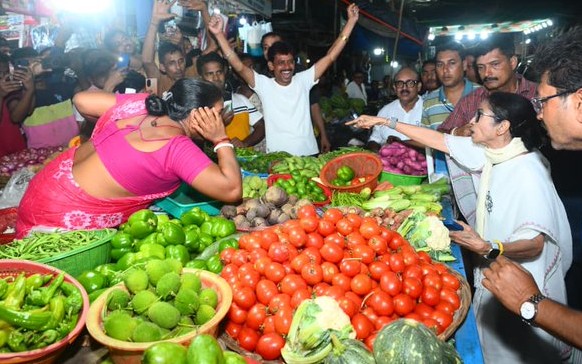
West Bengal CM Mamata Banerjee at a vegetable shop in Kolkata on Sunday evening. (Image AITMC on X)
An opinion piece examining Mamata Banerjee’s political legacy in West Bengal and Arvind Kejriwal’s recent legal confrontations, raising questions about governance, ideology, and institutional norms.
By NIRENDRA DEV
Kolkata, April 27, 2026 — I have often remarked—half in jest, half in reflection—that Kerala never produced its version of Mamata Banerjee.
Mamata Banerjee—“Didi” to her supporters, “Pishi” in political shorthand—belongs to a generation of leaders who entered Parliament in the 1980s. Her contemporaries included figures like K. V. Thomas, who represented a more measured, institutional strand of politics.
West Bengal’s political journey, however, followed a different arc. The state spent 34 years under Left rule led by leaders such as Jyoti Basu, shaping a deeply ideological political culture. When Mamata Banerjee ended that era in 2011, it was widely seen as a historic rupture.
Yet, the promise of transformation did not translate into a clean break.
Continuity Beneath Change
The fall of the Left did not necessarily mean the end of its political methods or mass psychology. Instead, many argue that the ideological rigidity and confrontational street politics simply found a new vehicle in the All India Trinamool Congress.
By the mid-2010s, even some within the ruling establishment privately acknowledged a paradox: electoral victories were assured, but governance deficits persisted. The sentiment that “victory itself could be Bengal’s misfortune” captured a deeper unease.
Over time, critics point to a climate marked by political friction, allegations of appeasement, and a weakening of institutional confidence. Whether in debates around law and order or cultural priorities, the state’s politics remained intensely polarised.
The Limits of the “Post-Left” Narrative
The assumption that 2011 marked a decisive ideological shift now appears overstated. Instead, West Bengal may have transitioned from one dominant political culture to another without fundamentally altering its structural dynamics.
Meanwhile, the rise of the Bharatiya Janata Party (BJP) in the state signals a new churn—one driven by counter-mobilisation and identity politics. What direction this takes remains uncertain, especially in a politically volatile environment.
Arvind Kejriwal and the Politics of Confrontation
If Bengal represents continuity masked as change, the politics of Arvind Kejriwal presents a different challenge—one of institutional confrontation.
Emerging from the anti-corruption movement led by Anna Hazare in 2011, Kejriwal built his political identity on defiance of established systems. Over time, critics argue, this defiance has evolved into a pattern of confrontation with institutions.
His recent stance in the excise policy case—refusing to place faith in judicial proceedings and invoking a form of “Satyagraha”—raises significant questions. The Delhi High Court, under Justice Swarana Kanta Sharma, declined to recuse from the matter, reinforcing the primacy of due process.
The episode has triggered a broader debate: can political dissent extend to questioning judicial legitimacy?
Anarchy or Strategy?
Kejriwal has previously described himself as an “anarchist,” a remark that now returns to the centre of political discourse. His critics see a pattern—mobilising public sentiment while challenging institutional authority.
Leaders from rival parties, including the Bharatiya Janata Party, have accused him of misusing the legacy of Mahatma Gandhi to justify political tactics.
The larger concern is not merely political rhetoric but precedent. If institutional processes are selectively contested, it risks normalising a culture where legal outcomes are accepted only when favourable.
A Broader Political Question
Both Mamata Banerjee’s Bengal and Kejriwal’s Delhi raise a common question: has Indian politics entered a phase where personality-driven mobilisation overrides institutional stability?
The influence of radical political methods—whether rooted in ideological legacy or modern populism—can blur the line between dissent and disruption.
A Moment of Reckoning
India’s political landscape in 2026 reflects transition rather than resolution. West Bengal’s journey suggests that removing a regime does not automatically transform governance culture. Meanwhile, developments in Delhi highlight the tensions between political strategy and institutional integrity.
The challenge ahead is not merely electoral—it is structural. Democracies endure not just on mandates, but on respect for institutions, processes, and limits. The real test, therefore, is whether political leadership strengthens these foundations—or strains them further.
This is an opinion piece. Views expressed are the author’s own.)
Follow The Raisina Hills on WhatsApp, Instagram, YouTube, Facebook, and LinkedIn




About The Author