Xi’s Washington Visit: Real Optics, Modest Outcomes, and a Relationship Still Being Negotiated Two Months at a Time
Chinese President Xi Jinping's state visit to Washington this week produced striking images, a handful of trade gestures (Image White House)
By TRH World Desk
The spectacle was unmistakable. The substance was a two-month extension. As Xi Jinping wraps up his first U.S. state visit in over a decade, the clearest signal from Washington may be how little actually got locked in.
New Delhi, September 26, 2026 — Chinese President Xi Jinping’s state visit to Washington this week produced striking images, a handful of trade gestures, and — by the account of the U.S. Treasury Secretary himself — a trade truce extended by just two months rather than any durable settlement. As the dust settles, the summit’s outcomes look considerably thinner than its optics.
The headline economic outcome was modest by design. U.S. Treasury Secretary Scott Bessent said the two sides had extended a trade truce originally due to expire in November — but only by two months, into January. “More time to see what we can do on the economic front,” Bessent said. Rather than resolving the central disputes, the Detroit News reported the extension effectively pushed the core questions — tariffs, the scale of Chinese purchases, rare-earth supply commitments, and technology restrictions — into yet another round of negotiations, with two further multilateral summits already scheduled in Shenzhen and Miami before a new January 10 deadline.
Even the agricultural commitments touted after May’s Beijing summit are showing cracks. Bessent said this week that Beijing was meeting its requirement to buy 25 million tons of soybeans, but “was lagging on its pledge to buy $17 billion in other agricultural goods” — a pledge the White House had separately touted in May as running through 2028.
U.S. officials also told reporters rare-earth deliveries were falling short of earlier commitments — a pattern that, taken together, points to a relationship where headline agreements consistently outpace their actual implementation.
The Optics Were the Real Story
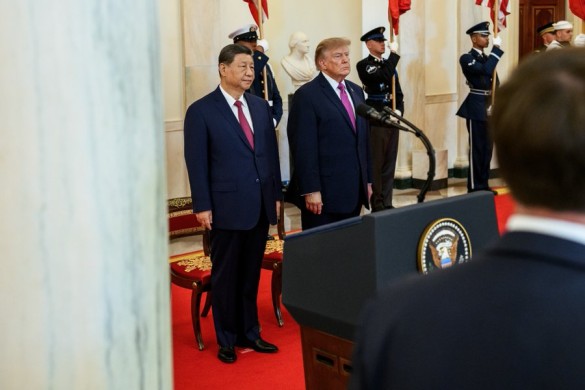
If the substance was thin, the staging was not. The Detroit News described Xi’s visit as an opportunity for Trump “to show off a Washington being remade in his image,” reporting that after Xi treated Trump to a tour of a Ming dynasty temple and a rarely-opened walled garden retreat during his May visit to Beijing, Trump reciprocated with “a different kind of spectacle: Troops wearing wigs and tri-corner hats marched in formation and played music in a Rose Garden redesigned to look like a Trump golf club.”
That tit-for-tat pageantry — each leader answering the other’s hospitality with an even larger production — has become something of a signature of this particular Trump-Xi relationship, now in its fourth or fifth iteration across roughly a year of summits.
Beneath the spectacle, however, sat a genuinely pointed substantive exchange. In his meeting with Trump, Xi placed Taiwan “at the center of the relationship between the U.S. and China,” describing it as a red line that, in his own words, if not managed properly would put relations between the two countries “in jeopardy.”
That’s a notably firmer framing than the trade-focused, soybean-and-rare-earths language dominating most of the public readouts — a reminder that even amid friendly staging, the relationship’s most combustible fault line remains fully live.
Reading the Gaps Between the Two Readouts
Comparison of the American and Chinese official accounts of the summit by analysts showed “minor inconsistencies” on issues including agriculture, tariffs, and rare earths — differences experts noted were not, on their own, especially significant. That’s a meaningfully different read than outright discord: it suggests both governments are still broadly aligned on the shape of the relationship, even if each side’s domestic messaging emphasizes different details for different audiences.
The most pointed assessment of where this leaves U.S.-China relations came from Jacob Shapiro, strategic partner and geopolitical advisor at The Bespoke Group, who told CNBC’s “Squawk Box Asia” the summit itself was “underwhelming,” though he expects ties to improve “incrementally” for as long as Trump remains in office. His sharper point was about durability beyond this presidency: “After you get past Trump, I don’t see that Trump is passing the baton to anyone in the United States who is [interested in] meaningfully improving ties with China,” Shapiro said, arguing this means Beijing will “say what they need to say to make things nice for the next couple of years,” while quietly preparing for a successor administration likely to take a harsher line.
That reading is consistent with commentary following earlier stops on this same diplomatic circuit. Bonnie Glaser of the German Marshall Fund, commenting after an earlier Trump-Xi phone call, offered a more optimistic gloss on the same underlying dynamic: “Both sides are signalling that they want to preserve stability in the U.S.-China relationship.”
Follow The Raisina Hills on WhatsApp, Instagram, YouTube, Facebook, and LinkedIn




About The Author