World Smile Day: The One Day We’re Expected to Smile Without Asking “Why?”
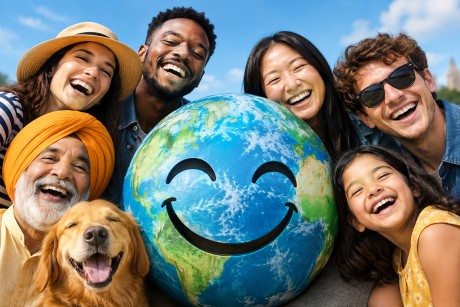
A smile is a universal language that needs no translation. AI Image)
By S. JHA
From awkward office meetings and politicians’ photo-op smiles to everyday acts of kindness, World Smile Day celebrates the universal power of a smile — even when life refuses to cooperate.
Mumbai, October 2, 2026 — There are days for everything these days. World Environment Day asks us to save the planet. World Health Day reminds us to take care of our bodies. And then there is World Smile Day, which arrives with a deceptively simple assignment: smile.
No meeting. No presentation. No Excel sheet. No “gentle reminder” from the boss.
Just smile.
Sounds easy, right?
Not necessarily.
Try smiling at 9:07 a.m. when your alarm has gone off for the third time, your phone is at 4 per cent, the Wi-Fi has developed philosophical doubts about its purpose, and someone in the family has already asked, “Breakfast mein kya hai?”
That is not a smile.
That is a survival expression.
The face that launched a thousand yellow circles
World Smile Day is celebrated on the first Friday of October and is associated with the iconic yellow smiley face created by American graphic artist Harvey Ball in 1963.
Ball reportedly wanted the symbol to spread happiness and goodwill.
He succeeded spectacularly.
The humble yellow circle with two dots and a curved line has travelled further than most motivational speakers. It appears on messages, mugs, T-shirts, stickers, notebooks and, increasingly, in conversations where nobody knows what to say.
“Okay 🙂”
Translation: I have seen your message. I am choosing peace.
“Fine 🙂”
Translation: We shall discuss this matter in approximately seven years.
“Sure 🙂”
Translation: Absolutely not.
The smiley face has therefore achieved something extraordinary: it can express happiness, politeness, passive aggression and emotional exhaustion without changing its face.
Frankly, it has range.
Smiling is free — unlike almost everything else
The best thing about a smile is its price.
Zero rupees.
In an economy where even breathing can feel like a subscription service, a smile remains stubbornly free.
You can smile at a stranger in a lift. You can smile at the person delivering your food. You can smile at a child who is running around with the confidence of someone who has never seen an electricity bill.
You can even smile at yourself in the mirror.
Although this last one may lead to questions if it continues for too long.
The Indian smile has many varieties
India deserves its own scientific classification of smiles.
There is the shaadi smile — deployed when approximately 46 relatives are taking photographs and your cheeks have stopped cooperating.
There is the teacher-entering-the-classroom smile — an expression that says, “Good morning, children,” while the eyes quietly say, “I know who broke the window.”
There is the relative-at-a-family-function smile — activated immediately after someone asks, “Beta, shaadi kab kar rahe ho?”
And then there is the legendary customer-care smile.
“Sir, we completely understand your concern.”
No, they don’t.
But they are smiling.
Respect.
Then came the emoji
Humanity eventually decided that physically smiling was too much effort and invented the emoji.
Now we don’t even need facial muscles.
Need to say “thank you”? 🙂
Need to say “I am happy”? 😊
Need to say “This is fine”? 🙂
Need to say “I have made a terrible decision but let’s continue”? 😂
The emoji has become the digital equivalent of body language — except it works at 2 a.m., during arguments and while lying horizontally under a blanket.
A smile can also be suspicious
Of course, not every smile is innocent.
If someone says, “I have a small favour to ask,” and smiles, run.
If your boss says, “Can we have a quick chat?” and smiles, update your résumé.
If a friend says, “I have an idea,” while smiling unusually broadly, check your calendar.
And if someone says, “Don’t worry, I’ve got this,” with a smile, you should probably start worrying.
The great national shortage: genuine smiles
Perhaps that is why World Smile Day matters.
Not because the world has forgotten how to smile, but because we have become very good at producing the social smile — the quick one, the polite one, the photograph one, the “yes, everything is absolutely fine” one.
A genuine smile is different.
It arrives when somebody tells a terrible joke and you laugh anyway.
It appears when an old friend calls after months.
It sneaks onto your face when you see your favourite food arriving at the table.
It happens when a child says something so brutally honest that the entire room needs a moment to recover.
And sometimes, for no particularly sensible reason, you just smile.
Those are probably the smiles worth celebrating.
So, what should you do today?
Nothing complicated.
Smile at someone.
Laugh at a bad joke.
Send a ridiculous meme to a friend.
Call someone who makes you happy.
Or simply look in the mirror and smile — even if your brain immediately asks, “What exactly are we doing?”
Tell it: World Smile Day.
For once, we have official permission.
And if none of that works, remember the oldest rule in the book: When life gives you lemons, smile.
Because making lemonade requires effort.
And today, we’re conserving energy.
International Coffee Day: Coffee, the Unofficial Operating System of Modern Life
Follow The Raisina Hills on WhatsApp, Instagram, YouTube, Facebook, and LinkedIn




About The Author