Why Poland Could Become a Key Partner in Taiwan’s China Strategy
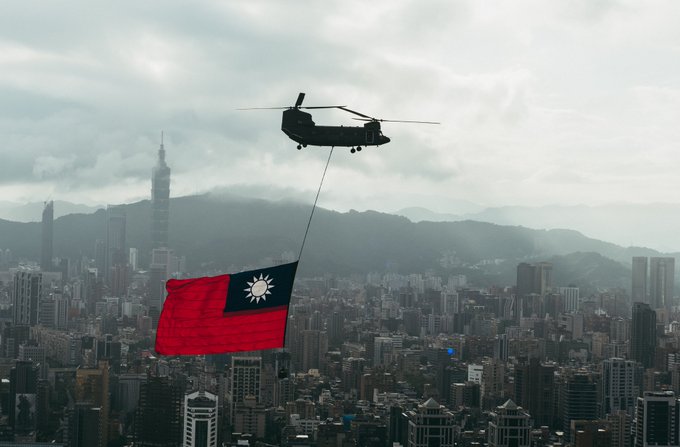
Taiwan celebrated National Day on October 10 and flew a giant flag from a helicopter
By TRH World Desk
A Taipei Times analysis says Poland’s trade corridors, Taiwanese investments and growing political support for Taipei could make Central Europe a key part of Taiwan’s economic-security strategy.
New Delhi, August 17, 2026 — Taiwan and Poland are emerging as key partners in what could become a new “non-red Intermarium” aimed at strengthening economic resilience and countering Chinese influence, according to an analysis published by Taipei Times.
The analysis by Taiwan-based journalist and Polish media correspondent Hanna Shen argues that Poland’s strategic location, growing Taiwanese investments and control over important trade corridors could give Warsaw a significant role in Taiwan’s broader economic and security strategy.
The concept draws on the historical idea of Miedzymorze, or the Intermarium, proposed by Polish Marshal Jozef Pilsudski a century ago. The idea envisaged a belt of free states between the Baltic, Black and Adriatic seas that could collectively resist pressure from larger powers.
“The Intermarium was conceived as a shield against Russia. What is new — and should interest readers in Taipei as much as in Washington — is that the same belt could become a shield against Beijing,” Shen wrote in the Taipei Times.
The article noted that the concept has acquired an institutional form through the Three Seas Initiative, which links 13 EU member states in Central and Eastern Europe, with Poland as its largest economy and one of its leaders.
Poland’s Strategic Role
The analysis comes amid growing attention to the role of Central Europe in any potential Taiwan conflict.
Shen cited Hudson Institute senior fellow Ken Moriyasu, who argued in the Washington Examiner that deterring a Chinese invasion of Taiwan could require pressure on the overland trade corridors that Beijing has developed as alternatives to vulnerable maritime routes.
The western ends of several of these corridors are located in Central Europe.
The Malaszewicze terminal on the Polish-Belarusian border, in particular, handles a major share of rail trade between China and the European Union.
“Poland does not need to send frigates to the Pacific to matter in the Taiwan Strait; it needs to control its own section of China’s economic lifelines — and to show up in Taipei,” Shen wrote.
Taiwanese President William Lai has been advocating “non-red supply chains” linking free nations and reducing dependence on production networks controlled by Beijing.
According to Shen, this strategy mirrors the original Intermarium concept in economic rather than military terms.
“Pilsudski’s belt was made of borders and bayonets meant to hold back Moscow. Lai’s belt is made of semiconductors, servers and battery plants, and it holds back Beijing,” the article said.
Taiwanese Investment in Poland
The growing economic relationship between Taipei and Warsaw is already visible through a series of investments.
A Taiwanese consortium organised by the Taiwan Electrical and Electronic Manufacturers’ Association and led by Hon Hai Precision Industry Co, commonly known as Foxconn, is set to build a technology park in Miekinia near Wroclaw.
The site was previously associated with an Intel project that was abandoned last year.
Poland also emerged as the preferred destination after Chinese automaker Geely withdrew from Poland’s national electric-vehicle project. State-owned ElectroMobility Poland subsequently signed an agreement with Foxconn to develop an electromobility centre in Jaworzno.
The article noted that Poland has been building ties with Taiwan for several years. Warsaw opened a trade office in Taipei in 2018.
Cross-Party Support for Taiwan
A recent visit by Polish members of the European Parliament to Taiwan has added a political dimension to the growing economic relationship.
President Lai received the delegation at the Presidential Office. Led by former Polish prime minister Beata Szydlo, the group also met Legislative Yuan Speaker Han Kuo-yu.
Shen described the visit as significant because the delegation included members of Poland’s conservative opposition, which governed until 2023 and could potentially return to power.
The visit therefore offered a degree of political continuity for Taiwan.
“Whatever divides Polish politics — and much does — Taiwan is becoming one of the few points of cross-party consensus,” Shen wrote.
For Taiwan, such continuity could be important because investments and strategic partnerships need to survive changes in government.
Call for Greater US Role
The analysis called for Taiwan and the United States to deepen their engagement with Central Europe.
Taipei, Shen argued, should treat Central Europe as a destination for advanced technology rather than merely as an assembly base. This could include research and development, semiconductor packaging expertise and training programmes.
Washington, meanwhile, should place the Three Seas region more prominently on its economic-security agenda.
The article suggested greater coordination between the US and Poland on export controls and investment screening, alongside allied financing for infrastructure in the region.
The broader objective would be to prevent strategic trade corridors from becoming overly dependent on Chinese capital.
The article concluded that the original Intermarium concept and Taiwan’s current push for non-red supply chains share a common objective: ensuring that smaller and medium-sized nations are resilient enough to resist coercion from larger powers.
“Taiwan, which knows better than anyone what it means to live next to an empire that calls its neighbors its own, has every reason to make sure that this time, the belt holds,” Shen wrote.
Follow The Raisina Hills on WhatsApp, Instagram, YouTube, Facebook, and LinkedIn




About The Author