Life, Death and the Law: India’s Passive Euthanasia Debate
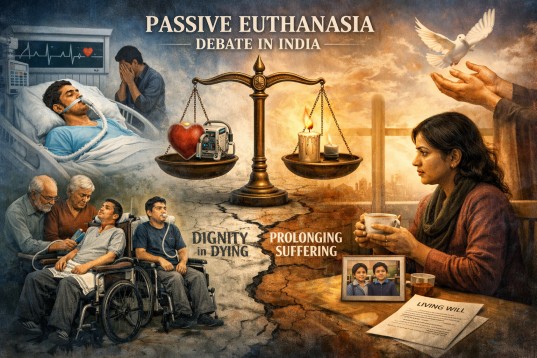
Passive Euthanasia in India: The Right to Die With Dignity
A landmark court decision has renewed India’s most difficult conversation — when does sustaining life become prolonging suffering? Personal stories and expert voices explore the ethics, the law, and the living will.
By BHAWNA MALIK
New Delhi, March 26, 2026 — A landmark court decision allowing passive euthanasia in India has reignited a deeply personal debate on compassion, medical ethics, and the boundaries of life-sustaining treatment.
Harish Rana (name changed) was 31 years old when he died at the All India Institute of Medical Sciences in New Delhi — thirteen years after falling into a coma. His passing stirred something far beyond grief in Sonia Jaiswal (name changed), an Indian living in the United States.
Sipping her morning tea, Jaiswal found herself thinking of her twin brothers, both of whom battled muscular dystrophy for twelve years before they died. She welcomes the court’s decision.
“Muscular dystrophy is a genetic disorder that primarily affects males,” she explains, adding: “Slowly, the body gives away. My brothers — once active in business — became wheelchair-bound, dependent on family for everything. They couldn’t lift their heads, couldn’t scratch their nose. They were fed through tubes.”
Their parents lived in a state of anxious waiting. “It was wait and watch,” Jaiswal recalls. “Which is extremely painful.”
After her brothers’ deaths, the family moved abroad. But the fear followed her. Knowing the disease is hereditary, Jaiswal has since prepared a living will. While married and having a son, she has left clear instructions: “If the genes take over my body, I would prefer euthanasia over prolonged suffering.”
A Patient’s Choice
The word euthanasia derives from the Greek for “good death.” In India, it has become one of the most contested phrases in medical and legal discourse.
In 2018, the Supreme Court recognised the validity of a “living will” — an advance directive allowing individuals to specify that they do not wish to be kept on life support in the event of an irreversible medical condition. The document is intended to guide both doctors and families through some of the most difficult decisions they will ever face.
A Moral Dilemma
For Nancy — whose name has been changed to protect her identity — passive euthanasia is not a legal question. It is a moral one, and it remains unresolved.
Her younger, unmarried sister suffered a cardiac arrest and fell into a coma. Doctors declared her brain dead, but she was placed on life support. A week passed with no visible improvement. Then came multiple organ failure.
“What is the point of letting a person suffer when even the doctors see no hope?” Nancy asks.
Her sister died of organ failure, leaving Nancy with unanswered prayers and a question she cannot shake: when does sustaining life become prolonging suffering?
A Society Divided
Passive euthanasia sits at a fraught intersection of law, medicine, and ethics — and Indian society remains divided.
Supporters argue that human dignity must remain central to medical care. When a patient is trapped in a permanent vegetative state with no realistic hope of recovery, continuing life support may prolong suffering rather than life itself. For advocates, passive euthanasia is not abandonment — it is an act of compassion that honours personal autonomy.
Dr. K. Srinath Reddy, public health expert and former president of the Public Health Foundation of India, shares that view cautiously.
“End-of-life care is one of the most sensitive areas of medicine,” he says, adding: “When recovery is medically impossible, allowing patients to die with dignity can be a compassionate decision. However, strict safeguards and ethical oversight are essential to prevent misuse.”
Others are less certain. Saksham Sharma lost his mother after six months in a coma — the result of a sudden drop in blood sugar. She was stabilised in hospital, placed on life support, then shifted home on medical advice. What followed was a slow, painful vigil.
“Our home became a mini ICU,” he recalls. “Beeping machines, tubes, a suction machine, a full-time nurse — and no sign of improvement. She developed bedsores. My father couldn’t handle the stress. He passed away too.”
His mother eventually died of multiple organ failure and internal haemorrhage. Sharma still cannot say where he stands on passive euthanasia. But he has one appeal — not to the courts, but to society.
“It’s hard for a family to let go,” he says. “But society also needs to be sensitive and forgiving.”
Work-Life Balance in India: Why 51% of Workers Are Overworked
Follow The Raisina Hills on WhatsApp, Instagram, YouTube, Facebook, and LinkedIn




About The Author