Modi Meets Putin and Pezeshkian: Why India Does Not Want to Choose Sides
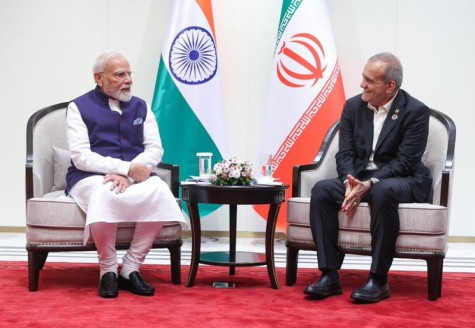
Chabahar, trade and the West Asia crisis and a lot on cards when Modi meets Iran president (Image Modi on X)
By NIRENDRA DEV
Prime Minister Narendra Modi’s engagements with Russia and Iran underline India’s strategic-autonomy doctrine: deepen partnerships across competing power centres without becoming dependent on any one bloc.
New Delhi, September 11, 2026 — Prime Minister Narendra Modi’s bilateral engagements with Russian President Vladimir Putin and Iranian President Masoud Pezeshkian carry significance well beyond the immediate issues of energy, trade or regional conflicts. For New Delhi, the larger strategic objective is clear: India does not want to choose between Moscow and Washington, or between China, Iran and Europe. It wants enough strategic space to avoid having to choose at all.
India’s tightrope walk in global diplomacy has become increasingly visible. New Delhi maintains a working relationship with Tehran, remains a longstanding partner of Moscow, has deepening economic ties with Washington and recognises the continuing geopolitical importance of China.
The emphasis is therefore on maintaining a climate of trust, expanding economic cooperation and rebuilding relationships where necessary. Indian diplomacy does not appear to subscribe to the idea that strategic trust can be rebuilt overnight.
Russia and Iran: Relationships That Pre-Date Today’s Crises
India’s ties with both Russia and Iran have roots far deeper than contemporary oil trade.
New Delhi’s relationship with the Soviet Union was established in April 1947, months before India became independent. During the Cold War, Moscow became an important economic, military and diplomatic partner. On issues including Kashmir, the Soviet Union’s position at the United Nations Security Council often supported Indian interests.
That history continues to matter even as India seeks greater strategic diversification. New Delhi’s pursuit of a permanent seat on the UN Security Council also makes relationships with major powers and influential groupings important.
The same logic applies to India’s engagement with Iran, particularly given Tehran’s geographic importance, connectivity potential and position in the wider Gulf and Central Asian neighbourhood.
Strategic Autonomy Means Strategic Options
For Prime Minister Modi, National Security Adviser Ajit Doval and External Affairs Minister S. Jaishankar, strategic autonomy cannot mean dependence on a single partner.
The Ukraine war has reinforced one lesson: great-power relationships can change rapidly. Russia’s growing dependence on China is one example of how even historically close partnerships can acquire new strategic dimensions.
For India, the answer is therefore not to select one camp.
The objective is to ensure that India retains enough economic, diplomatic and military options that it does not have to choose between competing power centres.
That explains the importance of relationships stretching from Moscow and Tehran to Washington, Beijing, London and Tokyo, while regional partners such as Colombo, Kathmandu and Seoul also remain relevant.
India needs self-reliance, but self-reliance does not mean isolation. It requires a sophisticated balance between domestic capability and interdependence with major global economies.
BRICS 2026 Under Pressure: Can India Turn Global Turbulence into Strategic Cohesion?
BRICS and SCO Provide Strategic Space
Multilateral platforms such as BRICS and the Shanghai Cooperation Organisation offer India additional diplomatic space.
These forums allow countries with sharply different strategic interests to engage without necessarily forming military or ideological blocs.
The prospective participation of Chinese President Xi Jinping in New Delhi also carries symbolic significance. Xi stayed away from the 2023 G20 Summit in India. The contrast with 2026 highlights how quickly diplomatic circumstances can change.
For India, such engagement creates opportunities to stabilise relationships while preserving differences.
Iran’s Economic Crisis Adds Urgency
The Iran dimension is particularly important.
Tehran is confronting severe economic pressures, including high inflation and contraction. Restrictions on access to dollar-based financial infrastructure have also affected economies such as Iran and Russia.
But diplomacy cannot be reduced to economic statistics. The psychological consequences of conflict, displacement and economic isolation can survive long after active fighting declines.
This is particularly relevant for India as it seeks a constructive relationship with Tehran.
The expectation from New Delhi is therefore not simply that India will expand trade with Iran. It is that sustained diplomatic engagement can contribute to regional stability while protecting India’s own economic and strategic interests.
India’s Russia-Iran-RIC Equation
The wider geopolitical environment is also changing as Washington recalibrates its global commitments under President Donald Trump.
Central Asia and the Gulf remain strategically unsettled, while global energy markets are undergoing major structural changes.
For India, this makes the Russia-Iran relationship and the Russia-India-China, or RIC, equation potentially important diplomatic instruments.
India’s strategic challenge is not to become the champion of one geopolitical camp. It is to remain sufficiently important to all major centres of power that New Delhi retains the freedom to pursue its own national interests.
That is the real significance of Modi’s engagements with Putin and Pezeshkian.
India’s foreign policy is increasingly about ensuring that when the great powers ask New Delhi to choose, India has the strategic weight and diplomatic relationships to say: why should we?
Follow The Raisina Hills on WhatsApp, Instagram, YouTube, Facebook, and LinkedIn




About The Author