BRICS Finance Ministers Renew Push for IMF Reform, Push Back on Unilateral Tariffs

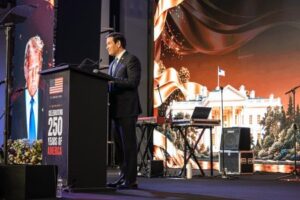
BRICS 2026 mural at Bharat Mandapam (Image BRICS 2026 on X)
By TRH Economy Desk
Finance Ministers and Central Bank Governors of the BRICS bloc issued a joint statement from Mumbai, capping meetings held in Jaipur in August and the Indian financial capital this month, under the theme “Building for Resilience, Innovation, Cooperation and Sustainability.”
New Delhi, September 11, 2026 — The statement opens with a pointed warning on the state of the global economy, citing “persistent geopolitical tensions, trade fragmentation and protectionism, policy uncertainty, fiscal and inflationary pressures, growing debt and financial vulnerabilities.” The grouping voiced “serious concerns” over the unilateral use of tariffs and non-tariff measures, arguing such steps are inconsistent with World Trade Organisation rules and weigh disproportionately on emerging markets and developing economies (EMDEs).
BRICS members reiterated long-standing calls to overhaul the Bretton Woods Institutions, urging a governance structure that better reflects the global economy’s transformation since the IMF and World Bank’s founding. The statement pressed for the stalled 16th General Review of Quotas to take effect “with no further delay” and called for work to begin on a 17th review that would realign voting shares toward EMDEs without penalizing the poorest members. It also endorsed the “Diriyah Guiding Principles” on quota reform and reaffirmed that voluntary financial contributions to the IMF should not buy additional governance influence.
Several new mechanisms launched under India’s rotating BRICS chairship featured prominently. The bloc welcomed a Task Force on Growth and Development, organized around resilience/innovation and sustainability workstreams, along with technical notes on development finance architecture and on artificial intelligence’s role in inclusive growth. A separate Task Force on Public-Private Partnerships and Infrastructure produced a technical report on de-risking frameworks and disaster-resilient infrastructure.
The statement also announced a new BRICS-NDB Knowledge Portal, developed with the New Development Bank to archive best practices and policy research across member countries, and reported progress on the BRICS Multilateral Guarantees initiative, aimed at mobilizing private capital for development projects.
Payments, Tax, and Emerging Tech
On cross-border payments, ministers acknowledged continued technical work by the BRICS Payment Task Force toward faster, lower-cost payment interoperability and local-currency trade settlement, while explicitly noting “there is no one-size-fits-all approach” — language that tempers earlier bloc rhetoric about challenging dollar dominance. The group also touted new tax-cooperation bodies, including working groups on transfer pricing and a “BRICS Women in Tax Network,” alongside efforts to combat illicit financial flows.
The statement further flagged growing attention to artificial intelligence and quantum computing risk in finance, referencing a new “Approach Paper on AI in Finance” and an “AI Governance and Enablement Toolkit,” plus continued cybersecurity information-sharing through the BRICS Rapid Information Security Channel.
The ministers confirmed the bloc will continue its work through the remainder of 2026 before handing the rotating chairship to China in 2027. The statement stops short of announcing binding new commitments, instead consolidating a year of technical-track discussions into shared principles — leaving implementation of most initiatives, from the insurance resilience centre proposed for GIFT City to the New Investment Platform, to further voluntary, consensus-based negotiation among members in the years ahead.
Modi Meets Putin and Pezeshkian: Why India Does Not Want to Choose Sides
Follow The Raisina Hills on WhatsApp, Instagram, YouTube, Facebook, and LinkedIn




About The Author