BRICS 2026 Under Pressure: Can India Turn Global Turbulence into Strategic Cohesion?
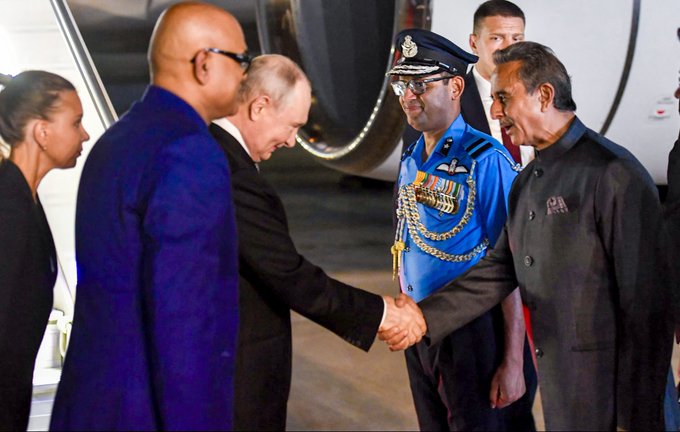
Russian President Vladimir Purin arrives in New Delhi for BRICS Summit on Friday. (Image MEA India)
By TRH Foreign Affairs Desk
Major General S B Asthana argues that India’s BRICS chairmanship faces a defining test as the Russia-Ukraine war, West Asian conflict, US tariff pressure and India-China tensions expose the grouping’s internal contradictions.
New Delhi, September 11, 2026 — As India hosts the 18th BRICS Summit at Bharat Mandapam on September 12–13, the grouping faces an unusually complicated geopolitical test, with the Russia-Ukraine war, the US-Israel-Iran confrontation, American tariff pressure, energy security and the evolving India-China relationship converging at the summit table.
Writing on his website AsthanaWrites, Major General (Dr) S B Asthana argues that the challenge before India is no longer simply to make BRICS speak with one voice, but to determine whether the expanded grouping can translate its growing geopolitical weight into meaningful collective action.
Asthana writes: “BRICS 2026 meets at Bharat Mandapam at precisely the moment when the world order is under maximum stress. Ukraine, Iran, US tariffs, China, energy security and competing visions of multipolarity are converging at India’s doorstep. The real test is no longer whether BRICS can speak together—but whether India can make it act together.”
A More Difficult BRICS Test for India
According to Asthana, the international environment has deteriorated rapidly.
The Russia-Ukraine war continues, while the US-Israel-Iran confrontation has altered West Asian security and energy calculations. At the same time, the possibility of punitive US tariffs on countries purchasing Russian energy has direct implications for major BRICS economies.
India-China relations, meanwhile, are showing cautious signs of stabilisation after years of tension.
The expected meeting between Prime Minister Narendra Modi and Russian President Vladimir Putin adds another layer to India’s diplomatic balancing act. Asthana notes that defence, energy, trade and technology are likely to feature prominently as India continues its engagement with Moscow while facing pressure over Russian energy imports.
The larger challenge for New Delhi is therefore to maintain its strategic partnerships without allowing BRICS to evolve into an explicitly anti-Western bloc.
Iran Complicates the BRICS Equation
Iran’s position could prove particularly difficult for India.
According to Asthana, Tehran is expected to seek a stronger BRICS response to the US-Israeli military campaign and has urged members to explicitly condemn what it describes as US-Israeli aggression.
But BRICS now includes countries with sharply different security interests.
Saudi Arabia and the UAE have been directly affected by the regional conflict and Iranian attacks on Gulf states and shipping. Both countries have condemned Iranian attacks and asserted their right to defend their sovereignty and security.
That makes a unified geopolitical position considerably more difficult.
Asthana argues that BRICS cannot operate like a conventional military or political alliance because its members do not share a single geopolitical narrative.
The grouping includes countries seeking condemnation of US-Israeli action, states exposed to Iranian military activity, Russia seeking relief from Western pressure, China pursuing a larger role in an alternative global architecture, and India attempting to preserve strategic autonomy without entering into bloc confrontation.
SCO Offers India a Diplomatic Template
Asthana sees India’s handling of the recent SCO discussions as potentially useful for the BRICS process.
The SCO, he argues, demonstrated that a diverse grouping can express opposition to military action and reaffirm multipolarity while allowing individual members to retain their own strategic relationships.
But BRICS faces a more complicated test because its expanded membership has brought together countries with increasingly divergent regional interests.
The question for India’s chairmanship is whether these differences can be managed without allowing them to paralyse the organisation.
Beyond an Anti-Western Bloc
Asthana also argues that India’s objective should not be to turn BRICS into an instrument against the West.
Instead, India should seek to build BRICS as a mechanism for greater strategic autonomy and practical cooperation among emerging and developing economies.
Asthana writes that the test at Bharat Mandapam is “larger than another summit declaration.”
It is, he argues, a test of whether India can help BRICS become “non-Western, but not anti-Western; strategically autonomous, but not strategically confrontational”, while making the grouping increasingly capable of translating Global South aspirations into practical institutional outcomes.
India’s Balancing Act
For New Delhi, the challenge is particularly delicate.
India maintains an important defence and energy relationship with Russia, has deepening strategic ties with the United States and other Western powers, seeks greater economic and diplomatic engagement with Gulf countries, and remains engaged in managing its complex relationship with China.
BRICS therefore gives India an opportunity to demonstrate that strategic autonomy can operate within an increasingly fragmented international system.
But the same diversity that gives BRICS its geopolitical weight also limits how far the grouping can move towards a common strategic position.
The coming summit will consequently test not just BRICS, but India’s ability to convert diplomatic balancing into institutional leadership.
Asthana asks if India’s calibrated activism can transform the current turbulence into greater BRICS cohesion—or whether the geopolitical contradictions that have made BRICS more important will ultimately expose the limits of the grouping.
Follow The Raisina Hills on WhatsApp, Instagram, YouTube, Facebook, and LinkedIn




About The Author