BRICS Summit 2026: Can Modi Turn Xi Jinping’s India Visit Into a Border Breakthrough?
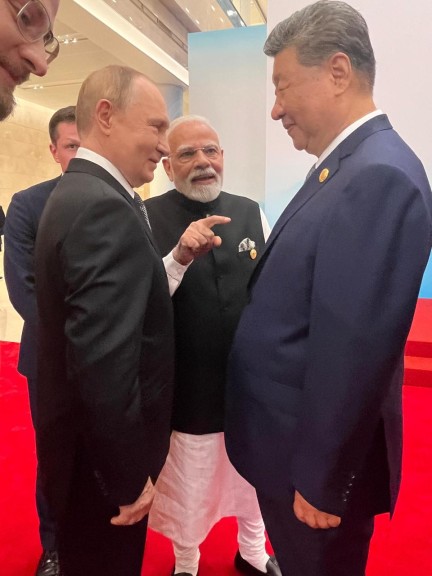
Prime Minister Narendra Modi with Chinese and Russian President Xi Jinping and Vladimir Putin at SCO Summit! (Image PMO)
By TRH Op-Ed Desk
Geopolitics analyst Manish Anand argues that Xi Jinping’s BRICS visit could give India an opportunity to seek tangible progress on the Line of Actual Control.
New Delhi, September 10, 2026 — Prime Minister Narendra Modi’s hosting of the BRICS Summit in New Delhi comes at a critical moment for Indian foreign policy, with China’s President Xi Jinping set to attend and expectations rising over whether the grouping can deliver more than diplomatic rhetoric.
In a monologue for The Raisina Hills, geopolitics analyst Manish Anand argued that India’s foreign policy appears increasingly difficult to define, comparing it humorously to the popular Koi… Mil Gaya song: “Idhar gaya, udhar gaya, jaane mein kidhar gaya.”
Anand said the BRICS summit provides India with an opportunity to demonstrate leadership among the Global South, but warned that the expanded grouping faces serious internal contradictions.
BRICS, he noted, has grown substantially from its original grouping of Brazil, Russia, India and China, later joined by South Africa. With its expanded membership, reaching consensus on major issues has become more difficult.
Anand pointed to the failure of a BRICS foreign ministers’ meeting to reach consensus even on a joint statement as an indication of the challenges facing the grouping.
According to Anand, India should use its BRICS presidency to pursue strategic objectives rather than treat the organisation merely as a diplomatic talking shop.
He argued that India’s broader objective remains leadership of the Global South and strengthening multilateral institutions. India, he said, has historically supported multilateralism and platforms where developing countries can collectively articulate their interests.
However, Anand cautioned that China’s growing influence within BRICS and other multilateral groupings creates a strategic dilemma for New Delhi.
He drew a parallel with the Shanghai Cooperation Organisation, where China has considerable influence and where India participates alongside China, Russia, Pakistan, Iran and Central Asian countries.
The more immediate opportunity, Anand suggested, could emerge from Xi’s participation in the Delhi summit.
He recalled the assessment of former Indian foreign secretary Shyam Saran that Xi’s participation in the 2023 G20 Summit could have indicated a more positive Chinese approach towards resolving the India-China border dispute.
Xi did not attend the 2023 G20 Summit in New Delhi, instead sending Chinese Premier Li Qiang.
Anand argued that Xi’s presence in Delhi in 2026 could therefore create expectations of movement on the Line of Actual Control.
“Some hopes are now emerging that China may be willing to seriously discuss the Line of Actual Control with India and explore a way forward,” Anand said.
He suggested that India should seek tangible progress rather than expect an immediate settlement of the entire border dispute.
The western and eastern sectors involve complex territorial claims, Anand noted, making a comprehensive resolution difficult. But agreements in less contentious areas, he argued, could help rebuild trust between the two countries.
For India, the economic dimension is equally important.
Anand pointed out that India’s largest trade deficits are with several BRICS members, particularly China, while India’s trade position is comparatively stronger with the United States, Europe and parts of the Middle East.
This, he argued, raises questions about how effectively BRICS serves India’s immediate economic interests.
“If there is no serious outcome, then BRICS is nothing more than a talking shop,” Anand said.
The central test for Modi, therefore, is whether India can use the summit to convert diplomatic symbolism into measurable strategic and economic gains.
Xi’s presence, Russia’s continuing role, India’s Global South ambitions and the changing global balance provide New Delhi with an unusual diplomatic opportunity.
The question is whether India can turn that opportunity into concrete outcomes.
(Manish Anand is a geopolitics analyst. His views were expressed in a monologue for The Raisina Hills.)
Why India Won’t Broker Iran-US Peace — But BRICS Could Change the Equation
Follow The Raisina Hills on WhatsApp, Instagram, YouTube, Facebook, and LinkedIn




About The Author