Karnataka State Finances Under the CAG Lens: The Fiscal Arithmetic That Does Not Add Up

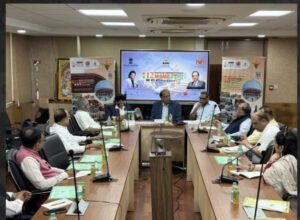
Karnataka Chief Minister D. K. Shivakumar at the inauguration of QUANTUM at Science Gallery Bengaluru. (Image CM on X)
By P. SESH KUMAR
A critical reading of the Report of the Comptroller and Auditor General of India on State Finances for the year 2024-25, Government of Karnataka (Report No. 2 of 2026), with proposals for value addition, management information support, performance indices and PEFA alignment.
New Delhi, August 8, 2026 — Let us begin with the sentence that ought to have been the executive summary of the Report of the Comptroller and Auditor General of India on State Finances for the year 2024-25, Government of Karnataka (Report No. 2 of 2026) and instead sits at the bottom of page fifty-eight.
Revenue expenditure, the report says in its Chapter 1 conclusion, was understated by 2.27 per cent—Rs 6,333.29 crore—because the State refunded unutilised money from Single Nodal Agency accounts and adjusted unspent balances lying in the Zilla Panchayat and Taluk Panchayat Fund II.
Elsewhere the report is more explicit about what that manoeuvre bought: the State attained its fiscal deficit target, it says, by writing back Rs 5,000 crore of balances that had accumulated between 2014 and 2020 and by recovering Rs 1,333 crore from SNA accounts. In the exit conference of January 2026, the Government accepted the facts.
Now let us hold that beside the report’s own compliance table. Post-audit, after correcting for: (i) Rs 2,020.87 crore of revenue expenditure booked as capital; (ii) Rs 72.46 crore booked the other way; (iii) Rs 57.48 crore of unpaid interest on reserve funds; and (iv) Rs 3.03 crore of overstated receipts, the revenue deficit becomes Rs 22,843 crore and the fiscal deficit Rs 85,087 crore—0.79 and 2.95 per cent of a Gross State Domestic Product (GSDP) of Rs 28,83,903 crore.
The Report then records the fiscal deficit target of three per cent as achieved, and the debt-GSDP ratio of 23.73 per cent as comfortably inside the 25 per cent statutory cap.
The write-back never travels into either table. If we restore it—and it must be restored, because money spent in 2016 and surrendered in 2025 is not a reduction of 2025’s expenditure in any economic sense—and the revenue deficit becomes Rs 29,176 crore, or 1.01 per cent of GSDP, and the fiscal deficit Rs 91,420 crore, or 3.17 per cent.
That is my arithmetic, not the report’s, and the assumption is stated plainly: I treat the reversal of prior-year expenditure as a below-the-line adjustment rather than as current-year saving. On that basis Karnataka did not meet the 3 per cent ceiling in the Karnataka Fiscal Responsibility Act. Nor did it stay inside the net borrowing ceiling of Rs 85,858 crore that the Government of India fixed for the State for 2024-25, a figure the report itself reproduces in Chapter 3. The breach there is Rs 5,562 crore.
This is not concealment. Every number I have used is printed in the report, in bold, sourced and cross-referenced. It is quarantine. The auditor computes the correction, states it, and then declines to carry it into the paragraph where the correction would have a consequence.
The identical pattern was visible in the West Bengal State Finances Audit Report, where a restated revenue deficit of Rs 32,074 crore sat three pages away from a compliance statement certifying the target achieved. Two different States, two different Accountants General, one template, one habit.
What the report does well, stated fully and first
It would be lazy and unfair to build a critique without first conceding how much of the SFAR is good, and by the standards of the genre it is better than good.
Let us start with the timeliness, the complaint that dominates every conversation about Indian public audit. The Accountant General (Audit I) signed this report on 17 March 2026 and the Comptroller and Auditor General countersigned it on 23 March 2026—three hundred and fifty-seven days after the close of the financial year it examines.
Set that beside the UK National Audit Office’s certification of the United Kingdom’s Whole of Government Accounts, which has repeatedly run to two years and more, and Karnataka’s audit machinery emerges with credit. The delay in Indian state finance accountability is real, but it is not primarily the auditor’s delay. It sits downstream, and I return to it.
Then the candour on the guarantees. Chapter 1 does not flinch: the five schemes cost Rs 52,525.60 crore in 2024-25, 19 per cent of revenue expenditure, 20 per cent of revenue receipts and 27 per cent of the State’s own revenue; Gruha Lakshmi alone absorbed Rs 29,608.40 crore against a total budget provision of Rs 28,608.41 crore; the schemes are universal where other States target theirs; and their introduction in 2023-24 flipped Karnataka from revenue surplus to revenue deficit.
The report goes further and names what was squeezed to pay for them—nutrition, assistance to local bodies, urban development authorities, town improvement boards and grants to gram panchayats. It records that only 62.12 per cent of borrowings went to developmental expenditure, the rest to covering the revenue deficit and repaying old debt. That is a chain of reasoning from policy choice to fiscal consequence to compressed capital formation, and it is exactly what a state finances report is for.
The debt analysis is genuinely sophisticated. Ten years of Domar-gap arithmetic, real growth against real effective interest, quantum spread plus primary balance as a debt-stabilisation test, effective rate of interest computed net of interest-free instruments, a maturity and repayment profile, and a peer comparison of revenue deficit, fiscal deficit and debt against the aggregate of all States excluding Union Territories. The verdict is properly hedged: the Domar gap remained favourable, but with the primary balance deteriorating and the debt ratio rising in two consecutive years, it is too early to call the debt burden sustainable. Most supreme audit institutions (SAI) in the Commonwealth do not run this analysis at sub-national level at all.
And the report catches the constitutional violations it exists to catch. Expenditure of Rs 10,035.13 crore across twenty-one grants was released through one hundred and eighteen executive orders before the Legislature sanctioned it, contrary to Article 266(3); a further Rs 261.75 crore in fifteen cases had no provision of any kind and no re-appropriation order.
Excess disbursement of Rs 4,388.75 crore over three grants in the current year awaits regularisation under Article 205, on top of Rs 5,175.21 crore inherited from 2020-21 to 2023-24—Rs 9,563.96 crore of spending that the Legislature has not yet been asked to bless.
Finally, the report does something the West Bengal template does not: it audits the money after it leaves the Consolidated Fund. Chapter 2 follows Rs 760.25 crore released to twenty corporations in the last quarter, with instructions to draw within ten days and park in Personal Deposit (PD) accounts; it names Rs 145 crore pushed into two institutions’ PD accounts on 30 March 2025 for a purpose neither had requested, still unspent in August; and it totals Rs 412 crore sitting in the bank accounts of four community development corporations while shown as expended in the State’s accounts. The report’s own conclusion is unusually direct: this was parking to avoid lapse.
From SAI20 to AI Audits: Can CAG Deliver Ground-Level Results?
Four more sums the report leaves unadded
Having credited the report, one must say what a reader is owed and does not get. In each case the raw material is in the document; only the addition is missing.
The first is the completeness of the debt figure. The Karnataka Fiscal Responsibility Act was amended in February 2014 to bring borrowings by state undertakings and special purpose vehicles, where principal or interest is serviced from the State budget, inside the statutory definition of Total Liabilities.
The report says so twice. It then reports off-budget borrowing outstanding at Rs 14,154.91 crore, of which Rs 5,437.78 crore was raised during the year, chiefly by four irrigation nigams and a securitisation of gram panchayat dues by the Power Company of Karnataka.
And it then tests compliance with the 25 per cent ceiling using Rs 6,92,115 crore—a figure that excludes the off-budget stock entirely, and from which a further Rs 7,687 crore of back-to-back GST loan is deducted before the ratio is struck. Add both back, as the State’s own statute requires, and liabilities are Rs 7,06,270 crore, or 24.49 per cent of GSDP.
Against a ceiling of Rs 7,20,976 crore that leaves headroom of Rs 14,706 crore, or barely half a percentage point of GSDP—and the State added Rs 5,437.78 crore of off-budget borrowing in this year alone. Whether that headroom survives depends entirely on nominal growth outrunning debt accumulation, which is a forecast, not a cushion. The report’s reassurance that Karnataka sits well below the national average of 27.63 per cent is true on the narrow definition and misleading on the statutory one.
The second is the undischarged liability total, which is the most startling number in the report for reasons its authors did not intend. Paragraph 1.6.2(C) gravely warns that deferred liabilities erode fiscal space and credibility, and then puts the cumulative value of the State’s undischarged liabilities at Rs 64.08 crore—Rs 57.48 crore of unpaid interest on reserve funds plus Rs 6.60 crore of untransferred pension contributions. Sixty-four crore, in a State that spends Rs 3,43,524 crore a year.
Yet the same report documents Rs 640.44 crore of Building and Other Construction Workers cess collected and not transferred to the Welfare Board; Rs 2,298 crore of contractors’ bills unpaid, on account of which 226 works stand recorded as incomplete; and Rs 14,154.91 crore of off-budget debt. Those three alone come to Rs 17,093 crore, 267 times the figure the report offers as the total.
A paragraph that announces a total and then omits the three largest items in its own report is not an oversight of arithmetic; it is a failure of aggregation discipline, and it is precisely the sort of thing a reviewing officer exists to catch.
The third is the decade-long erosion of fiscal capacity, which the report charts and never prices. Chart 1.27 shows total receipts excluding borrowings falling from 11.37 per cent of GSDP in 2015-16 to 8.96 per cent in 2024-25, and the State’s own revenue from 7.74 to 6.71 per cent. The accompanying text observes, correctly and blandly, that receipts are declining faster than expenditure and that this creates fiscal pressure. It does not multiply.
Two hundred and forty-one basis points of GSDP in 2024-25 is Rs 69,502 crore. The fiscal deficit that year was Rs 85,030 crore. On the report’s own chart, in other words, roughly four-fifths of Karnataka’s fiscal deficit is explained not by the guarantees, not by the pandemic and not by Delhi, but by the fact that the State now mobilises materially less of its own economy than it did a decade ago.
Much of that fall is structural—the GST transition, the tapering of compensation cess from an average of Rs 12,425.17 crore a year to a final tranche of Rs 1.84 crore, a devolution share fixed by the Fifteenth Finance Commission—and a fair auditor would say so. But the sum belongs in the executive summary, because it reframes the whole document. Karnataka’s problem is not that it spends like Kerala. It is that it has quietly stopped collecting like Karnataka used to.
The fourth is the cost of the investment portfolio. The State holds Rs 74,325 crore in one hundred and fifty-nine companies, corporations and other bodies and drew Rs 977 crore of dividend in 2024-25—a return of 1.31 per cent, itself flattered by a special dividend mopped up by government order, against an effective borrowing cost of 6.93 per cent.
The report states both numbers and charts them next to each other. The subtraction—a negative spread of 5.62 percentage points, or about Rs 4,177 crore a year of implicit subsidy financed from market borrowing—is left to the reader.
India’s Grassroots Audit Crisis: Why the CAG Must Reclaim Oversight
Costs to the paisa, benefits from the newspapers
There is one sentence in this report that should not have survived the second draft. Introducing its assessment of the five guarantees, the report says that the social benefits were learnt “from the media coverage”, and proceeds to list financial inclusion, women’s empowerment, food security, youth support and household relief.
Let us consider what that asymmetry does. The cost of Gruha Lakshmi is established to two decimal places from grant registers and appropriation accounts. The benefit of Gruha Lakshmi is established from the newspapers. Every subsequent judgement in the chapter—that the schemes strain the exchequer, that they crowd out capital formation, that they should be rationalised or better targeted—rests on a cost figure of forensic quality and a benefit figure of no evidentiary quality at all.
A finance ministry official could dismiss the entire analysis on that single sentence, and would be entitled to.
This is where the State Finances Audit Report (SFAR) should have reached across the corridor. Karnataka’s own audit offices have produced, in recent years, performance audits on primary educational institutions, on public health infrastructure and the management of health services, on the functioning of the Bengaluru Metropolitan Transport Corporation and on the conservation of protected monuments, alongside a continuing stream of compliance audits of departments and public sector undertakings.
The BMTC audit is directly relevant to the Shakti scheme’s Rs 5,615 crore; the health infrastructure audit speaks to whether the nutrition and local-body budgets that were squeezed had slack to give; the education audit bears on the opportunity cost of a universal cash transfer. None of that work is cited. The SFAR is written as though the rest of the Indian Audit and Accounts Department did not exist.
The fix is not difficult and requires no new mandate. A standing paragraph in Chapter 1—call it “Evidence from performance and compliance audit”—could carry, for each major expenditure head, the most recent audit finding on whether the money bought the outcome. Where no performance audit exists, say so; that absence is itself information for the House. Where the executive’s own outcome data exist and were not verifiable, say that too. Anything is better than a footnote to the press.
Money that is spent without being spent
The most under-explored theme in the report is the growing gap between expenditure as recorded and expenditure as incurred, and here the report supplies more evidence than it uses.
Personal Deposit (PD) accounts closed the year at Rs 29,770.45 crore across 97 administrators, having received Rs 12,926.77 crore from the Consolidated Fund during the year, of which Rs 6,026.22 crore went in during March 2025 alone. The balance in these accounts has grown from Rs 3,989.23 crore in 2020-21 to nearly Rs 30,000 crore in four years. That is 8.7 per cent of the State’s total expenditure and just over one per cent of GSDP, appropriated by the Legislature, debited to the Consolidated Fund, counted as spent, and sitting in an account outside it.
Alongside that sit the surrenders. Chart 2.5 puts the year’s savings at Rs 22,476 crore, of which Rs 16,547 crore was surrendered and Rs 10,448 crore of that on the last day of March; a separate paragraph records that savings of Rs 10,546.42 crore across 21 grants were never surrendered at all. Take those figures together and roughly nine-tenths of the year’s savings was either withheld from the reallocation process entirely or released on 31 March, when reallocation is arithmetically impossible.
The report says only that 73 per cent of savings were surrendered and that surrendering on the last day serves no purpose. The stronger statement—that the Appropriation Act’s in-year flexibility mechanism has effectively ceased to function—is available on its own figures.
And the rush. Thirty-five and a half per cent of the year’s expenditure fell in the January-to-March quarter, 18.94 per cent in March alone and Rs 10,093.17 crore on 31 March itself. A uniform run-rate would put those at 25 per cent, 8.3 per cent and about Rs 940 crore. The report reproduces General Financial Rule 62(3)—rush of expenditure in the closing months is a breach of financial propriety—and then describes the skew as “pronounced” and moves on.
It does not ask the obvious question, which is whether the Rs 6,026.22 crore that entered PD accounts in March and the Rs 10,093.17 crore spent on the final day are substantially the same money.
Add to this the Rs 7,588.39 crore of expenditure and Rs 3,203.05 crore of receipts buried in the omnibus Minor Head 800; the 58 per cent of savings for which controlling officers in 22 of 28 grants gave no specific reason, covering Rs 6,066.68 crore; the 6 capital grants where the deviation from budget exceeded 100 per cent; and the Rs 53,907.98 crore of revenue arrears, equal to more than 30 per cent of a full year’s own tax revenue, against which the tax departments finalised 7,780 of 26,289 evasion cases and raised demands of Rs 472.46 crore.
Individually these are compliance observations. Together they describe a budget execution system in which the number voted, the number spent and the number that reached a beneficiary are three different numbers, and the report never says so in one breath.
(This is first of the two-part series. This is an opinion piece. Views expressed are the author’s own.)
Why India’s CAG Needs Appointment Reform to Protect Its Independence
Follow The Raisina Hills on WhatsApp, Instagram, YouTube, Facebook, and LinkedIn




About The Author