India’s Next Freedom Struggle Is Economic, Not Political
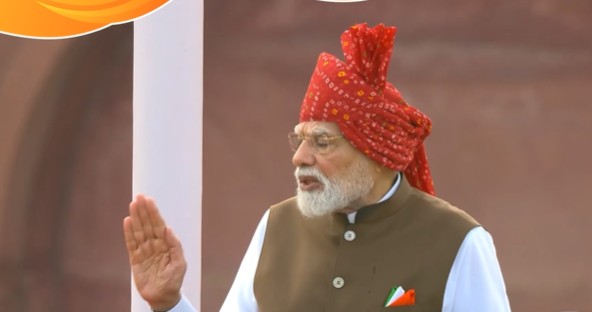
PM Modi at Red Fort on Saturday. (Image PIB)
By Prof. S.S. SOMRA
India’s economic transformation since 1947 has been remarkable, but poverty, unemployment, inequality and workplace exploitation show why growth alone cannot guarantee freedom, dignity and opportunity.
Jaipur, August 22, 2026 — India has entered its 80th year of Independence, yet it stands at a juncture where its next major test lies not merely in achieving rapid economic growth, but in transforming that growth into meaningful freedom for every citizen. A nation is truly free only when its citizens possess not just the right to choose their rulers, but also the means to shape their own futures. This is the point where politics and economics converge.
Therefore, the question is not simply how large or prosperous India has become; the real question is the extent to which this prosperity has generated freedom, security, dignity, and opportunity in the lives of ordinary Indians.
In 1947, India’s population was approximately 340 million, with the vast majority living in rural areas and facing poverty. Ordinary families understood rising prices, but they experienced inflation primarily through the increased costs of essentials like rice, wheat, clothing, or kerosene—rather than through modern terminology such as the Consumer Price Index, repo rates, GDP projections, or market capitalization.
Nearly eight decades later, India’s economic landscape has undergone a complete transformation. Today, approximately 1.45 billion Indians are part of an economy whose nominal GDP is projected to reach ₹346.36 lakh crore in 2025–26, with a growth rate of around 7%. Current GDP estimates range between $3.95 trillion and $4.2 trillion. The equity market capitalization stands at several trillion dollars.
The MSME sector contributes 31% to the GDP and accounts for 49% of exports. India trades with over 200 countries and territories, while public capital expenditure has risen from approximately ₹2 lakh crore in 2014-15 to ₹12.2 lakh crore for 2026-27. These are not merely statistics; they are figures recorded in the economic balance sheet of our Independence.
India’s transformation is the result of the hard work of several generations: the building of institutions after 1947; economic liberalization in 1991; continuous reforms thereafter; and, since 2014, rapid infrastructure development, digitalization, financial inclusion, GST, UPI, the shift towards a formal economy, and the expansion of trade agreements.
Yet, the Samudra Manthan (churning of the ocean) offers an enduring economic metaphor. The churning was undertaken to obtain Amrit (nectar of immortality), but before the nectar emerged, Halahal—a deadly poison—surfaced. India’s nectar is visible in its industry, technology, capital markets, banking, infrastructure, enterprise, and the aspirations of its people.
Why India’s Growth Story Faces a New Challenge: The Shrinking Middle Class
Its poison exists in the form of poverty, unemployment, inequality, corruption, bureaucratic hurdles, delays in justice, and unequal opportunities. Development succeeds not merely by producing nectar, but by confronting the poison.
There is another form of poverty that GDP never records—the poverty of a lack of dignity. Exploitation existed even before independence, and political freedom did not automatically eliminate it from workplaces.
Even today, workers who are economically vulnerable, inexperienced, or less informed can be coerced or suppressed through fear, insecurity, or humiliation. The resulting damage may never appear in a company’s accounts, yet it can erode people’s self-confidence, harm families, and diminish human potential.
Therefore, economic freedom must also encompass freedom from exploitation—whether it involves the exploitation of wages, the taking advantage of vulnerability, or the exploitation of the human mind.
A good employer does not merely purchase labour; they also enhance people’s capabilities. True enterprise lies in generating profit by empowering people, whereas profit earned by suppressing them eventually becomes an economic and social burden.
There is nothing wrong with wealth. Trust itself is a form of economic capital. India needs profit-making companies, successful entrepreneurs, and risk-taking investors.
Equally, workers have a duty to demonstrate honesty, discipline, skill, and productivity towards the enterprise. Capital deserves a fair return, and labor deserves fair remuneration; economic freedom entails responsibilities on both sides of the pay slip.
At the same time, political will alone cannot transform the lives of 1.45 billion people. Ministers can initiate reforms and Parliament can enact laws, but only capable institutions and an accountable bureaucracy can turn those reforms into everyday reality.
Investors seek predictable regulations, entrepreneurs need timely decisions, MSMEs require affordable credit, and citizens desire impartial institutions. No developed economy can claim absolute economic freedom coupled with total certainty; even affluent societies grapple with challenges such as inequality, rising costs, job insecurity, and unequal opportunities.
Economic freedom is not a destination reached simply by crossing a specific income threshold.
We all take pride in being Indian; our true patriotism lies in making freedom meaningful for everyone. India has achieved remarkable success, yet it continues to confront significant challenges.
Both these realities coexist under the same flag. Ultimately, economic freedom cannot be measured solely by GDP, Sensex levels, or corporate profits. This happens when education leads to opportunities, businesses gain access to capital, work brings dignity, and families can face the future without fear.
Every Indian should also possess the economic freedom to choose their own future.
World Bank Income Classification: Why India Hasn’t Moved Up Yet
(This is an opinion piece. Views expressed are the author’s own.)




About The Author