CGTMSE Under Scrutiny: Why Collateral-Free Credit Needs Stronger Accountability
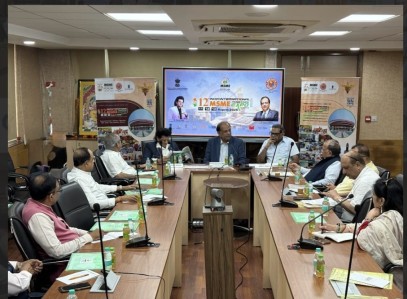
The 12th International MSME Expo & Summit begins in Delhi with 500 global buyers and business delegations from several countries. (Image organiser)
By P. SESH KUMAR
CGTMSE has expanded dramatically since the 2020 CAG audit, but questions remain over risk management, collateral-free lending, transparency and whether guaranteed credit is actually creating viable enterprises and jobs.
New Delhi, August 24, 2026 — The Comptroller and Auditor General’s (CAG) 2020 audit of the Credit Guarantee Fund Trust for Micro and Small Enterprises (CGTMSE) exposed a fundamental disconnect: a scheme designed to unlock collateral-free credit for micro and small enterprises had expanded without a commensurate risk architecture, reliable borrower-level verification, or a clear framework for measuring outcomes. Subsequent reforms by the Ministry of MSME and CGTMSE have undoubtedly widened the scheme’s reach, lowered some access barriers, digitised processes and increased coverage ceilings. Yet the latest parliamentary scrutiny makes clear that scale is not the same as effectiveness: CGTMSE still needs transparent, outcome-based monitoring, firm enforcement of collateral-free lending norms, granular public data, and an independent evaluation of whether guaranteed loans actually create viable enterprises, employment and durable growth.
The audit’s central charge
The CAG’s Report No. 10 of 2020 examined CGTMSE principally over 2015–16 to 2018–19 and found a scheme whose public purpose was strong but whose governance machinery had not caught up with its expanding balance-sheet exposure. Created jointly by the Ministry of MSME and SIDBI in July 2000, CGTMSE was meant to substitute institutional credit assurance for collateral and third-party guarantees, thereby making bank finance available to new and existing micro and small enterprises that conventional lending often excludes.
The audit’s criticism was not that credit guarantees were undesirable; it was that the Trust had been operating a sophisticated contingent-liability business without some of the elemental disciplines expected of one. The CAG recorded the absence of norms on minimum liquidity relative to guarantees approved or issued, capital adequacy, solvency, exposure limits for different classes of member lending institutions, and applicable accounting standards. It also found no rationally fixed leverage benchmark for the corpus fund, a shortcoming that weakened confidence in the guarantee instrument and could discourage lenders from extending larger front-end support to the MSE sector.
This was the audit’s sharpest insight: the Trust was not merely administering a subsidy-like programme. It was pricing, pooling and assuming credit risk. In that setting, corpus adequacy, concentration limits, risk pricing, claims experience, recoveries, liquidity stress and lender conduct are not back-office technicalities; they are the scheme’s operating constitution. The absence of a coherent prudential framework created the risk that CGTMSE might look successful through approvals while carrying opaque fiscal and credit vulnerabilities underneath.
A guarantee without verification?
CAG also identified a strikingly weak assurance architecture at the point of guarantee approval. The prevailing approval process essentially confirmed that member lending institutions (MLI) had entered the mandatory borrower particulars; it did not provide an adequate basis to verify the accuracy of those particulars. Audit therefore pressed for a more reliable system capable of testing information supplied by lenders, especially because the quality of initial appraisal and loan monitoring directly shapes claims, recoveries and ultimate losses borne by the Trust.
The problem was compounded by misalignment between the Ministry and the Trust. The CAG noted that CGTMSE had not implemented the Ministry’s January 2017 direction that loans up to Rs 10 lakh, which were eligible under the Credit Guarantee Fund for Micro Units (CGFMU) operated through National Credit Guarantee Trustee Company Limited (NCGTC), should not continue to receive CGTMSE cover. The implication was not merely administrative overlap; it was the danger of fragmented public guarantee design, blurred scheme boundaries and an inefficient deployment of public risk capital.
Audit further noted that the Trust had not designed an appropriately calibrated leverage benchmark, even though such a benchmark is essential to balance outreach against the corpus buffer. In plain terms, a guarantee fund cannot indefinitely increase its promises without a transparent view of how much loss-absorbing capital, liquidity and risk diversification stand behind those promises.
MSME SRI Fund Under Scrutiny: Why ₹18,773 Crore in Investments Still Lacks Proof of Success
What changed afterward
The post-audit trajectory shows real movement. The scheme document updated as of 1 January 2025 recognises a much broader operational framework, including coverage for banks, cooperative institutions, small finance banks, regional rural banks and specified microfinance institutions. It also creates a hybrid or partial-collateral product, under which the unsecured portion of a facility may receive CGTMSE cover even where lenders hold collateral for another part of the exposure.
The scheme’s credit ceiling has progressively risen. The 2025 scheme document sets the standard maximum credit facility eligible for cover at Rs 5 crore for public-sector banks, private-sector banks, foreign banks and select financial institutions, subject to lower institution-specific limits for certain other lender categories. The Ministry’s 2025–26 Annual Report, however, records a further enhancement of the overall per-borrower guarantee-coverage ceiling to Rs 10 crore with effect from 1 April 2025, indicating that the scheme has moved decisively from a micro-ticket guarantee facility toward a broader MSE credit-risk platform.
The 2023 revamp, supported by a Rs 9,000 crore corpus infusion announced in the Union Budget, increased the earlier ceiling from Rs 2 crore to Rs 5 crore, reduced the annual guarantee fee and raised the threshold for loans qualifying for more favourable treatment from Rs 5 lakh to Rs 10 lakh. These changes were intended to make guaranteed credit cheaper and more attractive to both borrowers and lending institutions.
The scheme has also become more inclusion-sensitive. For guarantees issued from 10 December 2024, the published terms provide 90 percent guarantee coverage for women entrepreneurs and MSEs promoted by Agniveers, 85 percent for SC/ST entrepreneurs, persons with disabilities, enterprises in aspirational districts and ZED-certified MSEs, and an additional 5 percent in RBI-identified credit-deficient districts. The framework also provides fee concessions for several underserved social, geographic and enterprise categories.
There have been practical improvements in the claims and recovery process as well. The threshold for waiver of legal action before invocation was increased in stages and reached Rs 10 lakh for claims lodged from 1 April 2023. CGTMSE’s current terms also provide for online claim lodgement, electronic declarations and undertakings, recovery remittances through the portal, and a stated requirement that an eligible first claim be paid within 30 days, subject to completeness and other conditions.
A more important, though quieter, reform is risk differentiation. The revised annual guarantee fee framework uses external portfolio analysis to categorise member lending institutions (MLI) by factors such as NPA rate, claim rate, quick-mortality ratio and net flows. Better-performing institutions may receive a discount, while riskier ones can face a premium of up to 70 percent of the standard rate. That is a notable departure from a flat-fee mentality and is broadly responsive to the CAG’s concern that the Trust needed a more mature risk-management orientation.
The scale story–and its limits
By the Ministry’s account, CGTMSE had approved more than 1.18 crore credit guarantees aggregating Rs 9.80 lakh crore since inception, including Rs 3 lakh crore in FY 2024–25 alone. It also reported that, as of 31 December 2024, more than one crore enterprises had benefited and 1.01 crore proposals amounting to Rs 8.07 lakh crore had been approved.
These are formidable reach metrics, but they do not by themselves establish developmental effectiveness. A guarantee approval is an input; an enterprise that survives, creates jobs, grows turnover, repays responsibly and graduates into ordinary commercial credit is an outcome. The distinction matters because public credit guarantees can inadvertently become a volume race if reporting remains dominated by proposal counts and sanctioned amounts rather than loan additionality, borrower survival, credit quality, recovery performance and regional or social inclusion. The Parliamentary Standing Committee has explicitly urged a shift to impact-based monitoring that tracks enterprise survival, employment, turnover growth and NPA trends, rather than approvals and disbursements alone.
Parliament’s latest warning
The Department-related Parliamentary Standing Committee on Industry has delivered the clearest recent diagnosis of CGTMSE’s remaining weaknesses. It has recommended strict enforcement of collateral-free lending norms, written justification whenever a lender departs from those norms and deterrent penalties for repeated breaches. The recommendation goes to the heart of the scheme: if lenders continue to seek collateral in practice, the guarantee becomes a public backstop without delivering its defining access benefit to entrepreneurs who lack asset security.
The Committee has also recommended a comprehensive public dashboard showing scheme-wise applications, sanctions, rejections and employment outcomes. This is more than a transparency proposal. It is an institutional answer to the CAG’s old concern about unverifiable information and weak governance: public, disaggregated data would permit Parliament, researchers, state agencies, lenders and entrepreneurs to test whether the scheme is reaching credit-starved districts, first-generation businesses, women, SC/ST entrepreneurs and genuinely collateral-constrained firms.
The Committee’s larger message is that CGTMSE must become an evidence-led guarantee institution rather than remain principally a high-volume credit facilitation vehicle. The next phase should therefore measure lender additionality, rejection patterns, collateral demands, time to sanction, claim settlement times, lender-wise default and recovery performance, borrower-level repeat access, enterprise survival after three and five years, and the concentration of guarantees across geography, lender type, sector and borrower category. The Ministry’s own RAMP programme documentation similarly identifies “enhancing effectiveness of CGTMSE and guarantee-guarantee delivery” as an intervention area, confirming that the institutional agenda has shifted toward quality and effectiveness rather than mere expansion.
MSME Payment Crisis: What the MSMED Amendment Act 2026 Actually Changes
Was there an independent holistic assessment?
The available official material does not establish that the Ministry or CGTMSE commissioned and published a genuinely independent, holistic impact evaluation of the scheme during the last five years. There is evidence of external analytical work, but it falls materially short of a full-scale independent assessment of scheme design, lender behaviour, borrower outcomes, economic additionality, fiscal risk, recovery performance and social inclusion.
The 2025 scheme document states that CGTMSE engaged an external agency to analyse its portfolio and categorise member lending institutions (MLI) based on NPA rate, claim rate, quick-mortality ratio and net flows, with the results feeding into risk premiums or fee discounts. This is a portfolio-risk and lender-classification exercise, not a holistic third-party impact evaluation of the scheme’s developmental performance. Its stated output is risk-based pricing of MLIs, not a public finding on whether CGTMSE-generated credit has improved enterprise survival, employment, productivity, formalisation or access for financially excluded MSEs.
Accordingly, the answer must be qualified but firm: an external, limited risk-analysis exercise was undertaken, but no publicly evidenced independent third-party holistic assessment–with published methodology, counterfactual or additionality analysis, borrower-outcome findings and implementation recommendations–appears to have been completed in the last five years from the official sources reviewed. That gap is precisely why the Standing Committee’s insistence on public outcome data and impact-based monitoring is consequential rather than cosmetic.
After a quarter-century of operation, the persistence of these questions is a sobering indictment of the scheme’s governance architecture. CGTMSE has undeniably achieved extraordinary numerical scale–having completed 25 years and expanded collateral-free guarantee support to ever-larger volumes of MSE credit–but its public accountability framework has not kept pace with that expansion.
The CAG had already found in 2020 that neither the Government nor the Trust had prescribed basic norms for liquidity, capital adequacy, solvency, exposure concentration, disclosures and accounting, or rationally determined the leverage of the corpus; it also found that the guarantee-approval process did not adequately test the correctness of borrower information furnished by member lending institutions.
Subsequent reforms have introduced welcome operational sophistication, including lender-specific risk premiums based on portfolio indicators such as NPA rates, claims, quick-mortality ratios and net flows, but this is not the same as demonstrating that public guarantee capital has generated additional credit, prevented collateral demands in practice, improved enterprise survival, created employment or produced sustainable borrower growth.
The latest Parliamentary Standing Committee’s call for binding collateral-free lending norms, written reasons for departures, penalties for repeated violations, a public dashboard covering applications, sanctions, rejections and employment outcomes, and monitoring based on enterprise survival, turnover, jobs and NPA trends is therefore a candid acknowledgement that the scheme has long reported its activity more convincingly than its impact.
The real institutional failure is not that CGTMSE has grown; it is that, despite its maturity, the State has yet to build and publicly disclose the independently verifiable evidence needed to show whether the Trust is underwriting transformative MSE finance or merely enlarging a guarantee ledger.
The unfinished reform
CGTMSE has travelled far from the scheme audited in 2020. It now has higher coverage limits, risk-sensitive pricing, a wider lender universe, targeted inclusion incentives, hybrid-security options, digitised payment and claims processes, and an enlarged corpus. Those changes show a scheme trying to behave more like a modern credit-guarantee institution.
But the deepest CAG question still survives: who verifies the verifier, and how does the Trust know that its guarantee capital is buying genuinely additional, collateral-free and economically productive credit? The reform programme is incomplete until the Ministry fixes explicit liquidity, capital, solvency, leverage, concentration and accounting standards; publishes lender- and borrower-level outcome indicators in an accessible dashboard; enforces the collateral-free mandate; and commissions a rigorous independent evaluation whose findings are made public. Until then, CGTMSE’s impressive expansion remains a powerful promise whose proof lies not in the value of guarantees issued, but in the quality of enterprises that endure because of them.
(This is an opinion piece. Views expressed are the author’s own.)
MSMED Amendment 2026: Parliament’s New Rules Face a Major Enforcement Gap
Follow The Raisina Hills on WhatsApp, Instagram, YouTube, Facebook, and LinkedIn




About The Author