MSMED Amendment 2026: Parliament’s New Rules Face a Major Enforcement Gap
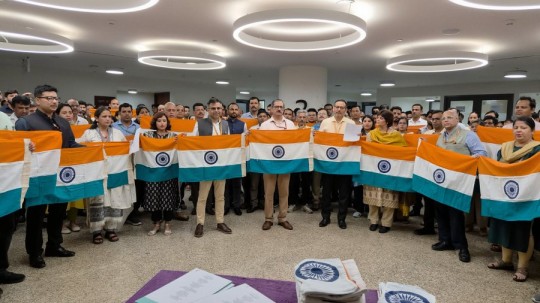
MSME officials with Indian flags. (Image Ministry on X)
By P. SESH KUMAR
The 2026 MSMED amendment introduces new obligations and timelines, but penalties, State-level capacity and accountability remain the critical weak points.
New Delhi, August 16, 2026 — The MSMED (Amendment) Act, 2026, is a competent and coherent piece of legislation. It introduces useful reforms: mandatory TReDS routing for Central Public Sector Enterprises, timelines for mediation and arbitration, a 50 per cent release mechanism where an award has remained under challenge for more than six months, recovery of awards as arrears of land revenue and graded civil penalties.
But that is not the same as solving the MSME delayed-payment crisis.
The right question is not whether the amendment is better than no amendment. The right question is whether it can deliver what its own Statement of Objects and Reasons claims.
Four holes open up — three avoidable by better drafting and one structural.
Where the Drafting Runs Out
The first hole is the most striking.
The Act now creates two brand-new statutory obligations — routing invoices through TReDS under Section 15A and disclosing those invoices under Section 22A — and attaches no penalty to either.
The substituted Section 27 is titled, and operates as, a penalty for contravention of Section 8, Section 22 or Section 26.
Section 15A is not mentioned. Section 22A is not mentioned. The central liquidity reform of the 2026 amendment is a duty without a consequence.
A CPSE that simply declines to onboard TReDS, or onboards and routes nothing, commits no penalised contravention under the Act it is violating. It may face departmental displeasure, a Department of Public Enterprises MoU mark, a CAG paragraph — but the statute itself is silent.
In a Bill whose stated purpose was to strengthen enforcement, that is not an oversight one can read past.
The second hole is that the new timelines carry no sanction and no automatic consequence.
Ninety days for mediation, 30 for reference, 90 for the award — admirable numbers, and every one of them a repetition of a mistake the Act already made.
The pre-amendment Section 18(5) already required the Council to dispose of a reference within 90 days.
It was ignored at scale; the arithmetic of 4.07 per cent disposal is the proof.
Compare Section 29A of the Arbitration and Conciliation Act, 1996, where breach of the time limit terminates the arbitrator’s mandate unless a court extends it — a consequence that bites.
Here, nothing happens.
MSME SRI Fund Under Scrutiny: Why ₹18,773 Crore in Investments Still Lacks Proof of Success
A Council that misses 90 days simply continues.
Legislating a deadline into a body that has already demonstrated it will not meet the identical deadline is not reform; it is exhortation in statutory drafting.
The third hole is quantitative and slightly comic.
A large buyer sitting on crores of MSME dues, who fails to make the Section 22 disclosure in its annual accounts, faces a warning, then up to Rs 50,000, then up to Rs 1,00,000.
The minimum escalates by 10 per cent every three years — which, for the Rs 10,000 floor, means an additional Rs 1,000 in 2029.
Set that against Section 16’s compound interest at three times the bank rate, which the parent Act already provides and which the amendment leaves entirely untouched.
The deterrent in this statute was never the penalty; it was the interest. The amendment polishes the ornament and ignores the weapon.
There is also, buried in the same clause, a drafting incoherence that will cause litigation. Section 27(2)(c) — the third-contravention rung of a ladder created expressly to decriminalise — says the buyer shall be “punishable with fine.”
Fine is the vocabulary of criminal sentencing by a court; penalty is the vocabulary of adjudication by an officer. Yet Section 27A directs the Development Commissioner to adjudge “the penalties under section 27.”
Either the third rung has been left criminal by accident, in which case the decriminalisation is incomplete, or the word is a slip, in which case an adjudicating officer will one day be told he had no jurisdiction to impose it.
This is precisely the kind of defect a fortnight in a Standing Committee would have caught. The fourth problem is capacity, and it is not fixable by drafting.
One Development Commissioner is now the adjudicating officer for the entire country — for a register of enterprises the Ministry itself puts at 9.16 crore, and for every buyer who fails a disclosure duty.
The appeal from his order lies not to a tribunal, not to a judicial member, but to the Secretary of his own Ministry.
That is an internal departmental review dressed as an appellate remedy, and it will be tested under Article 226 the first time a serious penalty is imposed on a large corporate.
Nothing in the Financial Memorandum contemplates a rupee of expenditure to make any of this work; the Bill declares no recurring or non-recurring charge on the Consolidated Fund at all.
Finally, let us note what Section 18A(2) actually delivers.
Declaring an award a debt “liable to be recognised” under the IBC sounds formidable.
But the minimum default threshold for an operational creditor to move the NCLT has stood at Rs 1 crore since March 2020, and the IBBI’s own 2026 study records that an operational creditor applicant must additionally find roughly Rs 5 lakh in upfront insolvency-resolution costs.
The average Samadhaan claim, on the Ministry’s own numbers, is around Rs 21.5 lakh.
For the overwhelming majority of micro suppliers, the IBC door the amendment gestures towards is locked, and the key is held by the Ministry of Corporate Affairs.
The Federal Fault Line
Now to the question that matters most, and which the amendment answers by pointedly not answering. Who actually decides an MSME delayed-payment dispute in India?
A Micro and Small Enterprises Facilitation Council. Who establishes it? The State Government. Who appoints its chairperson and members? The State Government.
Who prescribes its composition, the filling of vacancies, its meeting intervals and its procedure? The State Government, under the amended Section 30.
Who provides its premises, its case-management software, its stenographers and its trained manpower? The State Government — and here the drafting is devastatingly candid.
The substituted Section 20(3) says the State Government may provide adequate infrastructure and resources.
Not shall. May.
The entire delivery apparatus of the delayed-payments regime rests on an entity the Union does not command, staffed by officers the Union does not appoint, funded from a budget the Union does not vote, under a duty the Union has written as permissive.
The pattern repeats.
Section 15A(1) commands CPSEs.
Section 15A(3) says the State Government may, by notification, bring State Public Sector Enterprises (SPSEs) and other State bodies into the TReDS discipline.
The Ministry’s own communication describes this as an enabling mechanism for States to nudge their PSEs — the verb is nudge.
Yet Business Standard’s reading of the Samadhaan data identifies State governments as the second-largest category of defaulter, behind private buyers and ahead of central public sector undertakings, with Maharashtra and Delhi alone accounting for more than a third of all dues.
The amendment makes mandatory what was already mostly compliant and makes optional what is most delinquent.
Section 22A carries the same asymmetry: disclosure by State PSEs happens in a form the State prescribes, so even the reporting format is beyond Union reach.
And then Section 18A hands recovery to the District Collector.
The Collector is a State officer with famine relief, land records, elections, law and order and a hundred statutory recovery certificates already queued.
No timeline binds him.
No penalty touches him.
No Union authority may direct him under this Act.
Is any of this constitutionally necessary?
Largely, yes — and it is important to be fair about that.
Industries is Entry 24 of the State List, subject to Entries 7 and 52 of the Union List, and the MSMED Act’s reach over manufacturing rests on the declaration under the Industries (Development and Regulation) Act, 1951, which is why Section 7 opens with a non-obstante clause referring to Section 11B of that Act.
Trade and commerce within a State is Entry 26 of List II.
A Parliament that tried to command State Governments to fund and staff quasi-judicial bodies of their own creation would be picking a fight it might not win and certainly does not need.
But “cannot compel” is not the same as “has no lever.”
This is where the Union Ministry’s self-restraint deserves scrutiny rather than sympathy.
Article 256 obliges every State to exercise its executive power so as to ensure compliance with laws made by Parliament, and empowers the Union to give directions to a State to that end.
Article 257 extends the power to directions that do not prejudice the Union’s executive power.
Article 258(1) permits the Union to entrust functions to a State with its consent, and Article 258(3) requires the Union to meet the extra costs so imposed — a clean constitutional route to funding MSEFC infrastructure that nobody has used.
Beyond the Constitution, the Ministry runs RAMP, a World Bank-supported programme designed precisely to build State-level MSME capacity, and could make performance-linked disbursement conditional on Council staffing, meeting frequency and disposal rates.
The Department of Public Enterprises already scores CPSEs on MoU parameters.
GeM already carries transaction-level procurement data.
The Registrars of Companies were, under the 2018 and 2024 TReDS notifications, expressly made the monitoring authority for corporate onboarding.
The Ministry of MSME, in other words, is not powerless.
It has notification power, rule-making power, conditional-grant power, MoU power, portal power and constitutional direction power.
What it does not have — and what the amendment conspicuously declines to create — is a statutory duty on itself to use any of them, or a duty to report to Parliament on whether it has.
There is no provision requiring publication of State-wise MSEFC performance, no norm linking Council numbers to caseload, no annual compliance statement, no sunset review.
The Union has legislated obligations for CPSEs and possibilities for States, and has written no accountability for itself at all.
India’s MSME Crisis Is Not About Policy—It’s About Governance
Would Simple Amendments Have Been Enough?
The honest answer is that these amendments were necessary and are not sufficient, and that the insufficiency is of a particular kind: it is not that the drafters aimed low, but that they aimed at the statute when the failure was in the institution.
Let us consider the counterfactual that ought to trouble anyone who admires this Bill.
Between 2022 and 2024, delayed payments to MSMEs fell by roughly 30 per cent, from Rs 10.7 lakh crore to Rs 7.34 lakh crore.
Over broadly the same period, TReDS discounting grew nearly ninefold.
What caused that?
Two things, neither of which was an amendment to the MSMED Act.
The first was Section 43B(h) of the Income-tax Act, 1961, which from assessment year 2024-25 disallowed a buyer’s deduction for sums payable to micro and small enterprises until actually paid — a tax consequence, immediate, self-executing, requiring no complaint from a frightened supplier and no hearing before any Council.
The second was the Reserve Bank’s TReDS architecture, scaled by successive MSME Ministry notifications lowering the onboarding threshold from Rs 500 crore of turnover to Rs 250 crore.
The lesson is not subtle.
What worked was a fiscal disincentive administered by an agency with an existing enforcement machine, and a market platform regulated by an institution with existing supervisory teeth.
What did not work was a dispute-resolution remedy requiring a small supplier to sue the customer on whom his next order depends, before a Council that meets when it meets.
The 2026 amendment invests almost all of its energy in improving the second and almost none in expanding the first.
A sufficient reform would have looked different in four respects.
It would have made the delayed-payment remedy automatic rather than complaint-driven — GSTN already knows the invoice date, Udyam already knows the supplier’s status, and the Standing Committee has already recommended integrating GeM for automatic flagging of delayed payments.
Can we not flag the breach, let the interest accrue by system, and put the burden on the buyer to contest, rather than on the micro enterprise to complain?
It would have made the penalty proportionate to the sum withheld rather than a flat five-figure ceiling.
It would have created, and funded, an MSEFC capacity mission with Article 258(3) money and published State-wise scorecards.
And it would have covered the buyers who actually default — private companies above a turnover threshold and SPSEs — rather than only the CPSEs who were already the most compliant cohort.
Two further gaps deserve naming.
The delayed-payment protections in Chapter V remain available only to a “supplier” that is a micro or small enterprise; medium enterprises, now scaled up to Rs 125 crore of investment and Rs 500 crore of turnover, are protected by the TReDS routing in Section 15A but not by the interest and Council regime.
And the Standing Committee’s repeated demand for a distinct Nano category — noting that 7.56 crore of 7.61 crore Udyam registrants, 99.3 per cent, sit undifferentiated in the micro bucket alongside a factory with Rs 2.5 crore of plant, and that Kerala has already shown it can be done — has once again gone unaddressed in the very Bill that reopened Section 7.
A word, too, about the amendment’s cleverest device, which is also its most double-edged.
Routing an invoice through TReDS is not the same as paying it within 45 days.
TReDS gives the supplier early liquidity, but at a discount, and who bears that discount depends on whether the transaction is factoring or reverse factoring.
Where the supplier bears it, the MSME is financing the buyer’s delay and paying for the privilege, while the statutory entitlement to three-times-bank-rate compound interest quietly evaporates because the invoice was, formally, settled.
A liquidity instrument has been placed where a payment discipline should be.
That may be a reasonable trade — cash today at a haircut beats an award in four years — but it should be recognised as a trade, and the rules to be framed under Section 29 should ensure that CPSE routing is on reverse-factoring terms with the buyer bearing the cost.
That is a rule-making choice, and it is still open.
The Celebration Problem
There is a distinctive vice in our governance that this episode illustrates with unusual clarity, and it deserves to be named plainly, because the alternative is to keep mistaking activity for achievement.
We treat the passage of a law as the completion of a policy.
The press release announcing the amendment’s passage is a document of pure legislative triumph — twenty years, 9.16 crore Udyam registrations, 40 crore jobs, Viksit Bharat @2047, champions of growth.
It contains no baseline against which the amendment’s success might later be measured, no target date by which the 4.07 per cent disposal rate should reach some better number, no undertaking to report back.
The Financial Memorandum, with a straight face, certifies that none of this will cost anything.
And there is a data problem sitting in plain view.
The passage release puts Udyam registrations at 9.16 crore.
The Standing Committee, reporting in March 2026 on the same Ministry, recorded 7.61 crore on the Udyam portal as of January 31, 2026, and 7.69 crore including the Udyam Assist Platform.
A jump of roughly one and a half crore enterprises in six months is either a formalisation miracle or an artefact of aggregating two registers differently in two documents.
Nobody in Parliament had the opportunity to ask, because there was no committee to ask it in.
That is the deeper cost of a ten-day passage through a disrupted House.
The Bill was moved, debated against a wall of slogans about an entirely unrelated grievance, and carried by voice vote in both chambers.
Not one of the four drafting defects identified above — the unpenalised Sections 15A and 22A, the consequence-free timelines, the criminal “fine” inside a decriminalisation clause, the single national adjudicator with a departmental appeal — would have survived a fortnight of clause-by-clause scrutiny by a committee that had already, five months earlier and under an Opposition chairman, produced the most rigorous public document on precisely this subject.
The Standing Committee’s own recommendation had been explicit: mandatory buyer compliance, GeM integration for automatic flagging, and time-bound resolution mandates backed by penal provisions under the MSMED Act.
The Bill delivered the mandate for one class of buyer, skipped the automatic flagging, prescribed the timelines, and omitted the penal backing.
Three-quarters of a recommendation, executed in the quarter that required no money.
Lessons
Five, and they generalise well beyond MSMEs.
The instrument that works is the one that runs without the victim’s participation.
Section 43B(h) never required a supplier to file anything.
Its effectiveness is a standing rebuke to every remedial architecture built on the assumption that the weaker party will litigate against the stronger one on whom his livelihood depends.
Commercial dependence, not legal ignorance, is why two and a half lakh applications represent a fraction of eight lakh crore rupees of unpaid dues.
Enforcement authority must be co-located with the obligation.
Parliament placed the duty on CPSEs and the enforcement on a Ministry that does not own them; placed the adjudication on Councils it does not fund; placed recovery on Collectors it cannot direct.
Every one of those seams is where the reform will leak.
Quasi-federalism is a design constraint, not an excuse.
The Constitution supplies Articles 256, 257 and 258 precisely for the situation where the Union must legislate and the States must deliver.
A Union Ministry that declines to use conditional finance, entrusted functions with reimbursed cost, and published performance comparison, and then pleads federal delicacy, has chosen its constraint rather than inherited it.
Timelines without termination are decoration.
The 2006 Act’s 90-day rule was broken at scale for two decades; the 2026 Act adds three more 90- and 30-day rules to the same body with the same absence of consequence.
If a deadline does not transfer a right, forfeit a mandate or trigger a payment, it is a wish.
And a law with no measurement clause cannot fail, which is why it also cannot succeed.
Nothing in this amendment requires anyone to publish how many Councils exist, how many members they have, how often they met, how long disposal took, how much was awarded, and how much was actually recovered.
The absence of that clause is the most eloquent thing in the Bill.
Way Forward
The rules under Sections 29 and 30 are yet to be framed, the commencement notifications are yet to issue, and different provisions may be brought into force on different dates.
A great deal can still be recovered at the rule-making stage, and the following is where a serious Ministry would spend the next six months.
It must begin by using Section 15A(2) immediately and expansively.
The Central Government’s power to notify entities other than CPSEs is the widest lever in the amendment; it should be used to bring in central autonomous bodies, statutory corporations, port and airport authorities and — through the same route the 2024 notification used — private companies above a turnover threshold, with the Registrars of Companies retained as the monitoring authority.
Then prescribe, in the Section 29 rules, that CPSE routing shall be on reverse-factoring terms, so that the discount is a buyer’s cost and not a supplier’s haircut, and that the Section 22A disclosure shall be invoice-level, machine-readable and published rather than merely filed.
Second, let us close the penalty gap.
The absence of a sanction for Section 15A and Section 22A breach cannot be cured by rules; it needs a corrigendum amendment, and the Ministry should say so honestly rather than discover it in three years.
In the interim, the DPE MoU framework and the CPSE procurement policy can supply administrative consequence, and the Ministry should publish, quarterly, a named list of CPSEs with unrouted MSME invoices.
Third, let us fund the Councils through Article 258(3) and RAMP, not through appeals to State goodwill.
Fix a caseload norm — one Council bench per some defined number of pending references — publish State-wise compliance against it, and make the next tranche of RAMP performance grants contingent on it.
A Council that has not met in a quarter should appear, by name, in a public dashboard.
Fourth, we should automate the trigger.
GSTN holds the invoice date; Udyam holds the supplier’s status; GeM holds the public procurement transaction; TReDS holds the settlement.
The Standing Committee has already asked for GeM integration and automatic flagging.
Let us build the interoperability layer, with proper privacy and cyber safeguards, so that a 45-day breach is detected by the system and notified to both parties without anyone having to complain.
Then, and only then, does the ODR portal have a pipeline worth its Rs 189 crore.
Fifth, legislate a reporting duty on the Union itself.
An annual statement to Parliament on delayed payments — Council-wise disposal, average time, amounts awarded, amounts actually recovered, CPSE and State PSE routing compliance — costs nothing and would do more for accountability than the entire penalty chapter.
Let us pair it with a statutory review of the amendment’s operation after three years.
Sixth, Ministry of MSME should take up the two structural questions the Bill dodged.
Ask the Ministry of Corporate Affairs to consider a differentiated IBC default threshold for micro and small operational creditors, or the Section 18A declaration remains ornamental.
And create the Nano category the Standing Committee has now demanded twice, because a policy in which 99.3 per cent of the beneficiaries fall into a single class is not a classification at all.
A Closing Thought
The MSMED (Amendment) Act, 2026, is a good law by the standards of Indian legislative drafting and a modest one by the standards of the problem it addresses.
It will help.
Suppliers whose awards are under challenge will get half their money in six months instead of none in six years. CPSE invoices will move faster. Councils will be easier to create.
None of that is nothing.
But the phrase the drafters chose for the first rung of their new penalty ladder — warned at the first instance of non-compliance — reads, on reflection, less like a provision than like a description of the Act itself.
Parliament has issued a warning.
To CPSEs that will mostly comply anyway, to buyers whose worst exposure is a lakh of rupees, to States that may or may not fund the Councils on which everything depends.
Whether anything follows the warning depends entirely on the rules yet to be written, the notifications yet to issue, the money yet to be found, and the political appetite to publish, State by State and enterprise by enterprise, who is actually paying and who is not.
Eight lakh crore rupees are still sitting in someone else’s bank account.
Seventeen cases were resolved in eight months.
Those two numbers were true before August 7, 2026, and nothing in the Act that passed that day changes either of them by itself.
The celebration, if there is to be one, belongs at the far end of this process, not at the beginning.
We have a habit of holding it early, and then wondering, three annual reports later, where the reform went.
MSME Payment Crisis: What the MSMED Amendment Act 2026 Actually Changes
(This is second of the two-part series. The first part is above in the link. This is an opinion piece. Views expressed are the author’s own.)
Follow The Raisina Hills on WhatsApp, Instagram, YouTube, Facebook, and LinkedIn




About The Author