Patriotism vs Nationalism — When Love of Country Becomes Political Obsession
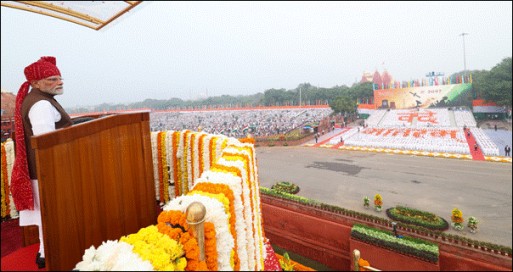
Prime Minister Narendra Modi spoke of seven steps to Viksit Bharat by 2047 in Independence Day speech. (Image PIB)
By RAVI SHANKER KAPOOR
Patriotism is rooted in attachment to the real and familiar, while nationalism can transform that attachment into a political doctrine built around collective pride, myths and claims of superiority.
New Delhi, August 16, 2026 — As India celebrated Independence Day, I will discuss two terms, patriotism and nationalism, which are used interchangeably. But they are very different.
Patriotism is about country; it is my love of the people, locale, ambience, social and cultural practices, etc., around me. It is human to develop some kind of attraction, moh, with whatever surrounds us—neighborhood, neighbors, streets, parks, markets. I feel sad when I come to know about the death of someone in the neighborhood I never interacted with. It is about my country—the country I live in, see, feel, talk about. It is spontaneous, natural, often unarticulated. Patriotism is fuzzy love for the things that are real.
But this is not blind love; when I find drains choked, streets dirty, and parks littered, I take a critical view of municipal amenities and civic sense.
Nationalism, on the other hand, is contrived, oriented around a narrative which often includes folklore and fables. The characteristic feature of the narrative is collectivist pride—civilizational superiority (Hindutva and Chinese), racial pride (Nazis), faith (Pakistan). It is more about the superiority of whatever is seen as ‘nation,’ which needs to be defined, explained, justified. Needless to say, all definitions, explanations, and justifications are customized as per the requirements of the specific nationalists.
Nation is a community, which is both real and imagined, involving political institutions, territory, language, citizenship, foundational beliefs, myths and fables, and shared history, ideas, ideals, and values. And nationalism is about the nation. Nationalism often evolves into a dangerous obsession with the things that are unreal.
And it is a very strong obsession, often blinding people to reality and morality. With deplorable consequences. Hence the Nanjing Massacre and the Auschwitz camp.
Patriotism begins with natural attachment to the real, concrete, to one’s country; nationalism transmogrifies this attachment into a political doctrine about the nation.
Another critical difference between the two is that while a patriot can be critical of his own country, a nationalist can never be so. The nationalist’s motto is: ‘My country, right or wrong,’ or worse, ‘My country, always right.’ He may use the term ‘country’ instead of ‘nation,’ but the purport remains the same.
In essence, there are five differences between the two. First, as I mentioned earlier, while patriotism is a fuzzy love of the things that are real, nationalism usually becomes a dangerous obsession with the unreal things. Second, patriotism can be self-critical, but nationalism is unlikely to be. Third, patriotism willingly admits to the shortcomings of the country; nationalism, on the other hand, suffers from a superiority complex and admits to few, if any, flaws in the nation.
Fourth, patriotism is grounded, as it is about the real world. It can be banal, as in the century before the 1920s. Patriotism is hard work, as it exists in the real world. It was because of the great socio-religious reformers of the 19th century that there is progress, education, and development in India. But nationalism, with fables at its core, is grandiose. It is rhetorical, loud, argumentative—and ever-changing. When the Congress was in power, Indian nationalism was about anti-colonial pride and struggle, secularism, pluralism, socialism, constitutionalism, Gandhian ideas, linguistic/regional accommodation, syncretic culture (Ganga-Yamuna sanskriti in Hindi), and Muslim appeasement (along with the attendant accoutrements).
Now, under Narendra Modi’s aggressive Hindutva, Indian nationalism is Hindu-centric, anti-Muslim, obscurantist, illiberal, etc.
And, finally, patriotism is tempered with free speech, whereas nationalism is a wild Leviathan with all the concomitant abominations. The century, between the 1820s and the 1920s, was not burdened with the blasphemy law; this was the reason that patriotism flourished, resulting in the astounding success of socio-religious reformers. They were successful because they could say anything about faith without the fear of prosecution. For example, Swamy Dayanand Saraswati could write, “Idolatry is evil (adharma).” Had he written what he wrote today, he would have been thrown behind bars—or maybe even lynched.
It is important to note that patriotism didn’t degenerate into nationalism in the English-speaking world as it did in other Western countries like Germany and Italy. There were—and are—racists, white supremacists, etc., in Anglo-Saxon countries, but their virulence never became epidemic. This is primarily because free speech has been a cherished value in these countries, though it is strained because of the shenanigans of the woke mob; that’s another story.
(This is an opinion piece. Views expressed are the author’s own.)
From Partition to Gen Z: What Kind of India Will We Have in 2047?
Follow The Raisina Hills on WhatsApp, Instagram, YouTube, Facebook, and LinkedIn




About The Author