Iran Speaker Ghalibaf’s “Companions” Post: America’s Mirror
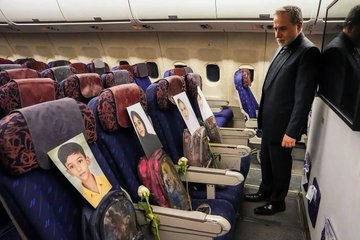
Iran's Parliament Speaker Ghalibaf arrived in Islamabad carrying the faces of 168 dead children in his social media post.
When Iranian Parliament Speaker Mohammad Bagher Ghalibaf posted photos of child victims from a US airstrike on a primary school, captioning them “My companions on this flight,” the world paused. But will America?
By NIRENDRA DEV
New Delhi, April 11, 2026 —The image was stark: a senior Iranian official boarding a diplomatic flight to Islamabad, carrying not files or briefcases in his thoughts — but the faces of 168 dead children. Ghalibaf posted the photographs on X, referring to victims of a US missile strike on the Shajareh Tayyebeh School in Minab, carried out around February 28, at the outbreak of the West Asia conflict.
The attack involved two missile strikes in rapid succession. Most of the 168 killed were girls. A Reuters investigation subsequently found that the school had a years-long online presence — dozens of photographs documenting children and their daily activities — raising serious questions about how the American military vets and approves strike locations before executing them.
Islamabad Talks, Diplomatic Optics
Ghalibaf arrived in Pakistan alongside Foreign Minister Seyed Abbas Araghchi for talks in Islamabad. The Iranian delegation was received by Deputy Prime Minister Ishaq Dar, National Assembly Speaker Ayaz Sadiq, Army Chief General Syed Asim Munir, and Interior Minister Syed Mohsin Raza Naqvi — a reception that underscored the diplomatic weight of the visit amid a volatile regional backdrop.
The symbolism of Ghalibaf’s post, however, carried its own weight — one that transcended the formal agenda of bilateral diplomacy.
The Mirror America Won’t Hold Up
Mirrors show what we look like, not who we are. And America, with its deep institutional resistance to self-examination, has long struggled to hold one up honestly.
The death of 168 children may not move a nation — and certainly not a president whose brand of governance, widely termed Trumpism, has already left a trail of casualties and destabilization across multiple regions of the world.
This is not a new pattern. In June 2003, Amnesty International documented systematic human rights abuses by US military forces at detention centres across Iraq. The most notorious was Abu Ghraib prison — once a symbol of Saddam Hussein’s brutality, repurposed under American control into something no less brutal. Prisoners were subjected to sleep deprivation, sensory assault through bright lights and loud music, and forced restraint in stress positions.
Major General Antonio Taguba’s 2004 report — commissioned to investigate the allegations — concluded bluntly that “numerous incidents of sadistic, blatant, and wanton criminal abuses were inflicted on several detainees,” calling it “systemic and illegal abuse… intentionally perpetrated” by military personnel. Photographic evidence confirmed the findings.
Structural Islamophobia: The Deeper Root
The Abu Ghraib abuses did not emerge from a vacuum. Anti-Muslim hostility in the United States is structural — embedded in institutions, policy, and cultural imagination. Though Muslims do not constitute a racial group, their identities have been systematically racialized through decades of discrimination and prejudice. Islamophobia, scholars argue, traces its modern institutional roots to the era of European colonialism in the early 20th century, intensifying dramatically after 9/11.
Guantánamo Bay stands as perhaps the starkest symbol of this institutionalized hostility. Of the approximately 780 detainees held there — including 22 who were minors at the time of detention — every single one has been Muslim. Built deliberately on foreign soil to circumvent constitutional protections, the facility has enabled what many legal scholars describe as systematic government-sanctioned torture.
China Aims at World’s Peacemaker — But Does It Have Leverage?
The Other Side: Vietnam’s Tables Turned
Context demands acknowledgment of the full picture. American POWs held in North Vietnam endured extreme torture and deliberate malnutrition. Despite North Vietnam being a signatory to the Third Geneva Convention of 1949, its military systematically violated those protections — not primarily to extract military intelligence, but to break prisoners psychologically and produce propaganda statements condemning US conduct. The goal was political: to erode domestic and international support for the war.
Atrocity, it seems, has never worn a single nation’s uniform exclusively.
Ghalibaf’s post was a political act, without question. But the children in those photographs were not political. They were real. And the question his gesture forces — whether America is capable of genuine moral reckoning with its own conduct — remains as unanswered in 2026 as it was in 2003.
FAQ
Q: What did Ghalibaf post on X about the children? Iran Parliament Speaker Mohammad Bagher Ghalibaf posted photographs of child victims from a US airstrike on the Shajareh Tayyebeh School in Minab, captioning them “My companions on this flight” while traveling to Islamabad for diplomatic talks.
Q: How many children were killed in the Minab school strike? 168 children, mostly girls, were killed in two rapid missile strikes on the Shajareh Tayyebeh School in Minab around February 28, 2026.
Q: What was Abu Ghraib and what happened there? Abu Ghraib was an Iraqi prison repurposed by the US military after the 2003 invasion, where detainees were subjected to documented torture and abuse, confirmed by Major General Taguba’s 2004 official investigation report.
Q: What is Islamophobia’s connection to US military policy? Scholars link structural Islamophobia — rooted in colonialism and intensified post-9/11 — to US detention policies at Guantánamo Bay, where all approximately 780 detainees have been Muslim, including children.
Follow The Raisina Hills on WhatsApp, Instagram, YouTube, Facebook, and LinkedIn




About The Author