‘America’s Suez Moment’: Trump Blinks to ‘Theocratic Dictatorship’
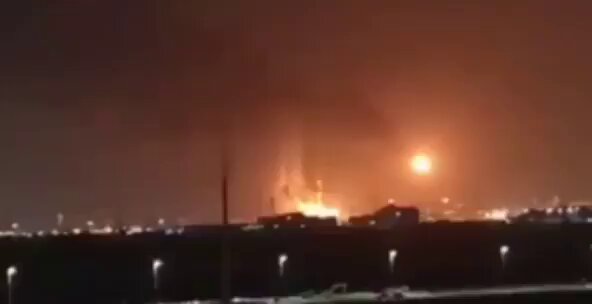
SABIC missile strike by Iran in Saudi Arabia (image X.com)
General Sir Richard Shirreff — former NATO Deputy Supreme Allied Commander — pulls no punches on Times Radio.
By TRH World Desk
New Delhi, April 8, 2026 — One of Britain’s most senior retired military commanders has delivered a withering verdict on the outcome of America’s military campaign against Iran, calling Trump’s decision to accept Tehran’s 10-point peace proposal as a basis for negotiation “America’s Suez moment” — a historic humiliation for the world’s preeminent superpower at the hands of what he called a “tinpot theocratic dictatorship.”
General Sir Richard Shirreff, who served as NATO’s Deputy Supreme Allied Commander Europe — the second most senior military post in the alliance — made the remarks in a blunt and unsparing interview with Times Radio as the two-week ceasefire between the United States and Iran took hold.
‘A Masterclass in Futility’
Asked what the United States had actually achieved through weeks of devastating strikes on Iranian military infrastructure, nuclear facilities, and leadership, Shirreff did not equivocate.
“Like you said it — it’s a masterclass in futility,” he said. “Yes, the US and Israel have decimated the Iranian leadership. They’ve written down the Iranian military capabilities substantially. But the fact is that so long as Iran held the Strait of Hormuz, America is losing. Trump is losing.”
The general’s assessment cuts to the core of the strategic paradox at the heart of the conflict. Military success — the destruction of leadership, the degradation of conventional military capacity, the sustained application of the world’s most advanced air power — has not translated into political victory. The Strait of Hormuz, the 34-kilometre chokepoint through which a fifth of the world’s oil passes, remained under effective Iranian control throughout. And in Shirreff’s reading, that fact alone determines who won.
“Iran wins if it doesn’t lose,” he said, “and America loses if it doesn’t win. America has not won. So it has lost here — and has lost massive prestige,” he added.
‘He Blinked. He Backed Off.’
Shirreff’s assessment of Trump’s decision to accept Iran’s negotiating framework was equally direct.
“The very fact that Trump is now accepting the Iranian 10-point proposals as a workable basis on which to negotiate says to me that he’s blinked, he’s backed off,” he said. “This is yet another example of Trump always chickening out, of course.”
The Suez comparison is historically loaded. Britain’s 1956 Suez Crisis — when London and Paris were forced to abandon their military campaign against Egypt after Washington withdrew support — is widely regarded as the moment the British Empire’s global dominance was permanently and publicly extinguished. The analogy Shirreff reaches for is not of military defeat in the field, but of strategic humiliation: a moment when the limits of superpower reach are exposed to the entire world simultaneously, in real time, with no possibility of managing the optics.
“The leadership of America completely underestimated,” Shirreff said, returning to the theme. “And you now see the global superpower humbled by — a tinpot theocratic dictatorship,” he argued.
Intelligence Professionals Ignored, Shirreff Suggests
The former NATO commander made a pointed distinction between the political leadership that prosecuted the campaign and the professional military and intelligence establishment that, in his assessment, understood the risks clearly but was sidelined.
“Trump certainly underestimated — and the acolytes that surround Trump certainly underestimated it,” Shirreff said. “I am absolutely certain that there are sensible, thoughtful, experienced operators in the United States military and security establishments who had no illusions about the likely threat. And the likely closure of the strait. But I suspect they were completely ignored in the decisions to go for this.”
This claim — that professional military judgment was subordinated to political calculation — echoes the criticism of senior US figures from across the ideological spectrum who had warned, before the campaign began, that air power alone could not achieve the stated objectives of regime change and Hormuz reopening. University of Chicago professor Robert Pape, who has spent decades studying the limits of coercive air power, made precisely this argument — noting the parallel with Vietnam, where tactical air superiority produced strategic defeat.
‘The Winners Are the Iranian People — and the Gulf’
Shirreff acknowledged the human cost on the Iranian side without softening his strategic verdict.
“The winners here are the Iranian people and the people in the Gulf,” he said. “The Iranian people faced the threat of genocide. But the ultimate aim for America was to remove the regime, remove the nuclear capabilities. That has not happened — maybe on the nuclear side — but the other bottom line is this: Iran wins if it doesn’t lose.”
The distinction between the nuclear and non-nuclear dimensions of the conflict is significant. American and Israeli strikes did inflict substantial damage on Iran’s nuclear infrastructure in previous rounds of the conflict. But the Islamic Republic’s political structure, its command of the Strait of Hormuz, its regional influence, and — critically — its negotiating leverage have all survived the campaign intact. It is on these dimensions, Shirreff argues, that the final score must be read.
The Suez Parallel: What It Actually Means
The Suez comparison carries a specific and uncomfortable implication that goes beyond the immediate outcome of the Iran conflict. Britain’s Suez crisis did not merely end a military operation — it permanently recalibrated the global understanding of British power. Allies recalculated their dependence on London. Adversaries drew conclusions about the limits of British will. The world’s mental model of the hierarchy of power was updated in a single episode.
If Shirreff’s framing is correct — and it is shared, in varying registers, by analysts from Professor Robert Pape at the University of Chicago to geopolitics commentators across the Middle East — then the consequences of the Iran ceasefire extend far beyond the immediate negotiations in Islamabad. China, Russia, and smaller states across the Global South are watching to determine whether American military threats, absent the will to press them to decisive conclusion, retain their deterrent value.
The Islamabad Talks begin on Friday. The two-week ceasefire is fragile. The IRGC has not fully stood down. And General Shirreff’s verdict — delivered from the vantage point of a career spent at the apex of Western military planning — is that whatever happens next, the damage to American prestige has already been done.
“America has not won,” he said. “So it has lost here.”
Follow The Raisina Hills on WhatsApp, Instagram, YouTube, Facebook, and LinkedIn




About The Author