US-Iran Islamabad Talks: Pakistan’s Moment — and Its Risks
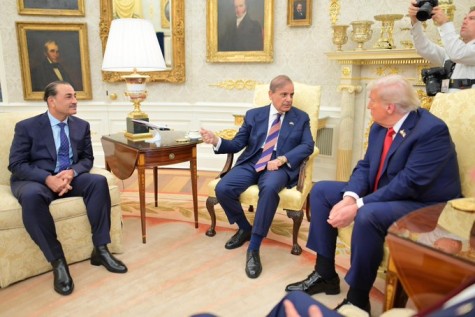
US President Donald Trump in a meeting with Pakistan PM Shehbaz Sharif and Army Chief Asim Munir (Image X.com)
JD Vance leads US delegation to Pakistani capital, but contradictions over Lebanon and a vacant US ambassadorship cloud the moment
By NIRENDRA DEV
New Delhi, April 10, 2026 — Pakistan is preparing to host one of the most consequential diplomatic gatherings of 2026 — direct US-Iran talks aimed at ending the six-week war that has reshaped Middle Eastern geopolitics. The venue is Islamabad’s Serena Hotel, steps from the foreign ministry in the capital’s fortified Red Zone. The stakes could hardly be higher.
Washington has confirmed that US Vice President JD Vance will lead the American delegation, joined by Trump’s senior envoy Steve Witkoff and son-in-law Jared Kushner. Vance’s appointment is politically loaded: widely seen as a cautious voice on prolonged US military engagement in the Middle East, he is also considered a frontrunner for the 2028 Republican presidential nomination. How he performs in Islamabad could define his foreign policy credentials.
Iran’s Supreme National Security Council has indicated talks could run up to 15 days, leaving open the possibility of multiple rounds in the Pakistani capital.
Why Pakistan?
Islamabad brings unusual assets to this role. It shares a 909-kilometre border with Iran and hosts the world’s second-largest Shia Muslim population after its neighbour — factors that lend Pakistan a degree of organic credibility with Tehran. Crucially, unlike much of the wider region, Pakistan hosts no US military bases, a gap that may make it appear a more neutral host in Iranian eyes.
Yet Pakistan is simultaneously designated a Major Non-NATO ally of the United States since 2004, making it a rare bridge between the two adversaries.
The ambassador problem
There is, however, a glaring diplomatic awkwardness. The US ambassadorial post in Islamabad is currently vacant. Since 2018, only one confirmed ambassador — Donald Blome — has served, departing in early 2025. Vance’s visit would mark a rare instance of a sitting US vice president travelling to a country where America has no confirmed ambassador in place. The last US president to visit Pakistan was George W. Bush in March 2006; the last vice president, Joe Biden in January 2011.
Reasons for pessimism
The structural obstacles are formidable. Iran’s ten-point peace proposal demands Iranian oversight of the Strait of Hormuz, full withdrawal of US combat forces from the Middle East, and a halt to military operations against Iranian-aligned armed groups. Washington has not formally accepted any of these terms.
More immediately destabilising is the dispute over Lebanon. When Prime Minister Shehbaz Sharif announced the ceasefire on Wednesday, he stated it applied “everywhere, including Lebanon” — effective immediately. Within hours, the US and Israel publicly contradicted him, insisting Lebanon was never part of the deal. Iran says it was. Israel has continued striking Beirut and Lebanese cities since March 2, killing over 1,500 people.
Iran’s Parliament Speaker Mohammad Bagher Ghalibaf — who also commands the Islamic Revolutionary Guard Corps — accused the US and Israel of ceasefire violations and declared that “in such a situation, negotiations are unreasonable.”
Pakistan, which brokered the agreement, now finds itself at the centre of a storm not of its making. Whether Islamabad can hold the deal together — and what Vance can actually deliver — remains the defining question of the next fifteen days.
China-Iran Military Pact — And What It Means for India-Pakistan
Follow The Raisina Hills on WhatsApp, Instagram, YouTube, Facebook, and LinkedIn




About The Author