Gen X Survival in 2026: Why India, Gen Z and Politics Have Already Changed
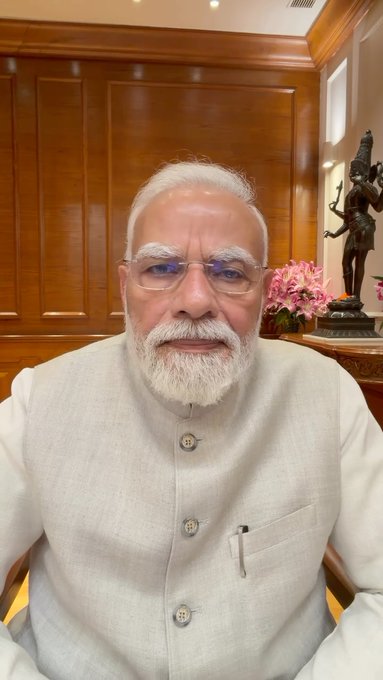
Prime Minister Narenda Modi in a selfie video forgave Jantar Mantar protestors for abusing him. (Image Modi on X)
By NIRENDRA DEV
What is changing in India and the world — perhaps has already changed. From UCC debates to Gen Z politics, from traditional media to Instagram Reels, the real question may no longer be what is changing, but whether we are equipped to survive the change.
New Delhi, August 25, 2026 — Did each one of us tell a lie to ourselves when we were young?
There was something wrong on the face, but we kept changing the bathroom mirrors.
An estimated 588 million internet users in India — 61% of the country’s internet users — consumed short-video content in 2025, according to the Internet in India 2025 report. Short videos have become one of the defining features of India’s digital culture, particularly among younger audiences.
So, we often ask: Has India changed, or is the world still changing fast?
Perhaps India — and the world — has already changed.
The question of what is changing may no longer be the most relevant one. The more uncomfortable question is whether we have understood the change at all.
This is not a debate about capital punishment. This is our post-modern era. The noose can come in many forms.
The melancholic Kishore Kumar song, “Zindagi ka safar…”, suddenly makes a lot of sense.
Life, these days, often feels like a junction. And for those of us around 50, life is moving very fast. It is no longer waiting.
Sometimes it appears to be pulling us towards an ultimate destination — one we may not even have consciously chosen.
I often say: We may not live as long as we have already lived. Gen X — right?
Those born roughly between 1965 and 1980 are now confronting insecure jobs, unpleasant workplaces, ageing parents and children facing challenges that previous generations could not have imagined.
Our parents are disappearing.
That is a personal tragedy. And when they are gone, one can suddenly feel like an orphan.
There is another middle-class reality: highly demanding and increasingly dependent children.
Gen Z and Gen Alpha are now central to political and social debates in India. Youth-led movements have demonstrated how quickly digital mobilisation can spill into the streets and into politics.
The political significance of this generation is no longer theoretical.
The 2024 Bangladesh uprising, the protests in Sri Lanka and Nepal, and the 2011 Egyptian revolution all demonstrated, in very different circumstances, how youth mobilisation can challenge established political systems.
The Egyptian experience also produced a fierce “perception battle” over how the 18-day uprising would ultimately be defined — as a democratic awakening, a foreign-backed conspiracy, a hijacked ideal or a military transition.
The new battle is being fought through Reels
India, too, is witnessing a new kind of political communication.
The Modi government has responded to the rise of Gen Z politics with a mixture of traditional political messaging and new-age digital communication. Prime Minister Narendra Modi reportedly urged Union ministers in July to become more active on Instagram, use Reels and communicate with young Indians in a more direct and less polished manner.
The change is significant.
For years, the BJP’s digital strategy was built heavily around X and WhatsApp. Now Instagram, short videos, memes and creator-style communication are becoming increasingly important.
Reuters reported in August that Modi’s digital outreach to young voters had expanded after the Gen Z-led protests, with ministers and government departments adopting more informal, short-form content.
This is not merely a change in political advertising.
It is a change in the language of politics.
The Reuters Institute Digital News Report 2026 says around 58% of respondents in India rely on YouTube for news, while more than half say they use social media platforms for news.
So, somehow, the elders — and particularly Gen X — are losing control of the information environment.
And perhaps that is the real story.
From River Swims to Roasts: Inside the BJP-Congress “Battle of Reels”
The world we prepared for has disappeared
Narendra Modi has been Prime Minister since 2014. By 2029, he would have completed 15 years in office.
The BJP won the 2024 Lok Sabha election with roughly 36% of the vote and 240 seats.
But the next major political test is not very far away.
Assembly elections are due in 2027 in seven states, including Uttar Pradesh, Gujarat, Uttarakhand, Punjab, Manipur, Goa and Himachal Pradesh.
For the BJP, Uttar Pradesh and Gujarat will be particularly important.
For Indian politics more broadly, the bigger question may be how younger voters perceive politics, government and institutions.
The youth population is enormous. Their expectations are different. Their attention spans are different. Their sources of information are different.
And their definition of political communication is different.
The BJP has already changed its digital approach.
The bigger question is whether we — Gen X — can change with the emerging world.
When survival replaces ambition
I have friends who survive on highly unpredictable sources of regular income.
That, however, has not deterred expenditure.
The results deserve closer study.
Intellectual discussions among lawyers, professors and media professionals often become melancholic. Conversations eventually turn to difficult offices, “donkeys” at workplaces, frustrations with family life and the feeling that nobody really understands anybody else.
Spouses do not always understand the pressures either.
There was a time when families seemed to strike a better balance between austerity, responsibility and expectations.
The joke during drinking sessions today is that we are attending more funerals than weddings or anniversary parties.
That joke, perhaps, is not entirely a joke.
Friends disappear.
Some colleagues died during Covid. Others are now ageing rapidly.
Some simply may not wake up one morning.
Others have died suddenly — even of heart attacks while waiting for a cab to catch an early-morning flight.
And then there are parents, uncles and elders slipping away one by one.
They take with them the last people on earth upon whom one could depend — and sometimes even the people at whom one could scream.
Who Is Ajeet Bharti? Inside the Face of India’s Anti-Reservation Movement
From UCC to an entirely different India
Only a few years ago, India’s political conversation was dominated by issues such as the Uniform Civil Code.
The UCC was presented by its supporters as a call for legal uniformity and national integration. Critics, particularly in a communally sensitive and pluralistic India, viewed it as potentially imposing a Hindu-majoritarian conception of uniformity.
But by 2026, the nature of public debate has changed dramatically.
The political argument has moved from constitutional uniformity to digital attention.
From legislation to Instagram.
From speeches to Reels.
From the newspaper editorial to the 30-second video.
And Prime Minister Modi appears to understand this shift.
His message to ministers was essentially that politics must go where young Indians are spending their attention.
The Reuters Institute Digital News Report 2026 describes India’s media environment as increasingly video-led and platform-driven, with YouTube particularly important as a source of news.
The question is no longer whether politicians will use social media.
They already do.
The question is whether politics itself will eventually be redesigned around the logic of social media.
And what about Sheikh Hasina?
The classic fighter of August 2026 may well be Sheikh Hasina.
Two years after fleeing Bangladesh for India amid the 2024 uprising, the former prime minister announced that she intended to return to Bangladesh in December.
She knows the risks.
She has been convicted in absentia and faces a death sentence. Yet she has publicly said she intends to return.
That is an extraordinary political gamble.
Meanwhile, many of us are simply trying to understand our own lives.
Me and my friends are increasingly at a loss.
We have lost colleagues.
We have watched parents disappear.
We have seen marriages break down and children become emotionally distant.
And yet the world keeps demanding productivity, ambition and reinvention.
The light at the end of the tunnel
“Somewhere in your 50s, the light at the end of the tunnel is no longer bright. It has changed its character and nature. It is gloomy and, most often, dark,” a 57-year-old friend told me.
She is trying to practise family counselling.
Her own family story is complicated. She has a broken marriage, and her children have become indifferent to her personal struggles.
She and other “experts” like her tell me that things are not merely complex.
They are sometimes beyond comprehension.
And perhaps that is where the real crisis of Gen X lies.
You no longer have unlimited ambition around you.
Plans have gone awry.
The career that was supposed to provide security may no longer provide it.
The children who were expected to provide emotional support have their own worlds.
The parents who once provided the safety net are gone.
The political system is speaking in Reels.
The workplace is speaking in algorithms.
The family is speaking in silence.
And what remains of Zindagi?
Mere survival.
If you are not economical with the truth, then perhaps the uncomfortable conclusion is this: The cockroach is not outside you. The cockroach is already within you.
And maybe that is what we have been trying to avoid seeing every time we changed the bathroom mirror.
(This is an opinion piece. Views expressed are the author’s own.)
Ram Madhav’s BJP Return: RSS Concession or a Bigger Political Script?
Follow The Raisina Hills on WhatsApp, Instagram, YouTube, Facebook, and LinkedIn




About The Author