Delhi Gymkhana Row: Heritage or Reordering Power Map?
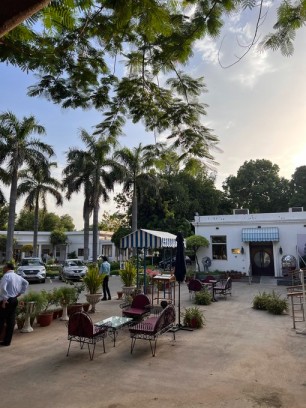
Exterior view of Delhi Gymkhana Club, a historic social and sporting institution in New Delhi. (Image X.com)
By TRH Op-Ed Desk
Delhi Gymkhana Club Notice Sparks Debate on Heritage, Elite Spaces and Modi Government Narrative
New Delhi, May 24, 2026 — The Narendra Modi government’s move to issue an eviction notice to the historic Delhi Gymkhana Club has triggered a larger debate extending beyond land use and administrative control. The development has reopened questions around heritage preservation, access to elite institutions, public land utilisation, and what critics describe as a broader post-2014 effort to reshape symbols associated with Lutyens-era power structures.
The Delhi Gymkhana Club, established in 1913 during British India, occupies around 27.5 acres in one of the most strategic zones of the national capital, close to the Prime Minister’s current residence area, the Race Course precinct and the diplomatic district. Reports indicate the government has asked the club to vacate the premises by June 5 as it seeks to take back the land.
Political analyst Manish Anand, speaking in a monologue on The Raisina Hills YouTube channel, argued that the timing of the move has amplified attention around the issue.
“The Delhi Gymkhana notice has come at a time when the national discourse was already witnessing viral debates online. In that backdrop, the issue is being viewed not merely as an administrative step but through the lens of the Modi government’s larger political narrative since 2014,” Anand said.
He argued that critics see the move as fitting into a pattern where institutions associated with old elite networks, colonial legacy, or perceived Congress influence are being revisited, reinterpreted or symbolically transformed.
Anand cited examples such as the renaming of Rajpath to Kartavya Path and the installation of the statue of Subhas Chandra Bose near India Gate as instances where the government projected a new civilisational narrative around “Bharatiyata”.
However, the Delhi Gymkhana issue is more complicated because it also raises questions of public access and land utilisation.
The club reportedly has around 1,100 members and nearly 600–700 employees while occupying prime land in central Delhi. Supporters of government intervention argue that scarce urban land cannot remain restricted to a small elite group.
“The counter-argument is straightforward,” Anand said. “Can 27.5 acres in one of Delhi’s most valuable zones remain accessible to barely over a thousand members while the city struggles with land pressure and public infrastructure demands?”
The Gymkhana Club has long been one of India’s most exclusive institutions, with membership often viewed as a marker of status among bureaucrats, diplomats, military officers and influential figures. Waiting lists have historically stretched over years.
Yet defenders of the club argue that the institution is not merely an elite social space but part of Delhi’s historical and sporting ecosystem.
Former IPS officer Kiran Bedi recently highlighted its contribution to Indian sporting culture, noting the sporting facilities and infrastructure additions made over the years.
Former foreign secretary K. C. Singh has also argued that such clubs historically served an important social function for civil servants and military officials during periods when public-sector salaries were relatively modest compared to private industry.
Another argument emerging in defence of the club concerns ecology and urban planning. Unlike dense commercial developments, much of the Gymkhana campus remains green space with limited built structures. Supporters argue that Delhi’s transformation into a heavily concretised metropolis makes preservation of green zones increasingly important.
“Not every parcel of urban land must become concrete,” Anand said. “Global capitals preserve heritage clubs and green spaces because they also shape international identity and urban character.”
The debate has also broadened into comparisons with other institutions occupying expansive public land parcels, including governors’ residences, diplomatic compounds and elite clubs such as the Delhi Golf Club and India International Centre.
Critics ask whether targeting one institution alone indicates a selective approach. “If the argument is optimal public use of land, then the question naturally extends to many other legacy institutions,” Anand noted.
At the same time, he suggested a middle path may exist: democratising membership structures and expanding public utility without completely dismantling heritage institutions.
“A constructive approach could involve making such institutions more accessible while preserving their heritage value and increasing their public utility,” he said.
Legal challenges may still emerge if the club approaches courts, potentially delaying any final decision.
For now, the Delhi Gymkhana controversy appears to have evolved into something larger: a debate over who owns elite spaces, how history is preserved, and whether New Delhi’s post-colonial landscape is witnessing another phase of political redesign.
Follow The Raisina Hills on WhatsApp, Instagram, YouTube, Facebook, and LinkedIn




About The Author