China’s Space Milestone: Hong Kong Astronaut Reaches Orbit
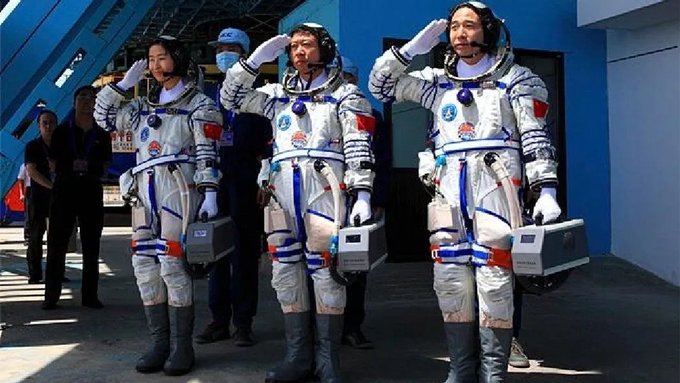
Lai Ka-ying posing before launch as China’s first astronaut from Hong Kong. (Image X.com)
By TRH World Desk
Shenzhou-23 carries Hong Kong-born astronaut Lai Ka-ying to Tiangong while China begins its first continuous year-long human spaceflight experiment ahead of lunar ambitions.
New Delhi, May 24, 2026 — China has taken another giant leap in its crewed spaceflight programme, launching the Shenzhou-23 mission on Sunday, May 24, 2026 — a mission that carries not one but two historic firsts: the country’s inaugural astronaut from Hong Kong, and its first attempt at a continuous year-long human stay in orbit.
Liftoff and the Crew
The China Manned Space Agency (CMSA) launched the Shenzhou-23 spacecraft from the Jiuquan Satellite Launch Center in northwest China aboard a Long March-2F carrier rocket at 11:08 p.m. Beijing time, carrying a three-person crew to the Tiangong space station.
The crew comprises commander Zhu Yangzhu, pilot Zhang Zhiyuan, and payload specialist Lai Ka-ying — also known by her Mandarin name Li Jiaying. Zhu previously flew on the Shenzhou-16 mission, while Zhang and Lai are on their first spaceflight.
Describing his team at a pre-launch press conference, Zhu said: “We think with one mind and pull in the same direction.” Pilot Zhang Zhiyuan reflected on the path to space with characteristic resolve: “From having a dream to realizing it is a long journey paved with faith and perseverance,” he told reporters at Jiuquan, according to Xinhua.
Hong Kong’s Moment in Space
The mission’s most celebrated figure is Lai Ka-ying — a trailblazer in every sense. Born and raised in Hong Kong, Lai holds a doctoral degree in computer forensics and is the first astronaut from the city to fly on a space mission. She is a police superintendent who was selected as an astronaut candidate in 2024.
Hong Kong Chief Executive John Lee congratulated Lai, expressing gratitude to the country for its support and trust in the HKSAR, and praised her for passing a rigorous selection and training process to become one of China’s fourth batch of astronauts. Lee added: “As this year marks the beginning of the national 15th Five-Year Plan, the HKSAR is embracing a historic moment in the pursuit of its aerospace dream.”
At the press conference, Lai — referred to by Xinhua as Li Jiaying — expressed deep gratitude for the opportunity, embodying what Chinese state media have framed as a proud symbol of Hong Kong’s integration into the national space programme.
China’s First Year in Orbit
Beyond the symbolism, Shenzhou-23 carries a bold scientific ambition. One member of the crew will remain aboard the Tiangong orbital outpost for a full year — the longest continuous single-mission duration in the history of the Chinese space programme. This extended deployment is structurally calibrated to study the long-term biological and psychological effects of spaceflight.
The astronaut selected for the year-long stay will be determined based on how the mission unfolds in orbit, according to the CMSA. During the year-long residency, China will implement its first space-based human body research programme to collect crucial data on astronaut exposure to long-duration spaceflight environments.
The move mirrors what NASA and its partners have done on the International Space Station and reflects China’s ambition to prepare for deep-space and lunar missions. The launch comes as China prepares for its first crewed lunar landing by 2030.
Mission Objectives and What Comes Next
The Shenzhou-23 mission’s primary objectives include completing an in-orbit crew rotation with the outgoing Shenzhou-21 crew, conducting space science experiments, performing extravehicular activities and cargo transfers, installing debris protection devices, and carrying out science education activities.
The outgoing Shenzhou-22 crew — Zhang Lu, Wu Fei, and Zhang Hongzhang — are scheduled to return to Earth on May 29, 2026, after completing an extended stay.
Looking further ahead, the Shenzhou-24 mission, due later this year, will send a Pakistani astronaut to Tiangong for a short visit. That astronaut will arrive on Shenzhou-24 but return to Earth on a Shenzhou-23 spacecraft, leaving one Shenzhou-23 crew member behind to complete the full year in orbit — making the mission architecture itself a feat of planning and international cooperation.
Why This Mission Matters
Shenzhou-23 is more than a routine crew rotation. It marks the graduation of Hong Kong into China’s space narrative, validates the country’s fourth-generation astronaut selection programme, and pushes the boundaries of human endurance research in orbit. Tiangong — the crown jewel of China’s space programme, backed by billions in state investment — is Beijing’s answer to the ISS and a proving ground for its lunar ambitions. With Shenzhou-23, China has shown it is not just catching up — it is charting its own course.
K. Kasturirangan: The Visionary Architect of India’s Space Legacy
Follow The Raisina Hills on WhatsApp, Instagram, YouTube, Facebook, and LinkedIn




About The Author