Did Ancient India’s Women Write Rigveda Hymns? An Explainer
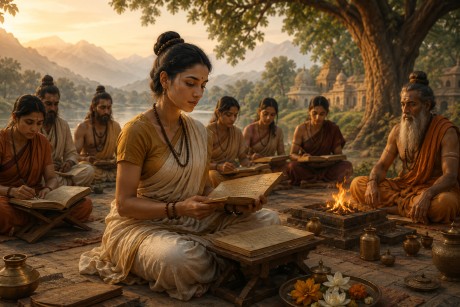
Illustration depicting women scholars and sages in an ancient Vedic learning setting,
By P. SESH KUMAR
Viral claims say women like Gargi and Maitreyi composed Rigvedic hymns, portraying Vedic India as unusually egalitarian. But what do the texts actually show? This analysis examines real Rigvedic rishikas such as Apala, Ghosha and Lopamudra while separating historical evidence from modern mythmaking.
Recent social-media posts have touted a “lost history” of the Rigveda, claiming that many hymns were composed by rishikas — female seer-poets like Gargi, Maitreyi, Lopamudra, Ghosha, Apala, and others — to show that Vedic India was unusually egalitarian. In truth, the Rigveda does contain hymns attributed to some women sages, but the viral narratives may be mixing up facts and myths. Close study of the texts and scholarship would show that indeed Lopamudra, Ghosha, Apalā and Visvavārā (for example) are named authors of specific hymns, and roughly 25–30 female rishis (rishikas) are listed in the Vedic corpus. However, figures like Gargi and Maitreyi belong to the Upanishads, composed centuries later, and did not write Rigvedic hymns.
Ancient India’s sacred Rigveda does indeed record some hymns “revealed” to women sages. Modern studies identify roughly 25–30 female rishis (rishikas) by name in the Rigveda (out of about a thousand hymns). For example, Rigveda 8.91 is attributed to Apalā Ātreyī, a daughter of the sage Atri; hymns 10.39 and 10.40 (each fourteen verses long) are credited to Ghoṣā, the daughter and granddaughter of rishis Kakṣīvata and Dirghatamas; and two verses of RV 1.179 (the “Rati” hymn) are by Lopā́mudrā, wife of the sage Agastya. Another hymnic seer is Viṣvāvarā Ātreyī (Rigveda 5.28), and still others like Vac Ambhrinī, Sikatanivārī, and Surya Śāvitri appear as rishikās in the tradition. In short, the Rigveda’s own colophons explicitly name female authors for at least a few hymns. As one recent study observes, “the Rigveda… proves, by the hymns it contains, that there were remarkable female poets who contributed to the text”.
In context, the presence of these women-seers is not a late myth: they were known already in Vedic tradition. E.g. the e-PG Pathshala (Indian government educational) notes that “the Rig-Veda mentions the names of some learned ladies like Visvavara, Apala and Ghosha who composed mantras and attained the rank of Rishis.”
Similarly, Jay Oza’s study “Poetesses of the Rigveda” lists the exact hymns by rishikās (Apalā 8.91, Ghoṣā 10.39–40, Lopā́mudrā 1.179.1–2, Viṣvāvarā 5.28, etc.). These confirm that educated Vedic women did participate in the hymn-composition process, at least in certain prominent families or lineages. It is fair to say that educated women (called brahmavadinīs if they married, or sadyovadhū if not) could study the Vedas and some attained sage-status. The Rigveda itself even celebrates women’s spiritual life: some hymns metaphorically call women the “foundation” of the household or extoll female goddesses. In several early verses, women recite mantras or act as priestesses in the soma ritual. So the idea that “only men” appear in the Vedas is oversimplified; indeed, Vedic-era society recognized women as scholars and seers in a way later societies often did not.
Yet the popular social media infographic’s claim appears to go too far in mixing eras and personalities. It lists names like Gargi and Maitreyi as if they were Rigvedic hymn-writers, but both those figures belong to the Brhadaranyaka Upanishad (circa 8th–6th century BCE), not the Rigveda hymns. Gargi Vācakaṇavī debates Yajñavalkya about cosmology in King Janaka’s court- a story from the Upanishads -and Maitreyi is Yajñavalkya’s wife who questions him on immortality. They were never “Rigveda composers.” (The confusion is understandable: later Hindu tradition often calls many wise women “Brahmavadinīs,” but being learned in the Vedas is not the same as being a Rigvedic rishi.) Similarly, the post’s list omits some true Vedic rishikās (like Ambhrinī or Sikatanivārī) and includes others only peripherally (e.g. Sakata or Kadru, who appear in Vedic myth but not as hymn-authors). In short, the authorship claims in the viral post would appear to overstate and blur the evidence.
We must also ask: how do scholars view these claims? In academic literature, there is little doubt that some Rigvedic hymns bear female names (as above). Most historians regard that fact as evidence of women’s respected roles in early Vedic ritual and learning. At the same time, experts caution against romanticizing or generalizing. The Rigveda’s female poets are a small minority of its nearly 1,000 hymns, and for every celebrated brahmavadinī there were many women with no ritual voice. By the later Vedic (Early Upanishadic) period, cultural norms shifted: as one survey notes, men by then dominated education and public life, and earlier freedoms (like widow remarriage or female scholarship) gradually gave way to patriarchal controls. Thus, historians warn that the “Vedic age equality” narrative is partly due to the survival of a few exceptional cases. For instance, some Rigvedic ‘scholars’ may have emphasized that women’s later marginalization does not erase the earlier evidence-but it does mean we can’t use a few names to claim blanket gender-parity.
Contrary views and debates
Not everyone interprets the evidence the same way. Some nationalist writers invoke the “27 hymns by women” line to counter any suggestion that the Vedas were solely patriarchal. But careful scholarship points out that even within the Rigveda, authorship is a complex tradition. Hymns were often attributed by family or clan (like “the Atri hymns”), and later redactors sometimes inserted mythic figures into genealogies. A verse attributed to a woman might have male compositional layers or vice versa. For example, Lopā́mudrā’s Rati hymn in RV 1.179 actually combines verses by her (verses 1–2) with verses by Agastya and a student. This suggests collaborative authorship rather than a lone female genius. Likewise, some songs credited to “Kirāta” or “Devasūnā” might conceal composite origins. In addition, names like Visvavārā and Ratri Bharadvajī (who appear as hymn-seers) might be symbolic personifications (e.g. female deities) rather than historical individuals. Thus, indologists debate how literally to take the colophons.
Social media claims may also ignore these subtleties. By presenting “women rishis” as an undisputed fact, they could sideline questions like: How widespread was this literacy? Were all ordinary men equally educated? Were these women aristocrats with special privileges? For example, some scholars note that Lopā́mudrā and Ghoṣā came from distinguished sage-families (Agastya’s and Dirghatamas’s), which may have been exceptional contexts. The social media posts proclaiming “the Rig Veda mentions 22 Rishikas” or “27 women scholars” often cite each other, but they rarely examine such nuances. In fact, reputable sources caution that while “the Vedic period saw remarkable female figures,” their voices survive in only a handful of hymns. Other researchers argue that by conflating Upanishadic women (Gargi/Maitreyi) with Rigvedic ones, these posts muddy the timeline.
No Gender Manifestoes
The story of Vedic women remains compelling, but it must be told accurately. Historians and enthusiasts agree we should celebrate Apalā’s stirring hymn to Indra or Ghoṣā’s emotional pleas to the Āśvins– they are part of India’s spiritual heritage. Yet we should also note that primary sources are scarce and often poetic, not meant as gender manifestos. The “ancient Bharat” meme does well to recall female agency, but it need not distort chronology or context to make the point.
A more nuanced account would say: Yes, some Rigveda hymns were composed by women sages; their existence was acknowledged in ancient scholarship; but no, Gargi and Maitreyi weren’t among them, and later cultural shifts changed how much women could speak. By distinguishing verifiable facts (e.g. RV 8.91 by Apalā) from trendy misstatements, scholars can engage the public enthusiasm without conceding accuracy. In other words, the Rigveda itself reminds us that wisdom was honoured above gender- a powerful legacy one can uphold honestly, without oversimplification.
(This is an opinion piece. Views expressed are the author’s own.)
Follow The Raisina Hills on WhatsApp, Instagram, YouTube, Facebook, and LinkedIn




About The Author