Women, History and Power: New Book Reframes Indian Feminism
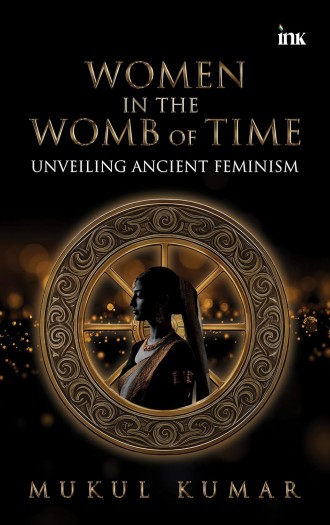
Book Review Women in the Womb of Time by Mukul Kumar (Image Book Cover)
Book Review: Women in the Womb of Time: Unveiling Ancient Feminism I Author: Mukul Kumar I Publisher: BluOne Ink I
By MANISH ANAND
New Delhi, May 2, 2026 — “Modesty is the true grace of a woman, not excessive display. One should not speak of her desires freely, for they are meant to be guided by a man.”
“But if we remain silent, how shall we claim our own voice? When desire is expressed freely, the heart shines with its own light.”
“A divine woman is not merely bound by marital duty; For the goddess is the root of the world, endowed with distinct knowledge.”
Mukul Kumar spotlights a raging debate from Kamasutra among a traditional, a progressive, and an elderly woman in his book — Women in the Womb of Time: Unveiling Ancient Feminism — to showcase Socrates’ wisdom — “truth shouldn’t be told; it should be established through dialogue and debate” — flowing through ancient Indian texts.
A wind of revisionist argumentation is unfolding in India to assert an Indian authorship of societal advancement. Kumar has methodically scanned Indian ancient texts to chronicle the journey of women establishing their autonomy in a visible patriarchy. The popular belief for decades shined the Britishers for bringing the air of renaissance that first stirred Indians in Kolkata and later elsewhere to truly demonstrate courage to unchain women from the chains of patriarchy.
The memory is still fresh that India reported the last Sati in Rajasthan a few decades ago, and that was several decades after the British rulers had banned the practice. Nitish Kumar, Bihar’s former Chief Minister, built his political career solely by focussing on women education and prohibition policy that had the underlying social thought that men under the influence of alcohol will stop beating women.
Kumar has ventured into his first non-fiction after seven previous literary works to document the quest of Indian women asserting their autonomy in a society where men ruled on their terms. That he could sift a vast volume of literary history — from the Veda to the Epics, from Smriti to Shruti, from Manusmriti to Kamasutra, from Arthshastra to Dharmashastra, from Romila Thapar to Lise Vogel — to retrace the journey of Indian feminism makes his book a credible source for researchers, as well as others who have appetite for history and sociology.
“Surpanakha’s persistence was not founded on naivety or recklessness; it was an assertion of agency in a world that sought to silence her. …Surpanakha refused to be contained within societal expectations. She dared to pursue what she wanted, challenging the very framework of patriarchal property,” Kumar writes in the book, as he lenses to see the feminist impulses in popular characters of the Epic.
He finds feminism firing in its all glory in acts of defiance of Sita to the set roles for women. Kumar credits Droupadi for demonstrating autonomy of a woman in a world where men ruled and even gambled away women. In Ahilya, popularly believed to have been cursed into a stone, Kumar searches for the agency of a women to pursue the path of autonomy.
Kunti comes out as an astute political agent in the Epic Mahabharata. That she gave birth to Karna as an unmarried woman by invoking Surya was outrageously revolutionary, opines Kumar in the book. He mentions that Krishna often consulted Kunti as the Mahabharata war unfolded to spotlight her political influence.
But power defined gender roles, and in Kumar’s own words, women took up domestic roles due to limitations of her biology and that shaped the structure of the society from the day man hunted to survive. In 1927, Mao Zedong said that “power flows from the barrel of the gun.” From the stone age to the modern age, power shaped not just gender roles, but politics, society and international order continue to flow from the strength of the muscle. Power defines roles, and not just women but even nations can face the brute reality of subjugation and their unjust destructions. By admitting the role of power in shaping gender roles, Kumar brings a realistic perspective to the debate surrounding the movement of feminism.
“The Gautama Dharmasutra, 600 BCE, spells out tripartite protection of women — by the father, husband, and son — and constructs their status within the boundary of purity and lineage,” Kumar writes. He also mentions the Baudhayana Dharmasutra detailing codes for women during pregnancy, menstruation, and marriage.
Kumar’s verdict comes out in his assessment that “the necessity of prescribing so many dicta perhaps also indicate resistance and the impossibility of full control. A culture that sanctified and feared womanhood in equal proportion articulated its weakness through texts.”
The conflict between power and morality, freedom and constraint, aspiration and order is as old as human history, and Kumar’s work affirms that the pursuit of freedom has been courageously led by women.
By writing the book, Kumar has also defied the stereotype that feminism is a subject only for women. The reviewer holds all kinds of stereotypes with contempt and rejects gender extremities firmly.
Muskism Review: The Book That Reframes Elon Musk as a System
Follow The Raisina Hills on WhatsApp, Instagram, YouTube, Facebook, and LinkedIn




About The Author