Punjab’s Move to End Govt Contractual Jobs Is Revolutionary — But There’s a Catch
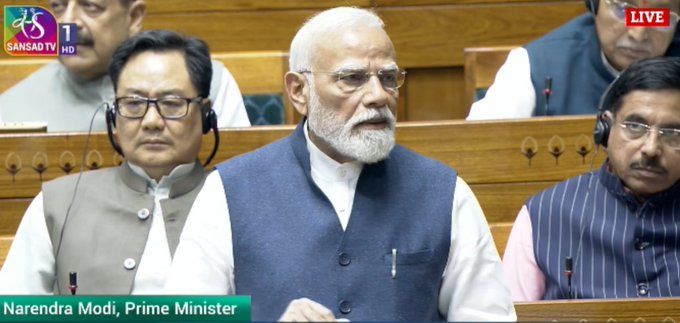
PM Narendra Modi speaks in the Lok Sabha on Women's reservation bill (Image Sansad TV on X)
By MANISH ANAND
As Punjab strikes at the culture of contractual employment ahead of Assembly polls next year, India’s demographic dividend now seems despairing due to Modi government’s failure on the promise of “Maximum governance, minimum government.”
New Delhi, May 31, 2026 — A journalist discarded after 35-year of job from one of India’s largest Hindi dailies ended his life in a park in city in Uttar Pradesh last week. In Noida, hundreds of workers hit the street over alleged low wages. AIIMS in New Delhi reports vacancies of senior doctors. MBBS doctors have been found to be in queues for recruitment drive for police constables in states. India’s demographic dividend is arguably in tatters as economy shrinks and jobs vanish.
N. Subrahmanyan, the CEO of Larsen and Toubro, got a 59 percent increment in his salary package. He will take home a cumulative of ₹25 crores annually per media reports. Luxury apartments are sold out in pre-launches in metro cities of India. The club of super rich is incrementally expanding. The mass of financially stressed population is exploding.
At an interview in a university for promotion of various ranks of professor, one candidate, an associate professor, explained India’s state of economy with his understanding of the “concept of utility.” He was asked how he would explain the concept.
“Imagine one brings two rasgullas to home and there are dozens of people. The plate with the two spongy sweet balls is taken to grandparents. They say, ‘we have already savoured the delicacy with the sight’. Other family members repeat the words. In the end, the two children at home eat the rasgullas. The full family is satisfied. This is the concept of utility,” the associate professor told a visiting interviewer. The visitor was wonder struck. He in anyways had no option to give negative rating to the interviewee.
“This is the state of the economy and the society in India now. The people are somehow accepting miseries as their fait accompli. But the situation is turning alarming on the grounds,” he told this author.
Prime Minister Narendra Modi on his inauguration on the forecourt of the Rashtrapati Bhavan in sweltering heat of a peak summer day in 2014 had bring relief to a massive chunk of the population. They believed that finally an outsider from Delhi will reform India. Modi whetted their appetite, saying he will work in the maxim of “minimum government, maximum governance.”
In 12 years, his rhetoric means — maximum government, minimum governance. An army of contractual workers occupy the government buildings. Sizes of earlier offices of senior officials are now not even one-fourth, for making space for surging wave of contractual workers. The Kartavya Bhavan give a sense of a Chinese factory.
Experts have pinned down crisis in India’s examination system to the National Testing Agency being run by contractual workers. AIIMS in New Delhi now has many avatars in states. But still patients from all across the country come to New Delhi. Every inch at the campus has been taken up by new buildings. Yet patients wait on roads outside. Some of the departments have not seen recruitments since 2005. Doctors blame the malaise to the norms of contractual employment.
Private sector now runs on contractual system. Bridges built recently collapse. The people die. The episodes are forgotten.
The Bhagwant Singh Mann-led government in Punjab on Saturday announced abolition of contractual employment. Over 65,000 contractual workers will be absorbed.
Economists give instant verdict — this is a recipe for disaster. Punjab is already debt trapped. In West Bengal, salaries and pensions account for almost 40 percent of annual budget. Salaries and pension in the railways take away over 65 percent of revenue annually.
The rot is deep. The cost is a disaster. Demography now despairs. The idea of a minimum government is now dead.
(This is an opinion piece. Views expressed are the author’s own.)
Follow The Raisina Hills on WhatsApp, Instagram, YouTube, Facebook, and LinkedIn




About The Author