Roti, Kapda, Makaan, Aur Shiksha: Has India’s Promise of Social Mobility Broken Down?
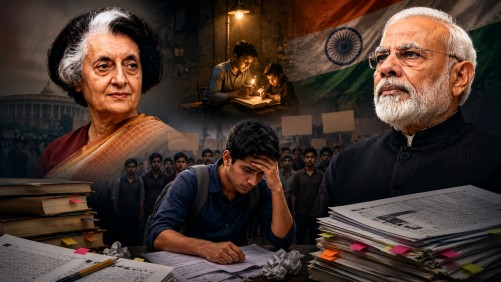
A representative image for India's deepening education crisis. (Image ChatGPT)
By TRH Op-Ed Desk
Systemic rot in India’s testing infrastructure is crushing the aspirations of a generation as education as a tool for social mobility ruptures.
New Delhi, May 31, 2026 — India’s political vocabulary in the 1960s was built on three words —roti, kapda aur makaan (food, clothing, shelter). The slogan became popular during Indira Gandhi’s era. That was for the popular demand for the bare minimum. A newly independent nation prioritized its mandate for its citizens. Zulfikar Ali Bhutto borrowed it wholesale for Pakistan People’s Party. Manoj Kumar turned it into a 1974 Bollywood blockbuster. This evolved into South Asia’s political grammar. It brought votes to political parties in loads.
Decades went by. Slogans lost appeal. Politicians in late 1980s began working on new vote catching phrases. They zeroed in on: shiksha — education.
“Education became the bridge through which anyone could rewrite their fate through hard work,” said Manish Anand, political analyst and host of The Raisina Hills YouTube channel. He invoked the iconic image of APJ Abdul Kalam — a boy from Rameswaram reading under a street lamp near Kanyakumari, who went on to give India missile autonomy and ultimately became its President — as proof that education could transform destiny.
“Kalam did not accept his poverty as fate. He decided to change it,” Anand remarked, while stressing on aspirational value behind education for the people in the country. That promise, Anand argues, is now under severe threat.
A System That Has Lost Its Students’ Trust
Millions of students across India along with their parents are watching the examination system fracture in real time. They’re losing faith with every crack.
“When any student walks into an examination centre today, the question in their mind is: can I trust this exam? Will my merit be recognised, or will the system kill my talent?” Anand said in his monologue for The Raisina Hills.
The list of failures is long and damning, Anand added as he examined the issue with empirical and anecdotal examples.
He noted that the National Testing Agency (NTA), the body responsible for conducting competitive examinations transparently and efficiently, is now mired in repeated controversies. The NEET undergraduate paper leak scandal forced cancellations. It emerged that question papers had allegedly been compromised from within. That was reportedly blamed on translators and paper-setters connected to the agency itself.
“Those whose very job was to protect the examination integrity allegedly leaked the paper,” Anand noted.
He cited the example of the CUET examination, which was held on a Saturday and attended by lakhs of students at centres across the country. It collapsed mid-way due to server failures. Students had arrived under intense examination pressure. But they ended up as protestors. In place of demonstrating their academic worth, the students showed that they can protest as well with full strength, Anand added.
He further cited the example of the CBSE Class 12 answer-sheet evaluation controversy. He said that the row revealed how outsourcing of the On-Screen Marking System to a reportedly discredited company — allegedly enabled by diluting tender norms to allow that company to qualify — led to marks being credited to wrong students.
“Results dropped by three percent this year. Over 400,000 of the 1.7 million students who appeared have already demanded re-evaluation,” Anand added.
The NTA’s Structural Weakness
Anand pointed to a structural flaw at the heart of the NTA: approximately three-quarters of its employees are on contractual terms, with no permanent institutional commitment. “This is where paper leaks are happening — from within an agency whose own workforce has no permanent stake in its integrity,” he said.
He also questioned the absence of oversight. “We have not seen a single CAG of India report in recent years that warned the public that termites have entered the education system. The CAG is accountable to the people, presents reports to Parliament — and yet Parliament’s oversight over something this large appears to have been completely weak,” Anand stated.
The analyst further stated that the “Supreme Court of India has itself questioned the culture of ad-hocism in examination administration, asking when accountability will finally be fixed.”
A Generation Cannot Wait
India’s median age is 28, said Anand, adding: “Its demographic dividend — the enormous youth population that economists say could power the country’s rise — is precisely the generation now sitting in examination halls wondering if the system works for them or against them.”
This despondency should never exist in an aspirational India, Anand said, adding that “A country dreaming of Viksit Bharat by 2047 cannot afford to have its youth this frustrated, this angry, this disillusioned.”
He was particularly pointed about political accountability, noting that under twelve years of the Modi government, two education ministers — Smriti Irani and Dharmendra Pradhan — have overseen this deterioration, neither being recognised as an educationist.
“If the attitude remains one of defence and deflection rather than genuine reform,” Anand warned, “India’s education system is headed for a very dark place.”
(Manish Anand is a political analyst and host of The Raisina Hills, a current affairs YouTube channel.)
Punjab’s Move to End Govt Contractual Jobs Is Revolutionary — But There’s a Catch
Follow The Raisina Hills on WhatsApp, Instagram, YouTube, Facebook, and LinkedIn




About The Author