Viksit Bharat Meets Syndicate Raj: The Invisible Tax Holding India Back
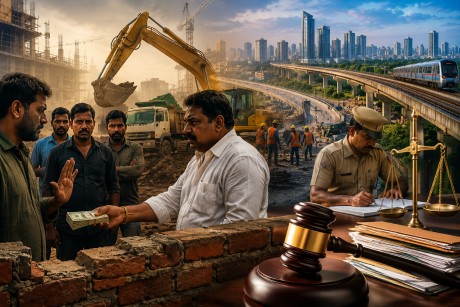
A conceptual illustration of India's development challenges and governance reforms. (Image ChatGPT)
By P. SESH KUMAR
India may have fixed the paperwork of doing business, but the real battle begins when the JCB reaches the site gate.
New Delhi, May 2026 — India tells the world a compelling story about itself. It climbed 79 places in the World Bank’s Ease of Doing Business rankings in five years. It built a payments infrastructure that processes more digital transactions than the rest of the world combined. It launched a National Infrastructure Pipeline of Rs 111 lakh crore, cut logistics costs to under 8% of GDP, and coined an irresistible vision — Viksit Bharat by 2047 — of a USD 30 trillion, first-world nation rising from the ashes of colonial underdevelopment. It is a story with data, dashboards, and prime-time delivery.
Then the JCB arrives at the construction site. And the story changes.
Before the first bucket of earth is moved, a group of men-sometimes wearing union jackets, sometimes carrying only the authority of political affiliation- will arrive and make a non-negotiable proposal. In Navi Mumbai, they call themselves the Sthanik Bhumiputra Sanghatana, or the Project Affected Persons (PAP) contractor society, and they want the excavation contract or they will park themselves at your gate. In Kerala- until a landmark High Court order forced the issue in 2018 and 2022- a headload worker would appear at your door when the furniture truck arrived and demand Rs 2,000 for having watched the unloading.
In Bengal’s Rajarhat and Budge Budge, the syndicate operative will tell you, with perfect calm, that you will buy your bricks, stone chips, sand, and cement from his group, at his price — 20 to 40% above market — or the project will not proceed. And in Tamil Nadu, Punjab, Uttar Pradesh, Bihar, Chhattisgarh, and Odisha, variations of the same script play out at quarry gates, highway checkpoints, and industrial estate entrances every single day.
These are not stray incidents of criminality. They are a system —distributed, politically embedded, and self-reinforcing — those functions as an invisible second taxation layer on every unit of productive economic activity in India. The official tax department gets its GST. The informal extraction economy gets its cut first, in cash, off the books, and without appeal.
The three flagship cases reveal a spectrum of sophistication. Maharashtra’s PAP/local-contractor arrangement is the most institutionally dressed: there are Government Resolutions, tender clauses, and registered societies. It began as genuine rehabilitation for farmers who lost land to CIDCO and MIDC. It has since become a cartelised monopoly over earthwork, rubble removal, and petty civil contracts, with a 15–30% premium routinely absorbed by every infrastructure project in the Mumbai metropolitan region.
Kerala’s nokku kooli — literally “wages for looking” — dispensed with policy pretence entirely and simply demanded payment for labour that was never performed, a practice the Kerala High Court ultimately declared “illegal and unconstitutional” and ordered treated as extortion under the Indian Penal Code. West Bengal’s Syndicate Raj is the most brazen of all: no policy fig leaf, no legal theory, pure coercive market capture of materials, transport, excavation, and labour — a system so deeply woven into the TMC political economy that even the BJP, which campaigns loudest against it, has been accused of running its own syndicates where it controls local government.
The India-wide picture is worse still. Bihar’s rangdari tax emptied the state of industry for two decades. RTO officials in Chhattisgarh were caught on camera collecting money from truck drivers on a national highway without receipts as recently as September 2025. In Odisha, transport department personnel were arrested in November 2024 for systematic extortion on NH-16. In Madhya Pradesh, a tout clung to a moving truck in December 2025 when a driver refused to pay “document verification” money at a check post that officially no longer exists. The geography changes; the grammar does not.
Punjab’s Move to End Govt Contractual Jobs Is Revolutionary — But There’s a Catch
Here is the paradox that should disturb every policymaker. India ranked 186 out of 189 countries on “enforcing contracts” in the World Bank’s 2015 Doing Business assessment. The government spent a decade building commercial courts, arbitration infrastructure, and digital portals to address this. Scores improved on paper. But none of those reforms addressed what happens before a contract dispute reaches a court — the systematic coercion that ensures the contract goes to the politically connected rather than the technically capable in the first place. DPIIT’s Business Reforms Action Plan (BRAP) assessed 9,700 reform points across seven editions; not one of them measured whether the JCB was blocked at the gate this morning.
The World Bank’s B-READY framework, whose India assessment is expected in late 2026, will likely rely on firm-level surveys- surveys that Indian businesses answer conservatively, knowing that the extorter is often the local MLA’s cousin and the police station is down the road.
Kerala offers the only credible proof of concept that the cycle can be broken. The High Court’s declaration in WP(C) 10204/2018 worked not because it was eloquent- though it was-but because it contained three enforcement teeth: it reframed nokku kooli as extortion rather than a labour dispute; it mandated FIR registration removing all police discretion; and it monitored compliance continuously until the practice retreated.
The result was not merely social: Kerala leapt from the “Aspirers” tier in BRAP 2020 to the top-performer tier in BRAP 2024. The HC’s own observation in 2021-that Kerala had “a reputation of militant trade unionism deterring investors from coming to the state”- became a reform mandate, not just a lament. Judicial courage directly moved the investment climate needle. That is the blueprint.
What must happen now is structural, not sloganic. State governments must enact unambiguous amendments clarifying that no payment is owed to any worker or union for work they do not actually perform -and impose automatic police accountability for extortion complaints within 48 hours. They must replace PAP contract preferences with DBT cash transfers or equity stakes in project SPVs, severing the link between rehabilitation and supply-chain monopoly.
The Competition Commission of India must be directed to investigate organised contractor cartels in construction, where its jurisdiction is already legally available but operationally untested. DPIIT’s BRAP framework must add a “last-mile enforcement index” — measuring FIR registration rates, resolution timelines, and conviction rates for economic coercion — because what gets measured gets addressed.
The Union Government’s greatest contribution to Viksit Bharat is not another PLI scheme or another logistics corridor, though both are welcome. It is the institutional courage to act on what every infrastructure project manager, every SME owner, and every home-builder in India already knows: that the last mile between national ambition and ground reality is patrolled not by tax officials or regulators, but by men who have learned, across generations and political cycles, that production must pay tribute before it is permitted to proceed.
A nation cannot be “Viksit”- developed, mature, institutionally sound — while it tolerates, at the panchayat and ward level, economies of extraction that tax productivity without producing a single unit of value. Direct Benefits Transfer (DBT) is supposed to have delivered Rs 3.48 lakh crore in savings by eliminating leakage from welfare transfers.
The same logic — digital accountability, institutional enforcement, zero tolerance for intermediary capture- must now be turned on the informal extortion economy that levies its own parallel welfare transfer on every truck, every trench, and every ton of sand in this aspiring nation.
Viksit Bharat by 2047 begins not at Davos but at the site gate. Not in the Prime Minister’s speech but in the Sub-Inspector’s FIR register. Not in the World Bank dashboard but in the decision of a district magistrate to tell the local syndicate that the law means what it says. Until that last mile is cleared, the vision remains exactly what the critics fear it will remain — a slogan searching for a state that is willing to enforce it.
(This is an opinion piece. Views expressed are the author’s own.)
Roti, Kapda, Makaan, Aur Shiksha: Has India’s Promise of Social Mobility Broken Down?
Follow The Raisina Hills on WhatsApp, Instagram, YouTube, Facebook, and LinkedIn




About The Author