Three States, One Monsoon, Zero Drains That Held: Inside India’s Week of Rain Havoc
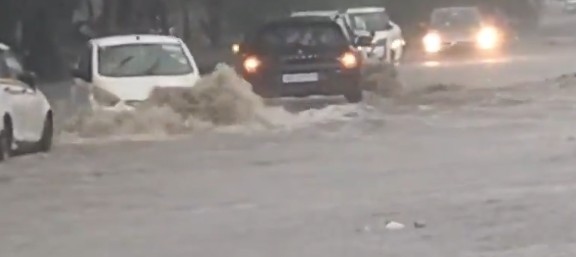
Heavy waterlogging reported in Delhi NCR areas (Image video grab)
By AMIT KUMAR
Surat floods, Mumbai’s red alert, Pune building havoc, Delhi underwater again — inside a monsoon week that broke three cities at once.
New Delhi, July 9, 2026 — By Thursday morning, the pattern had become numbingly familiar: grey skies over the capital, a red alert over Mumbai, and a Pune suburb still counting the trapped after a mountain of garbage came down on a building like a landslide.
Maharashtra, Gujarat and Delhi have spent recent days absorbing what the India Meteorological Department calls extreme rainfall and what everyone living through it is calling something closer to collapse — of roads, of drains, and in at least one case, of a building itself.
The numbers behind the week are stark. Delhi’s Ridge weather station recorded 154 per cent excess rainfall for July, even as the city logged its cleanest air in more than ten months.
Mumbai took in roughly 588 mm of rain over four days earlier in the month, with Vikhroli alone recording 316 mm. Surat took the hardest single hit — 358 mm in 24 hours, enough to leave entire neighbourhoods marooned. And in Pimpri-Chinchwad, more than 600 mm of rain across roughly 30 to 35 hours was enough to loosen an old waste mound and send it crashing into a three-storey building.
Delhi: A 1976 Drainage Plan Meets a 25-Million-Person City
Delhi’s Thursday looked like most of its recent monsoons. The India Meteorological Department issued a red alert for the day as residents woke to grey skies, waterlogged roads and uprooted trees after overnight rain that continued into the morning.
Traffic backed up on NH-24 near Akshardham, a tree came down on Ridge Road near the Rajendra Nagar Gurudwara, and commuters in Ghaziabad’s Abhay Khand waded through standing water that had been accumulating since the night before.
In Sadar Bazar, the damage went beyond inconvenience: continuous rain left the entire wholesale market submerged, with knee-deep water turning streets into ponds, shopkeepers forced to shut up and watch merchandise damaged, and losses running into lakhs and crores in an area that supplies goods nationwide — residents told reporters the same thing happens every year and the drainage system never gets fixed.
Two trees came down in East of Kailash alone, and civic agencies fielded a wave of complaints about waterlogging, fallen trees and power outages.
The complaints track a well-documented structural problem. Delhi’s core drainage network was mapped out under a 1976 master plan — designed, according to Public Works Department records, for a city of around six million people and rainfall loads far smaller than what falls today on a metropolis of over 25 million.
A 2021 GIS-based flood risk study of the capital attributes recurring flooding to the limited carrying capacity of existing river canals combined with dense populations settled in low-lying areas — pressures the drainage network was never engineered to absorb.
Delhi’s Chief Minister Rekha Gupta, asked directly about the recurring crisis, acknowledged the gap between short-term fixes and structural fixes head-on. “This year, we issued the Flood Control Order 2026 well before the monsoon. Every identified waterlogging point has been assigned a nodal officer with clear responsibility and accountability,” Gupta has said in her interviews with the media.
But let me be equally clear, desilting drains every year cannot be Delhi’s permanent strategy, she also added. Her government says it removed more than 34 lakh metric tonnes of silt from the city’s drains ahead of this monsoon and has pushed a public complaints app, but officials themselves caution that even freshly cleaned drains can choke again mid-storm if garbage and debris wash in during the rain itself.
Mumbai and Maharashtra: A Coastal City Built on Reclaimed Land, and a Landslide Made of Garbage
Mumbai’s monsoon test came earlier in July and hasn’t really let up. The IMD issued its highest-level red alert — reserved for conditions severe enough to kill people, bring down buildings, and push civic systems past the point where they can cope — for Mumbai, Thane, Palghar and Raigad, warning of extremely heavy showers, gusty winds and a high tide peaking at 4.19 metres, all converging within the same window.
Low-lying areas flooded first, as they do every year: Andheri, Powai and large stretches of Navi Mumbai went under, the Andheri subway was shut to vehicles, and roads through Sakinaka, Chandivali, Vile Parle, Chembur and Vikhroli closed entirely, along with the stretch linking the Bandra Kurla Complex to the main arterial road
The BMC logged 64 tree-fall incidents and eight building or wall collapses, and deployed close to 10,000 personnel — its largest single mobilisation of the season. Even Lokmanya Tilak Terminus in Kurla had waterlogging inside the station itself, passengers wading to their platforms, in a city where the report notes the drainage infrastructure “has not kept pace with its own population in decades.”
Further inland, Maharashtra’s worst moment of the week had nothing to do with a river or a drain, and everything to do with waste management. In Moshi, on the outskirts of Pimpri-Chinchwad, a three-storey administrative building attached to a waste-to-energy plant was flattened when a decades-old rubbish heap next to it gave way.
Pimpri Chinchwad Municipal Commissioner Vijay Suryawanshi described the mechanism plainly, per media report: “Following heavy rainfall of more than 400 mm over the past two or three days, the waste mound collapsed, much like a landslide, and fell onto the building.”
The civic body said 23 people were initially believed trapped in the debris; six had been rescued by Wednesday night, with rescue teams from the NDRF, the Indian Army, the municipal fire brigade and police working through the night to reach roughly a dozen more.
Pune district’s monsoon rainfall for the month had already blown past its full monthly average within the first week of July, forcing the evacuation of more than 6,000 residents from low-lying localities.
Gujarat: Surat Underwater, Nine Dead
Surat emerged as the worst-hit city in Gujarat, taking 358 mm of rain in the 24 hours ending Wednesday morning and flooding widely as a result. Neighbourhoods near the city’s creek — Limbayat, Udhna, Varachha and Kadodara — were marooned, with NDRF and SDRF teams running rescue operations by boat.
Schools, colleges and anganwadi centres across the city were shut, and at least nine people, including children, have died in rain-related incidents involving electrocution, drowning and falling trees over the past several days.
The state administration has moved thousands of residents out of low-lying areas and distributed food to people stranded in high-rise buildings surrounded by floodwater. Gujarat Chief Minister Bhupendra Patel reviewed the situation directly and directed his ministers to visit the worst-affected districts to oversee relief and rehabilitation work.
The scale of the crisis pulled in national coordination: Union Home Minister Amit Shah spoke with the chief ministers of Kerala, Maharashtra, Gujarat and Jammu and Kashmir to review the situation and assure them of central assistance, a call that followed a landslide-driven debris collapse in Kerala’s Wayanad and flash floods in Jammu’s Doda over the same stretch of days.
Why the Drains Keep Losing
Three states, three different disasters — a submerged wholesale market, a coastal city’s transport network buckling under a king tide, a garbage heap turned killer — but the underlying story is the same one urban planners have been telling for years.
A drainage-focused study of Delhi’s flooding lays it out plainly: the capital’s old drainage system “was not built for a city with such large population and has entirely failed after these rains,” choked further by poor waste control and the near-total absence of routine maintenance.
A parallel national review of Indian urban flooding makes the same point about the country as a whole, noting that rapid concretisation has drastically cut groundwater recharge and increased surface runoff, so that even short bursts of heavy rain now trigger severe waterlogging, while poor solid-waste management leaves plastic and debris choking stormwater channels in cities from Mumbai to Delhi to Chennai.
The same review points to weak Urban Local Bodies — most lacking the financial resources, technical expertise and institutional capacity to build real flood mitigation, with accountability gaps further delaying preventive action — as a root cause running underneath all of it.
Layered on top of ageing pipes and shrinking wetlands is a genuinely changing climate. 2026 was already flagged as a “real weather kicker” of a monsoon year, arriving under the shadow of a super El Niño expected to push ocean surface temperatures more than 2°C above the long-term average — enough, scientists say, to destabilise atmospheric pressure systems and jet streams and supercharge weather events globally.
That combination of a below-normal seasonal forecast and short, ferocious bursts of hyperlocal rainfall — 358 mm in a day over Surat, 600 mm in 35 hours over Pimpri-Chinchwad — is precisely the scenario Indian cities’ colonial-and-Cold-War-era drainage networks were never engineered to handle.
None of the three states lack plans on paper. Delhi has a Flood Control Order and a promised Drainage Master Plan; Mumbai has a 10,000-strong emergency workforce and an alert system tied to tidal charts; Gujarat has NDRF boats on permanent standby in flood-prone districts.
What all three still lack, this week’s damage suggests, is drainage infrastructure built for the rain that’s actually falling now, rather than the rain that used to fall decades ago when most of these systems were designed. Until that changes, the same water will keep finding the same low ground — and the same headlines will write themselves next July.
Where Mumbai’s Workforce Lives: Inside the Vasai-Virar Floods That Keep Coming Back
Follow The Raisina Hills on WhatsApp, Instagram, YouTube, Facebook, and LinkedIn+




About The Author