Corporate Loan Haircuts in India: Who Pays When Big Borrowers Fail?
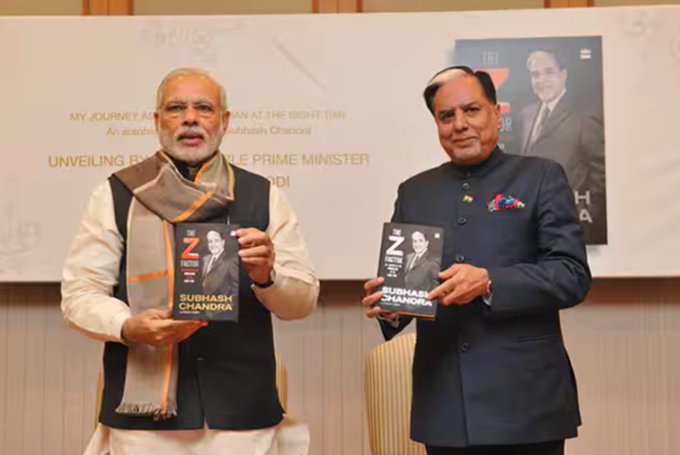
Media baron and defaulter Subhash Chandra with Prime Minister Narendra Modi at his book launch. (Image Chandra on X)
By Prof. S.S. SOMRA
Prof. S.S. Somra examines massive corporate loan haircuts, the limits of the IBC’s recovery framework and the larger question of whether banking losses are ultimately being socialised while accountability remains limited.
Jaipur, August 28, 2026 — The narrative of India’s economic growth is often told through stories of rapidly expanding companies, massive investments, and promises of millions of jobs. Yet, there is another, less glamorous side to this story—a system where large business conglomerates secure loans worth thousands of crores from banks, and when those loans go bad, the brunt of the loss falls upon the banks, investors, and ultimately, the public.
A recent case involving the founder and chairman of the Zee Group has once again brought this uncomfortable question to the fore. The National Company Law Tribunal (NCLT) has approved a repayment plan involving a payout of approximately ₹6.5 crore against admitted claims totaling around ₹22,006.57 crore. This implies a recovery of roughly 0.03 percent for creditors and a ‘haircut’ (debt write-off) of about 99.97 percent. A government note clarified that the cited 99.97% reduction does not represent a 99.97% loss on the ₹22,000 crore loan extended by banks; rather, this shortfall pertains to the amount that could potentially be recovered from the personal guarantor.
However, a question remains: why were the creditors’ earlier demands to scrutinize the guarantor’s assets rejected—assets that now appear to have suffered a massive decline in the declared net worth? Reference was made to net-worth certificates showing figures of ₹45,888 crore in 2017 and ₹40,562 crore in 2018, whereas his current net worth is stated to be around ₹31.79 crore. Meanwhile, government sources have stated that this is a unique case concerning the resolution of a personal guarantor and, therefore, cannot be viewed as a standard precedent for recovery under the Insolvency and Bankruptcy Code.
The 2010 LIC Housing Finance case was similarly shocking. Against an admitted claim of ₹1,322.39 crore, the proposal offers a recovery of approximately ₹38.09 lakh—roughly 0.028 percent. Several institutional lenders had even raised objections to this abysmally low recovery. It is important to understand a crucial distinction here: not every significant ‘haircut’ is, in itself, evidence of crony capitalism. The assets of a bankrupt company may be of such low value that accepting a smaller sum makes better economic sense than engaging in protracted litigation. Even under the IBC, there is no universally mandated minimum recovery percentage. In this specific case, the plan secured the support of creditors holding 80.81 percent of the voting value.
However, this gives rise to a larger question: has it been demonstrated in every instance that the maximum possible recovery of public funds was achieved? This is precisely where India’s past experiences lend gravity to the current case. In the 2019 case of Deccan Chronicle Holdings, a resolution plan involving a payout of approximately ₹408.6 crore was approved against total outstanding dues of around ₹8,335 crore—translating to a haircut of nearly 95.2 percent. Regarding the Videocon Group, a resolution amount of ₹2,962.02 crore was approved against admitted claims totaling approximately ₹64,838.63 crore across 13 cases; the aggregate haircut stood at 95.85 percent. Interestingly, the NCLT itself remarked that the resolution applicant was offering virtually nothing.
Some creditors had even challenged the plan. Apart from these incidents, there is the case of Kingfisher Airlines, where a consortium of banks—including public sector lenders—had extended loans worth thousands of crores of rupees to the company, even restructuring the debt in 2010. The matter subsequently spiraled into default and a protracted legal battle for recovery; before the Debt Recovery Tribunal (DRT), the banks had claimed an outstanding principal amount exceeding ₹6,203 crore.
In other words, the problem is not limited to a single businessperson, bank, or government. The issue lies in an institutional culture where risk assessment during lending can be flawed, loans may undergo repeated restructuring during crises, and losses are ultimately accepted simply as “business decisions.”
ARC Haircuts and Public Money: Why the Supreme Court’s JKM Infra Remarks Matter
This is where the term “crony capitalism” becomes relevant. This does not imply that every successful businessperson is close to the government or that every bank loan is granted corruptly. The real question is: are economic opportunities and risks equal for everyone, or do those with political and business influence enjoy extraordinary protection within the system? If an ordinary family takes a loan of ₹10 lakh and defaults on an EMI, they may face calls from the bank, legal notices, the threat of asset seizure, and social stigma.
Yet, when claims worth thousands of crores against a major business group are settled for a pittance after years of proceedings, the ordinary citizen naturally asks—for whom are the rules so stringent? This question is particularly significant given the rising debt burden on households. According to the latest RBI data, India’s household debt-to-GDP ratio reached 45.5 percent by March 2026, with non-housing retail loans accounting for 58.4 percent of total household borrowings.
Meanwhile, 2024 NCRB data reveals that 52,910 daily wage earners died by suicide that year—representing approximately 31 percent of the total 170,746 recorded suicides. While these figures do not in themselves prove that debt or the banking system caused these suicides—as there are numerous social and economic factors involved—they certainly illustrate the immense burden of economic insecurity borne by the vulnerable sections of society.
Therefore, the real debate should not be about “why a large business received relief,” but rather about who is footing the bill for that relief and how transparent the process of determining its cost is. If a bank has a claim of ₹1,000 crore but accepts ₹20 crore, the public has the right to know, at the very least: On what basis was the original loan sanctioned?
How were the borrower’s creditworthiness and collateral evaluated at that time? What action did the bank take upon receiving early signs of default? Did additional lending or restructuring exacerbate the losses? Who valued the assets, and was an independent valuation conducted? Why was a settlement considered better than liquidation?
Were all avenues regarding the promoter’s other assets and potential recovery explored? And most importantly—could a small borrower have secured such a massive settlement under similar circumstances?
The objective of India’s Insolvency and Bankruptcy Code (IBC) is not merely to declare companies bankrupt but also to preserve value and improve recovery for creditors in a time-bound manner. Consequently, the success of the IBC cannot be measured solely by the number of cases resolved; one must also consider how much the public and the creditors lost during the resolution process. The argument of ‘commercial wisdom’ cannot be the final word here either.
While a plan approved by a majority of creditors deserves respect, the funds public sector banks lend are ultimately linked to the public financial system in one way or another. Therefore, public accountability is just as essential as commercial wisdom. India has witnessed eras of major corporate defaults, banking crises, and poor lending practices in the past; during the 2010s, large infrastructure and corporate loans placed significant strain on bank balance sheets. Cases like Kingfisher have come to symbolize the critical need for rigorous scrutiny of large borrowers during the stages of credit assessment and restructuring.
Therefore, the need today is not to cast a single individual as the villain, but to place the entire process—which grants massive loans only to later normalize huge losses—under scrutiny. Crony capitalism arises when profits are privatized while losses are socialized. When a businessperson reaps the rewards of success but the burden of failure falls largely upon the banking system, depositors, investors, and ultimately the taxpayers, questions regarding accountability in a democracy are bound to arise.
If the administrative machinery exerts its full force to recover a mere ₹1,000 from a poor citizen, yet accepts a pittance against corporate dues worth thousands of crores—dismissing it as a “commercial decision”—public trust in the system erodes. India needs accountability, not just capitalism. Entrepreneurship should not be stifled, but neither should the risks associated with it be socialized.
The issue is not with any specific industrialist; the issue lies with a system where the assessment of banking risks is flawed, the monitoring of large loans fails, and the public is ultimately told that it was all a “business decision.” If this is indeed the optimal economic choice, the government, banks, and the insolvency framework must substantiate it with data. After all, public money is not private venture capital; if the loss is borne by the public, accountability must also be owed to the public.
(This is an opinion piece. Views expressed are the author’s own.)
Subhash Chandra’s ₹22,006 Crore Debt vs ₹6.5 Crore Repayment: The Big IBC Question
Follow The Raisina Hills on WhatsApp, Instagram, YouTube, Facebook, and LinkedIn




About The Author