₹10 Jhaalmuri: Can Modi Break Mamata Banerjee’s Fortress?

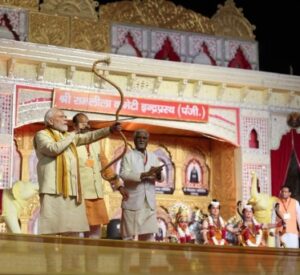
PM Modi eating jhaalmuri at a roadside stall in West Bengal during 2026 election campaign. (Images X.com)
With West Bengal voting in two phases on April 23 and 29, a viral snack video has reignited the central question of India’s most consequential state election: is Brand Modi still powerful enough to pull off a tectonic political upset?
By TRH Op-Ed Desk
New Delhi, April 20, 2026 — A roadside stall. A paper cone. Ten rupees. When Prime Minister Narendra Modi was filmed purchasing and eating jhaalmuri – West Bengal’s beloved spiced puffed-rice snack — from a street vendor during his campaign blitz through the state, it became the most-watched political moment of the election cycle. More than 90 lakh people viewed the clip online, the snack trended on Google, and what might have been a throwaway gesture became the defining image of the BJP’s outreach to a state it has never governed.
The optics were deliberate: a national leader fluent in West Bengal’s cultural language, paying ₹10 for the same snack millions of Bengalis eat every day. The question is whether such a gesture can move an electorate that has returned Mamata Banerjee and her Trinamool Congress (TMC) to power three consecutive times — in 2011, 2016, and 2021.
‘A Political Earthquake’ — The Stakes for All Sides
“If Mamata Banerjee loses this election, it will be a very big political earthquake in Indian politics. And if she wins a fourth straight mandate, nothing can stop her,” Manish Anand, political analyst, said in a monologue for the Raisina Hills YouTube channel.
Anand, speaking in a special episode of his Raisina Hills channel dedicated to the Bengal election, laid out the stakes with unusual clarity. For the BJP, West Bengal is the last major ideological frontier after its 2018 Tripura victory ended decades of Left dominance there. With Kerala once again expected to disappoint the party, Bengal is the only prize left.
Banerjee has set an audacious counter-target: winning more than 215 of the 294 assembly seats — surpassing her own 2021 tally — and reducing the BJP’s 77 seats to rubble. “We will make sure BJP nominees lose their deposits,” she declared at a party gathering in February.
The Cultural Question BJP Cannot Ignore
“The real question is whether West Bengal – India’s cultural nerve centre — culturally accepts the BJP or not. The answer to that question contains the answer to this election,” added Anand.
Anand argues that the BJP’s core challenge is not organisational but cultural. Bengal has a composite, syncretic identity — Durga Puja celebrations that Muslims and Hindus attend together, a cuisine built on fish, a secular political tradition across TMC, Congress, and the Left. The BJP, associated in the popular imagination with Hindutva politics and vegetarianism, has tried to counter this with fish-market rallies and pro-machh yatras. But the counter-narrative — that a BJP government would ban fish-eating — retains powerful emotional traction, precisely because it cuts to questions of identity, not merely policy.
The Women Factor: TMC’s Structural Fortress
If culture is one wall the BJP must breach, women voters are another. Anand cites survey data showing that roughly 52-53% of women in West Bengal vote for the TMC — a loyalty built over fifteen years of Ma, Mati, Manush politics, reinforced by the fact that about 37% of TMC’s Lok Sabha MPs are women. In a state where women vote in large numbers, this gender-based trust is a structural advantage that no single campaign moment, however viral, can easily dislodge.
“Bhadralok anger is not a new story. They were angry in 2016, they were angry in 2021. Yet despite that anger, TMC’s dominance in Bengal has not weakened — it has only strengthened,” stressed Anand.
The Abhishek Factor and Anti-Incumbency
Anand also highlights a variable national media sometimes underweights: Abhishek Banerjee, Mamata’s nephew and TMC’s national general secretary, whose grip on party organisation has tightened in recent years. A sharp strategist who has professionalised the TMC ground game, Abhishek has become an independent centre of political gravity — a factor that could prove decisive in the close contests that will determine the final margin.
Against this, the BJP’s ammunition is real. Anti-incumbency after fifteen years in power, an industrial economy that has stagnated since the 1970s exodus of major corporates, persistent law-and-order concerns, and the non-implementation of several central government welfare schemes all weigh against the ruling party. Government employees, Anand notes, are also discontented over pay commission and pension disparities with other states.
Verdict: Too Close to Call, Too Big to Ignore
Opinion polls project the TMC winning between 140 and 160 seats — a majority, but short of Banerjee’s 215-seat target — with the BJP projected at 130 to 150, suggesting a tighter race than 2021. Votes will be counted on May 4.
The jhaalmuri video may have 90 lakh views. Whether those views translate into votes — and whether Brand Modi can finally outweigh fifteen years of Mamata Banerjee’s ground-level politics — is the question Bengal, and all of India, will answer in a fortnight. As Anand concludes: which way Bengal sits, only the coming time will tell.
Follow The Raisina Hills on WhatsApp, Instagram, YouTube, Facebook, and LinkedIn




About The Author