Trump & Crypto Ethics: The WLFI Token Controversy Explained
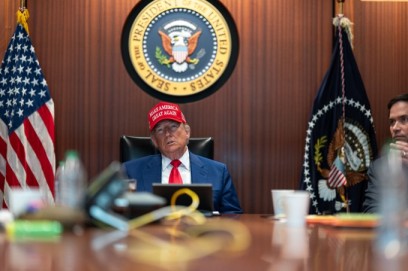
President Donald J. Trump in The Situation Room, June 21, 2025! (Image The White House)
The Locked Coin and the Golden Door: Trump, World Liberty Financial, and the Ethics of Political Crypto
By P. SESH KUMAR
New Delhi, May 5, 2026 — A Bloomberg report alleges that World Liberty Financial (WLF), the Trump-family-linked crypto venture, privately sold WLFI tokens while many ordinary early token holders remained largely unable to exit. The charge is not merely that a crypto project made money; it is that a politically connected enterprise used the language of “democratised finance” while creating a structure in which insiders, private buyers, and politically useful capital appeared to enjoy flexibility that smaller holders lacked.
The facts available from World Liberty’s own documents show that WLFI or token was originally sold as a non-transferable governance token, with no dividend, no equity, no revenue share, and no guaranteed resale market. Later, 20 per cent of early-sale tokens became unlockable, while the balance depended on governance decisions. That structure gives the project a legal defence: purchasers were warned.
But it also leaves a governance and ethics problem: when the President’s family benefits from a crypto venture in an industry shaped by presidential policy, disclosure alone may not be enough to cure the conflict.
The background is dramatic. World Liberty Financial (the Enterprise) was marketed as a bridge between DeFi and American financial power. Its “Gold Paper” says WLFI (token) holders get voting rights over certain protocol matters, but not ownership of the company, not membership rights, not dividends, and not revenue participation.
It also says World Liberty remains administratively controlled through multisig arrangements and that the company retains discretion over proposal screening and implementation. In plain English, the token looked like a vote without a purse, a voice without ownership, and a governance badge without the normal protections of a shareholder.
The authenticity of the basic story is strong because the core architecture is confirmed by World Liberty’s own materials. Its governance forum stated that all WLFI would be “non-transferable and locked indefinitely,” that purchasers should assume no secondary market, and that the token carried no economic rights. Its later official unlock page confirms that tokens were sold between about October 14, 2024 and March 14, 2025 at $0.015 and $0.05, and that only 20 per cent became available for unlocking on September 1, 2025, subject to a token unlock agreement.
The rationale offered by defenders is straightforward. Crypto projects often impose lock-ups to avoid dumping, preserve protocol stability, satisfy regulatory concerns, and ensure that governance is not immediately converted into speculative churn. World Liberty can also argue that purchasers were not trapped by surprise: the documents repeatedly warned that WLFI was non-transferable, non-refundable in economic substance, and not to be bought with an expectation of resale or appreciation.
In that narrow contractual sense, the project has a defence. A person who bought WLFI was not buying an ordinary listed security; he was buying a restricted governance token in a speculative political-crypto ecosystem.
In the United States, crypto regulation isn’t a single, clean statute-it is a high-stakes turf war dressed up as oversight, where the Securities and Exchange Commission treats many tokens as securities under the centuries-old Howey Test, the Commodity Futures Trading Commission claims commodities jurisdiction over assets like Bitcoin and Ethereum, and the Financial Crimes Enforcement Network polices money laundering through KYC/AML rules-while state regulators pile on with their own licensing regimes like New York’s BitLicense; the result is not a system but a patchwork, where exchanges are regulated, tokens are litigated, and innovation runs ahead of clarity.
The deficiency is not just technical-it’s structural: regulators are retrofitting 20th-century laws onto 21st-century code, leaving grey zones that savvy players exploit; yet it’s too simplistic to say crypto “cannot” be regulated-rather, the political economy of innovation, lobbying, and global competition ensures that some ambiguity is tolerated, if not quietly convenient, allowing the U.S. to police fraud aggressively while still keeping the golden goose of fintech innovation from flying offshore.
But the critique has force because disclosure is not the same as fairness. If a project raises hundreds of millions from buyers using the magnetism of presidential proximity, while routing major token-sale revenues to Trump-linked entities, then the question shifts from “was it technically disclosed?” to “was the arrangement ethically clean?” Reuters reported that World Liberty’s bylaws route 75 per cent of WLFI token-sale revenue to the Trumps, and Reuters calculated that World Liberty was the single largest source of Trump Organization crypto income in the first half of 2025. World Liberty’s lawyer called Reuters’ valuation and income analysis inaccurate and misleading but did not elaborate, according to Reuters.
The sharpest implication is conflict of interest. The President is not merely a celebrity endorser in this story. He is the head of the executive branch at a time when the crypto industry is seeking favourable regulation, stablecoin legitimacy, enforcement relief, and access to the commanding heights of American financial policy. Reuters also reported litigation by Justin Sun, who alleged that World Liberty froze his WLFI tokens and threatened to burn them; World Liberty’s Zach Witkoff called Sun’s claims meritless and said action was required to protect the company and users. That lawsuit does not prove wrongdoing by World Liberty, but it exposes the fragility of a governance model where token-holder rights can be technologically and contractually constrained by those controlling the protocol.
The White House defence is that Trump has taken steps to avoid conflicts by placing business holdings in a trust controlled by his sons, and it has denied that the President or his family engaged in conflicts of interest. That defence matters; public analysis must not convert suspicion into conviction. A trust structure, family management, disclosed documents, accredited-investor restrictions, and token lock-up warnings are all relevant mitigating facts. But the counterpoint is equally plain: a trust controlled by family members is not the same as a blind trust, and a disclosed profit stream from a regulated industry does not automatically remove the public-interest concern when the regulator-in-chief is also politically and financially associated with the sector.
The pros of the project are not imaginary. It brought political visibility to DeFi, tried to move crypto from offshore shadows into a more American, tax-paying corporate structure, and gave token holders at least some formal governance voice. For supporters, World Liberty represents ideological alignment: a pro-crypto administration, a patriotic financial technology brand, and a promise to make the United States the “crypto capital” of the world. The project may also be seen as a lawful private venture operating in a high-risk market where sophisticated buyers accepted the rules.
The cons, however, are heavier. WLFI’s governance rights appear limited, economic rights are absent, liquidity was restricted, insider economics were rich, and the political branding was unusually powerful. The structure allowed the project to raise large sums without giving purchasers the ordinary bundle of rights associated with equity or debt. It also created the appearance that access to political aura could be monetised through token sales. In public ethics, appearance is not a cosmetic issue; it is the oxygen of trust.
The lesson is blunt. Crypto cannot be allowed to become the new backdoor of political finance, where influence, fandom, speculative hunger, and regulatory dependence merge into one tradable instrument. A politically exposed crypto venture needs stricter disclosure than a normal token project, not weaker scrutiny. It should disclose beneficial ownership, insider allocations, lock-up terms, related-party revenue shares, private placements, major purchasers, conflict-mitigation arrangements, governance controls, freeze powers, and redemption or liquidity risks in simple language. Without that, “decentralisation” becomes theatre, and “community governance” becomes a curtain in front of private control.
In the end, the Bloomberg story is not simply about stuck holders. It is about the moral hazard of converting political power into crypto liquidity. World Liberty may have legal answers. It may even have contractual warnings on its side. But a republic must ask a harder question than whether the fine print was clever. It must ask whether public office, private enrichment, regulatory power, and speculative finance have been kept far enough apart for citizens to trust the system.
Crypto Crossroads: India’s Tightrope Between Control and Chaos
India’s takeaway from this episode is stark and urgent: it cannot run a trillion-rupee digital market on whispers, warnings, and half-measures. With the Reserve Bank of India (RBI) and the Government of India already signalling deep discomfort with cryptocurrencies, the real risk is not crypto itself but the regulatory fog around it-where retail investors wander blind, exposed to volatility without safeguards. The choice is no longer between ban and benign neglect; it is between clarity and chaos- can we not define what tokens are, force disclosures, track flows, ring-fence retail exposure, and bring exchanges under a hard regulatory lens? If we move decisively, the Government and RBI can turn scepticism into strength and write the rules of the game; if we dither, we will keep watching the game being played elsewhere-with Indian money still on the table.
What may really be holding back decisive action is not ignorance-it could be a knot of competing risks, institutional limits, and strategic hesitation. The RBI may worry that legitimising private crypto could undercut monetary control, fuel capital flight, and weaken the case for its own Digital Rupee; the Government of India, meanwhile, faces a policy minefield where consumer protection, tax revenues, innovation, and electoral optics all pull in different directions. Add to this the jurisdictional overlap with Securities and Exchange Board of India, Enforcement Directorate and tax authorities, the global nature of crypto (which slips across borders faster than rules can catch it), and the absence of a settled international template- the Government does not want to overregulate and lose innovation, or under-regulate and invite a crisis. The result is a cautious, calibrated pause: not paralysis, but a deliberate reluctance to move fast in a market where one wrong step can either choke the future or open the floodgates.
India thus, stands at a decisive inflection point-if it replaces ambiguity with clear, firm rules, it can turn crypto from a speculative gamble into a regulated engine of innovation and trust. But if hesitation continues, the market will keep racing ahead in the shadows, leaving the RBI and the Government of India reacting to crises instead of shaping the future.
(This is an opinion piece. Views expressed are the author’s own.)
Follow The Raisina Hills on WhatsApp, Instagram, YouTube, Facebook, and LinkedIn




About The Author