Trump’s $1M ‘Gold Card’ Visa Approves Just One Applicant
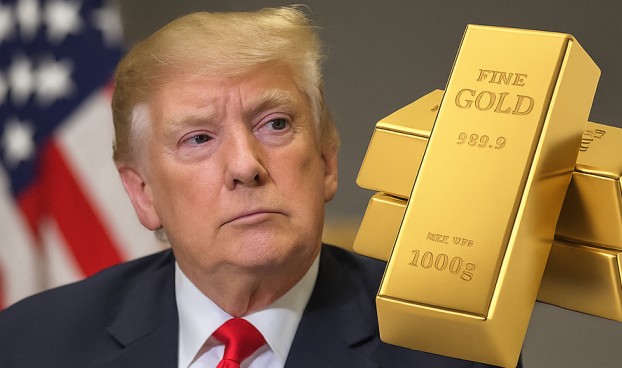
US President Donald Trump and tariffs on gold! (Image TRH)
Commerce Secretary Howard Lutnick confirmed the lone approval at a congressional hearing, even as hundreds remain in the queue — and critics call the programme a study in contradictions.
By S. JHA
Mumbai, April 24, 2026 — Four months after it launched with considerable fanfare, Donald Trump’s flagship “Gold Card” visa programme has produced exactly one approved applicant. The admission came Thursday from the man who helped design it.
Commerce Secretary Howard Lutnick, testifying at a House subcommittee hearing, confirmed that the Trump administration has approved just one “gold card” visa since starting to accept applications in December — a residency permit available to foreigners who pay a $1 million donation to the U.S. government. He was quick to add context. “They have approved, recently, one person, and there are hundreds in the queue,” Lutnick said. “They wanted to make sure they did it perfectly.” He further described the vetting process as “the most serious… in the history of government.”
The disclosure creates an uncomfortable contrast with earlier claims. After the programme launched in December, Lutnick had said the government sold $1.3 billion “worth” of gold cards in just several days, as Trump stood by holding up the gilded ticket. Lutnick did not address the apparent discrepancy when pressed by a congresswoman at Thursday’s hearing.
How the Programme Works
US President Trump launched the Gold Card programme in December, allowing applicants to pay a $15,000 non-refundable fee to the Department of Homeland Security for expedited processing. After a background check, applicants must then make a $1 million “contribution” to receive a visa similar to a green card, granting the right to live and work in the United States. Successful applicants receive lawful permanent resident status as an EB-1 or EB-2 visa holder. Trump had initially floated a price of $5 million, before settling on the $1 million threshold.
The Contradiction at the Heart of the Policy
The Gold Card exists in pointed tension with the broader thrust of Trump’s immigration agenda — the most restrictive in modern American history. The rollout came even as the Trump administration expanded enforcement measures, halted immigration applications from 19 countries under the travel ban, and froze all decisions on asylum cases approved during the Biden administration. In September, Trump had ordered a $100,000 fee for new overseas H-1B visa applicants, sparking concern among foreign students and tech companies.
Critics have argued that the Gold Card approach prioritises wealth over merit and may not effectively address economic concerns, even as the administration looks to remove millions of undocumented immigrants. Congressman Ro Khanna called for a merit-based alternative, saying the US should “welcome talented workers to America who will bring their creativity and productivity while also reforming the H1-B program to prevent abuses.” A federal lawsuit has also been filed against the programme, alleging illegal secrecy and a “pay-to-play” immigration scheme.
The idea of golden visas is not new — dozens of countries, including the United Kingdom, Spain, Greece, Malta, Australia, Canada and Italy, offer versions of residency-for-investment programmes to wealthy individuals. What is new is the overt branding: Trump’s name on the card, his face on the prototype, and a White House that has simultaneously made the expulsion of the poor and the admission of the rich twin pillars of the same immigration policy.
Kharg Island explained: why the US plan will make Iran smile
Follow The Raisina Hills on WhatsApp, Instagram, YouTube, Facebook, and LinkedIn




About The Author