Tariffs Blocked, Trump Unbowed: What the Verdict Means Now
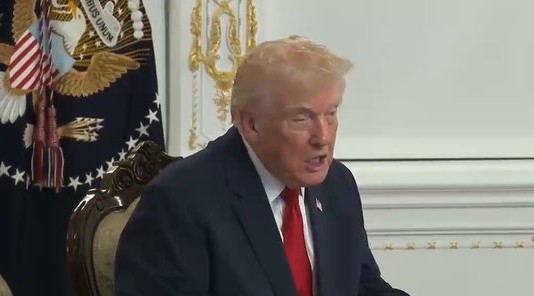
US President Donald Trump speaks after the killing of US National Guard Sarah Beckstrom in DC shootout. (Image X.com)
In a 6–3 decision, the Supreme Court rules IEEPA does not authorize unilateral tariffs, as Donald Trump defends his trade policy and vows alternative options.
By TRH World Desk
New Delhi, February 20, 2026 — A dramatic constitutional clash over trade powers has unfolded after the US Supreme Court struck down US President Donald Trump’s use of emergency authority to impose sweeping tariffs — even as Trump insisted he has other options and claimed major success in shrinking the trade deficit.
The Supreme Court Trump tariffs ruling declares that IEEPA does not authorize a president to impose unilateral tariffs, reshaping the balance of trade powers between Congress and the White House.
What the Court Said
In a 6–3 ruling in Learning Resources, Inc. v. Trump, the Court held that the International Emergency Economic Powers Act (IEEPA) does not grant the President authority to impose tariffs.
Chief Justice John Roberts wrote: “The President asserts the extraordinary power to unilaterally impose tariffs of unlimited amount, duration, and scope. In light of the breadth, history, and constitutional context of that asserted authority, he must identify clear congressional authorization to exercise it.”
Roberts further noted that IEEPA “contains no reference to tariffs or duties,” adding that no prior president had interpreted the statute to authorize taxation powers.
The ruling affirms that under the Constitution, the authority to levy taxes and tariffs rests with Congress — not the executive branch.
Trump: “A Disgrace” — But “Prepared”
Despite the setback, Trump remained defiant. According to a post on X by CNN’s Kaitlan Collins, Trump described the ruling as a “disgrace” during a White House breakfast with governors, while indicating he has a backup strategy to continue his trade agenda.
In a separate post, Trump claimed: “The United States trade deficit has been reduced by 78% because of the tariffs being charged to other companies and countries. It will go into positive territory during this year, for the first time in many decades.”
The trade deficit claim is likely to fuel further scrutiny from economists and lawmakers amid the constitutional ruling.
Pence: “Victory for Separation of Powers”
Former Vice President Mike Pence hailed the decision as a landmark affirmation of constitutional checks and balances.
Calling it a “Victory for the American People,” Pence said the ruling reaffirmed that “Congress — not the President — has the power to tax.” He added that American families and businesses bear the cost of tariffs, not foreign governments.
Pence also credited his organization, American Freedom, for contributing to the case through an amicus brief.
Trade Policy at a Crossroads
The Supreme Court Trump tariffs ruling could significantly alter the trajectory of US trade policy. If unilateral emergency tariffs are constrained, future administrations may need explicit congressional approval for sweeping trade measures.
The broader debate now shifts to: Whether Trump can pursue alternative statutory authorities; How Congress responds to renewed trade tensions; And whether markets react to the legal limits imposed on executive trade power.
With Trump signaling that tariffs “can continue” under other mechanisms, the battle between economic nationalism and constitutional guardrails is far from over.
Modi vs Trump Tariffs: How India Quietly Recalibrated Strategy
Follow The Raisina Hills on WhatsApp, Instagram, YouTube, Facebook, and LinkedIn




About The Author