From Sushma Swaraj to Jaishankar: India’s UN Message on Terrorism Has Remained Consistent
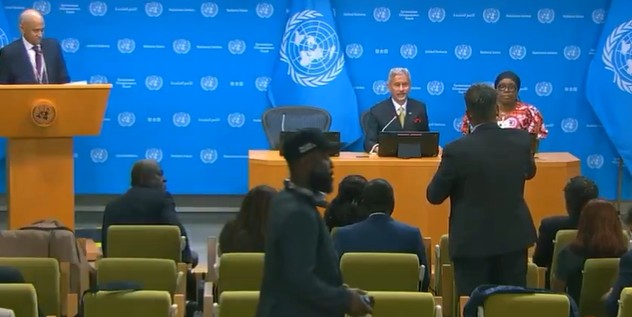
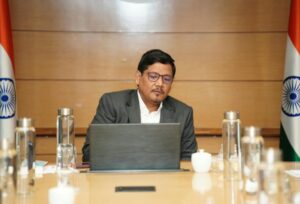
From Sushma Swaraj's 2016 UNGA address to S Jaishankar's September 2026 exchange at the UN, terrorism has remained central to India's diplomatic messaging on Pakistan. (Image video grab)
By NIRENDRA DEV
From Sushma Swaraj’s 2016 UNGA speech after the Uri attack to S Jaishankar’s Friday exchange with a Pakistani journalist, India’s diplomatic messaging on terrorism has retained a common thread.
New Delhi, September 26, 2026 — Nearly a decade after Sushma Swaraj delivered one of India’s most direct statements on terrorism at the United Nations General Assembly, External Affairs Minister S Jaishankar on Friday, responded sharply to a Pakistani journalist who questioned India over alleged sponsorship of terrorism.
“A terrorist country is asking me that question. Come on,” Jaishankar said at the UN headquarters in New York after the Pakistani journalist asked: “When will your government stop sponsoring terrorism in Pakistan?”
India’s Permanent Representative to the UN, Harish Parvathaneni, then told the journalist: “You have heard your reply. You have heard your response, loud and clear.” The exchange took place during a press interaction involving Jaishankar and Liberian Foreign Minister Sara Beysolow Nyanti on maritime security.
The September 25, 2026 exchange inevitably recalls Sushma Swaraj’s UNGA intervention of September 26, 2016, when she put terrorism at the centre of India’s response to Pakistan.
Sushma Swaraj’s 2016 UNGA message
Swaraj, then External Affairs Minister, described terrorism as “the biggest violation of human rights” and “a crime against humanity”. She questioned who finances, arms and provides sanctuaries to terrorists and argued that countries sheltering terrorists should be held accountable.
Her remarks came days after the September 18, 2016 Uri terror attack, in which 19 Indian Army personnel were killed. Swaraj referred directly to Uri in her UN address and accused Pakistan of supporting cross-border terrorism.
She also responded to Pakistan’s claims concerning Jammu and Kashmir, stating that India had attempted dialogue and friendship but had received attacks including Pathankot and Uri in return.
Her message on Kashmir was unequivocal: Jammu and Kashmir was an integral part of India and, in her words, Pakistan should “abandon this dream” of claiming it.
Swaraj also raised Balochistan in response to Pakistan’s allegations concerning human rights in Jammu and Kashmir, telling Pakistan to introspect about its own record.
“Bajradapi Kathorani, Mriduni Kusumadapi”
In 2016, Lok Sabha Speaker Sumitra Mahajan was quoted as praising Swaraj’s UN intervention, referring to the Sanskrit expression: “वज्रादपि कठोराणि मृदूनि कुसुमादपि।”
The expression conveys the idea of being firm like a thunderbolt while also being gentle like a flower.
That formulation was used to describe the contrast between Swaraj’s firmness on issues concerning terrorism and India’s national interests and the softer diplomatic language often associated with engagement between states.
The political and diplomatic circumstances have changed since 2016. The underlying issue, however, has remained central to India’s messaging at international forums: terrorism and the alleged support structures behind it cannot be separated from the broader India-Pakistan relationship.
2018-19: Sushma’s approach and Jaishankar’s arrival
The same continuity was visible in 2018 and 2019.
At the SAARC Foreign Ministers’ meeting on the sidelines of the UNGA in 2018, Swaraj spoke of terrorism as a major threat to peace and stability in South Asia. She left after making her remarks and did not have an exchange with Pakistan’s then Foreign Minister Shah Mahmood Qureshi.
A year later, in September 2019, Jaishankar was confronted with the question of how India would deal with Pakistan after the abrogation of Article 370.
At a press conference, he framed SAARC in terms of regional cooperation, trade and connectivity, while asking which country was promoting the regional organisation and which was impeding it.
During his New York engagements that September, Jaishankar also used the term “Terroristan” while describing India’s difficulty in dealing with Pakistan over terrorism. He argued that India had no problem talking to Pakistan but had a problem talking to “Terroristan”, and said terrorism could not be used as an instrument of statecraft.
From “Terroristan” to the UN exchange of 2026
The September 25, 2026 exchange therefore fits into a longer pattern of India’s public diplomatic messaging under successive External Affairs Ministers.
Swaraj’s 2016 intervention came in the aftermath of Uri and focused on terrorism, Pakistan’s alleged support for militant groups and India’s position on Jammu and Kashmir.
Jaishankar’s interventions in 2019 came amid the Article 370 decision and a renewed confrontation with Pakistan over terrorism and Kashmir.
The latest exchange at the UN in 2026 was shorter and more pointed. A Pakistani journalist accused India of sponsoring terrorism; Jaishankar responded by turning the accusation back on what he described as a “terrorist country”.
The language has changed from Swaraj’s detailed UNGA speech to Jaishankar’s brief verbal exchange. But the central theme of India’s diplomatic response has remained remarkably consistent: terrorism remains a defining issue in its engagement with Pakistan, and New Delhi continues to reject attempts to frame terrorism and Kashmir exclusively through allegations against India.
For Jaishankar, the September 25 exchange also came at the same international forum where Swaraj, a decade earlier, had made terrorism the centrepiece of India’s response to Pakistan.
The contrast between the two occasions is striking: Sushma Swaraj spoke at length from the UNGA podium in 2016; Jaishankar needed only a few words in 2026.
Pakistan Recalls Osama bin Laden Amid Push for Terrorism Tag
Follow The Raisina Hills on WhatsApp, Instagram, YouTube, Facebook, and LinkedIn




About The Author