Iran Offers a 7-Day Deal to Reopen Hormuz — Why Natural Gas Markets Aren’t Popping Champagne Just Yet
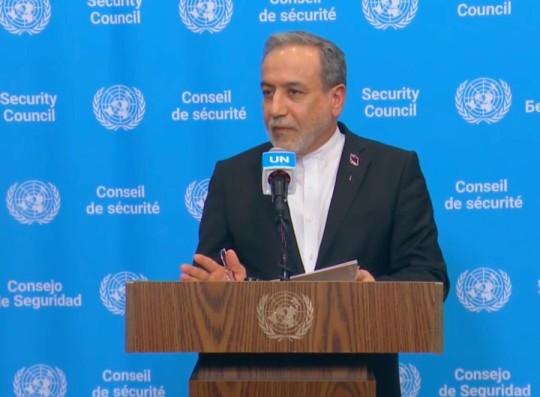
Iran FM Araghchi speaks on the sidelines of the UNGA on a fresh proposal. (Image X.com)
By S. JHA
Tehran’s foreign minister has floated a fast-tracked de-escalation plan through Qatari mediators at the UN, and Washington says the conversations are “positive.” But global gas markets, scarred by a June ceasefire that collapsed within weeks, are treating this latest overture with caution rather than relief.
Mumbai, September 26, 2026 — Iran has proposed a seven-day plan to reopen the Strait of Hormuz and resume talks on its nuclear program, conditional on the United States lifting its naval blockade, waiving sanctions on Iranian oil sales, and observing a ceasefire that would extend to Lebanon. Iranian Foreign Minister Abbas Araghchi detailed the proposal at a private gathering on the sidelines of the UN General Assembly in New York on Thursday, with the reopening timetable able to begin “as soon as Washington accepted the proposal.”
What’s Actually Being Offered
The plan, conveyed to Washington through Qatari mediators, closely mirrors an interim deal reached in June — but on a dramatically accelerated timeline. That earlier Memorandum of Understanding called for a 60-day interim period before quickly collapsing when Iran resumed attacks on shipping through the strait.
Al Jazeera reported that Araghchi separately met U.S. envoy Steve Witkoff and Trump’s son-in-law Jared Kushner on Tuesday, in talks mediated by Qatar, and described the exchange as “productive,” saying messages continued passing between the two sides.
Washington’s public response has been notably careful. The White House said only that U.S. officials are having “positive and constructive conversations with mediators on the Iran war,” while separately noting the U.S. “is facilitating significant oil exports through the Strait of Hormuz.”
Secretary of State Marco Rubio was more explicitly cautious, telling reporters “it would be wrong to describe the meeting as a major breakthrough,” even as he said “if there’s an opportunity to exchange ideas and messages, we will.”
Why Scepticism Is Running High
Analysts following the negotiations see real reason for both sides to want a deal — and real reason to doubt one will hold. Trita Parsi, executive vice president of the Quincy Institute, who attended Araghchi’s briefing, wrote the Iranian foreign minister suggested a speedy agreement would help President Trump politically ahead of November’s midterms. “If Trump calculates this arrangement is worthwhile and can bring political benefit before the midterms and reduce gas prices, perhaps we’ll see flexibility not seen in previous weeks,” Parsi wrote — while also flagging “deep suspicion,” particularly around concerns that Iran could use the arrangement simply to buy time to sell more of its oil and ease its own economic pressure.
Other regional analysts were more sceptical the timeline would move Washington at all. Middle East analyst Coningham told Al Jazeera, “Trump is prepared for this to go on through the midterms,” adding that “the same problem remains where the proposal does not answer questions about the nuclear file.”
Burcu Ozcelik, a senior research fellow for Middle East security, told the same outlet that the core blockage between Washington and Tehran is that “each is making different assumptions about how much pressure they can exert on the other.”
What This Means for Gas Prices: A Market Already Scarred
To understand why gas markets are reacting cautiously rather than euphorically to this news, it helps to understand how badly the Strait of Hormuz conflict has already scrambled global gas flows.
Iranian strikes on Qatar’s Ras Laffan Industrial City in March — the world’s largest LNG export facility — damaged two liquefaction trains and knocked out roughly 17% of Qatar’s export capacity, or 12.8 million tonnes a year, according to GIS Reports and CNBC. QatarEnergy declared force majeure on long-term contracts and estimated the damage would cost $20 billion a year in lost revenue and take up to five years to fully repair.
The price impact has been sharp but geographically uneven — a distinction crucial to understanding “what holds” for gas markets going forward.
Europe’s benchmark Dutch TTF contract and Asia’s Japan-Korea Marker (JKM), which both depend heavily on seaborne LNG shipments that transit Hormuz, have swung wildly with each escalation: the U.S. Energy Information Administration recorded TTF up 35% and JKM up 51% in the weeks after the initial closure, while Kpler tracked TTF hitting $20.91/MMBtu in July — its highest close since January 2023 — as renewed hostilities pushed the market from a “de-escalation” to a “prolonged crisis” scenario.
By contrast, the EIA noted U.S. Henry Hub prices actually fell roughly 9% over the same initial period, thanks to ample domestic storage and limited near-term ability to route more gas into LNG exports — meaning the domestic U.S. gas market has been comparatively insulated from the worst of the Hormuz-driven volatility, even as international benchmarks have been anything but calm.
The Pattern That Should Temper Optimism
The most important lesson for gas markets from this latest proposal is one the market has already learned the hard way once this year: the June MoU that this new plan closely resembles collapsed within weeks when Iran resumed attacks on shipping. Kpler analyst Laura Page, commenting on the market’s mood after that earlier ceasefire, said “continued uncertainty surrounding negotiations throughout the implementation period should preserve some residual risk premium” — a dynamic likely to repeat with this fresh proposal even if Washington responds favourably.
Given that Qatar’s Ras Laffan facility itself may take years to fully repair regardless of any ceasefire’s durability, a chunk of the elevated pricing in European and Asian gas markets looks likely to persist independent of whether this specific seven-day plan succeeds or fails — meaning traders are likely to treat any near-term price relief as provisional until Qatari export capacity is genuinely restored and a ceasefire demonstrably holds beyond its first few weeks.
Follow The Raisina Hills on WhatsApp, Instagram, YouTube, Facebook, and LinkedIn




About The Author