End of an Era: Nitish Kumar Quits Bihar Council, What Comes Next
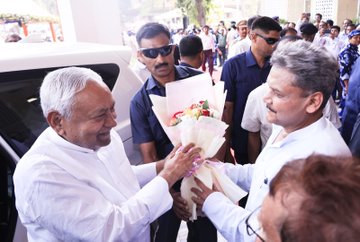
Bihar CM Nitish Kumar on Monday (Image JD (U) on X)
Tears in the chamber. Twenty years of dominance drawing to a close. And a state now asking: who comes next — and can anyone fill the space?
By TRH Political Desk
New Delhi, March 30, 2026 — An era in Bihar politics ended in emotion on Monday. Nitish Kumar, who has governed the state for more than two decades and reshaped it from a byword for lawlessness into a model of administrative recovery, resigned from the Bihar Legislative Council following his election to the Rajya Sabha. His resignation from the Chief Minister’s post is expected to follow within days.
The atmosphere inside the Legislative Council was charged. Colleagues wept. The farewell, says political analyst Manish Anand of The Raisina Hills, felt less like a routine resignation and more like a state sending off its most consequential political figure.
“It was a deeply emotional moment. There were tears in the eyes of colleagues in the Legislative Council. His associates were practically bidding him farewell,” said Manish Anand in a monologue for The Raisina Hills.
Twenty Years, Three Political Eras
To understand what Nitish Kumar’s departure means, Anand argues, you must first understand what Bihar looked like before him.
In the 1980s, the state churned through seven Chief Ministers in a single decade — each one installed or removed according to the mood in Delhi. Bihar was, in effect, governed by proximity to the Congress high command, not by popular mandate.
That changed in March 1990, when Lalu Prasad Yadav took over and dismantled Delhi’s stranglehold on Bihar politics. The 15 years that followed were defined by two competing legacies. Lalu’s admirers credit him with launching a social justice revolution — a Mandal-era politics that upended caste hierarchies. His critics call those same 15 years the “jungle raj”: kidnappings, murders, and dacoity so normalised that people in Bihar, Anand recounts, were afraid to leave their homes after dark.
“Law and order had collapsed entirely. Kidnappings, murders, robbery — these had become almost routine in Bihar. People were reluctant to step out of their homes after sunset,” added Anand.
By 2005, voters were exhausted. It was into this exhaustion that Nitish Kumar arrived.
The Nitish Decade: From Jungle Raj to Mainstream India
Nitish Kumar had been a Lalu associate. He broke away, built a new party alongside socialist veterans including George Fernandes, and aligned with the BJP. What distinguished him from others in that socialist firmament, Anand notes, was a quality his peers explicitly praised: he was not driven by self-interest, dynastic ambition, or ideological opportunism.
“George Fernandes and other stalwarts would say: this man is not with you for the day. Self-interest is not with him. Dynasticism is not with him. He walks the path of principled politics. That is why, while the other giants of socialism fell behind, Nitish Kumar’s stature kept growing,” added Anand.
His stature grew so large that, for a period, Nitish Kumar was seriously discussed as a potential Prime Minister. Even Sushil Kumar Modi, then the BJP’s senior Bihar leader and a close ally, said openly that Nitish Kumar possessed genuine prime ministerial qualities.
Destiny intervened in 2013. The Narendra Modi wave was building. Nitish Kumar cancelled a BJP dinner in Patna in protest. The break was public and acrimonious. And yet, years later, Nitish Kumar read the direction of Indian politics, recognised the Modi factor as a permanent constant, and chose to align with it — pledging, this time, that he would not switch sides again.
He did not fully keep that pledge. His tenth swearing-in as Chief Minister, most recently, lasted barely four months before he announced his intention to step down.
‘Tiger Is Still Alive’: How Nitish Kumar Won Most Stunning Mandate
The Questions Bihar Must Now Answer
The resignation triggers a question Bihar’s political class is struggling to answer: who comes next — and can anyone match Nitish Kumar’s stature?
Anand is direct. “Neither JD (U) nor BJP’s Bihar unit has anyone with Nitish Kumar’s stature. Whoever becomes Chief Minister — if from BJP, they will depend on the Delhi high command for decisions; if from JDU, Nitish Kumar and his inner circle may retain the remote control,” he added.
What Anand anticipates is a bureaucracy-driven government. A new cohort of IAS officers with experience in the Modi administration in Delhi is likely to move to Patna, effectively becoming the functional spine of governance regardless of who holds the CM’s chair. Their communication lines will run directly to the PMO.
This, Anand says, carries both promise and risk. The promise: faster clearance of projects, fewer roadblocks, direct alignment with central schemes. The risk: Bihar is a large, complex, sub-regionally diverse state. A Chief Minister who lacks genuine political roots, personal credibility, and a firm grip on the bureaucracy will struggle to manage it — regardless of which phone calls he takes from Delhi.
“Whoever becomes Chief Minister must prove very quickly — in a very short window — that they are not a remote control. First, that they understand governance. Second, that they have a firm grip on the bureaucracy. Because law, order, and anti-corruption can only be established when the Chief Minister’s own hold over the administration is strong — and when they have the capacity to monitor it around the clock,” added Anand.
The 2029 Clock Is Already Ticking
Bihar’s new Chief Minister will not have the luxury of a long settling-in period. The BJP contested the last Bihar assembly election on a manifesto that promised industrial investment in every district and substantial youth employment. The 2029 Lok Sabha election will be fought on whether those promises were kept — and Bihar’s voters will want to see results well before polling day.
With JD (U) holding 84 seats and BJP’s Bihar tally only marginally higher, the coalition arithmetic is tight. How the two parties coordinate — whether through a formal mechanism or informal alignment — will shape both governance and the lead-up to 2029.
Bihar’s dual-era of Lalu and Nitish — two giants who between them dominated the state for 35 years — is over. The state is now in genuinely open political territory.
“Both Lalu Prasad Yadav and Nitish Kumar — the two giants of Bihar politics — are now leaving the main stage. A new character will emerge. But the question is: can that character match either of them in personality, in stature? The honest answer, at this moment, appears to be: no,” said Anand.
Nitish Kumar: Politics, Protégé and the Question of Political Twilight
At a Glance
| Factor | Detail |
| Event | Nitish Kumar resigns from Bihar Legislative Council |
| Trigger | Elected to Rajya Sabha; constitutionally required to vacate state house seat |
| CM resignation | Expected within days; not yet formally tendered |
| Years as Bihar CM | 20+ years across multiple terms |
| Previous era | Lalu Prasad Yadav / Rabri Devi: 1990–2005 (jungle raj / social justice era) |
| Nitish Kumar’s legacy | Restored law and order; connected Bihar to national mainstream |
| Late-term criticism | Governance questions, bridge collapses, law and order slippage |
| Next CM options | BJP or JDU candidate; no figure with comparable stature in either party |
| Likely governance model | Bureaucracy-led; IAS cadre with PMO links expected to drive administration |
| Coalition math | JD (U): 84 seats; BJP Bihar unit: marginally more — tight NDA alignment required |
| Key electoral deadline | 2029 Lok Sabha; Bihar manifesto promises (industry, jobs) must show progress |
Follow The Raisina Hills on WhatsApp, Instagram, YouTube, Facebook, and LinkedIn




About The Author